Conspansion

Remember back in January when I described an evening out at Societi Brasserie? Of course you do.

Societi Brasserie claimed that evening to be in “Constantia”, where it isn’t.
Now, for those of you outside the Mother City, wikipedia describes Constantia as:

an affluent suburb of Cape Town, South Africa, situated about 15 kilometres south of the centre of Cape Town

and that’s a perfectly reasonable representation of the place. It’s green, leafy, pleasant. It’s posh. And that’s why people want to be there. Not least the ANCYL, who earlier this week named Constantia as one of the places that they wanted land:

Yozi singled out Constantia and the Rondebosch Common as land that could be given to the province’s poor.

(you may remember Yozi from this post about extra holidays) (but I digress) (often).

Constantia is sought after. Having the name in your address adds an extra 25% to your house price and a certain something to your standing. And perhaps that’s why so many places claim to be there, when they’re actually somewhere else. If we choose to believe these places, then it’s not hard to see that Constantia, like the Universe, is expanding. I’m calling this phenomenon “Conspansion”.
And I saw some more of it while eating steak at the Hussar Grill last night:

Yes folks, Steenberg Village is now in Constantia. Not Westlake (where it is) or Tokai (where it’s near), but Constantia.

That’s Conspansion right there.

How quickly is this Conspansion taking place? Well, here’s a handy map to help you out:
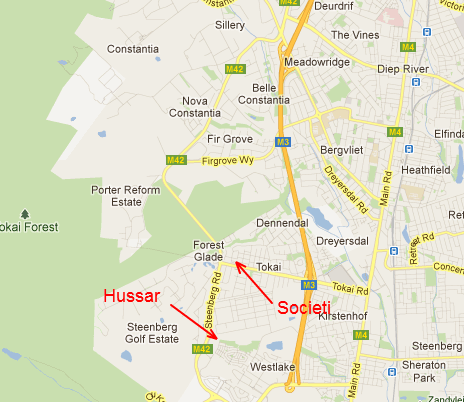
If you look towards the top left of the map, then you’ll see Constantia labelled clearly as “Constantia”. That’s where Constantia is and where it’s been since the mid 1600s.

You may then note its progress south, to Nova Constantia and Belle Constantia, the latter of which I found first reference to in a document from the 1850s. I’ve been doing some rudimentary calculations and it seems to me that the rate of Conspansion was about 1km in two centuries. That’s about 0.005km per year.

Let’s consider now the period from 1850 to January 2012, when I was at Societi Brasserie. So about 162 years in total, and Constantia expanded by about 3km. That’s a conspansion rate of 0.019km per year – about four times as quick as the previous two centuries. The warning signs were there – we just didn’t see them.

Until now.

Because last night, as I mentioned above, I noted that Constantia has now expanded as far as Steenberg Village – a further 700m south from Societie in Tokai… er… Constantia. 700m in 7 months.

Suddenly, we’re faced with the terrifying scenario whereby conspansion has not only topped the threshold level of 1km per year, standing at 1.21km per year, but also that the rate of increase is an incredible 6268.42%.
“Ish just got real”, I believe is the appropriate modern terminology.

If Conspansion continues unchecked at these rates, soon all of the peninsular will be Constantia. Forecasts as to what exactly will happen then are mixed. While some experts believe that Conspansion with stop at Cape Point lighthouse in Constantia, the majority suggest that we will witness an ever faster Conspansion moving eastward, beginning with the gentrification of Retreat, Lavender Hill and Mitchell’s Plain before Nyanga and Khayelitsha are swept up in an all encompassing Constantia.

Tony, Yozi – stop with the protests and marches. Stop with the violence. Just be patient. You don’t need to come to Constantia – Constantia is coming to you.

This isn’t just service delivery, it’s suburb delivery.

And by my reckoning, it’ll be there by February next year. Just in time for Valentine’s Day. Lovely.
Then we can all be friends and neighbours. And you can stop stoning cars on the N2 in Constantia.

Please forward me any examples of Conspansion so that I can update my database accordingly. 

Crowdfunding the Urban Turbine

OK, let’s get the full disclosure out of the way before we begin. The project I’m about to punt is the brainchild of a friend of mine. But that’s where it ends. I have no financial ties to him or to the project. I’m just putting this out there because I know he has been working damn hard on this for several years and because I think  it has really positive implications for the local environment and the local economy.

The Urban Turbine is a a vertical wind turbine project that is designed to offer an alternative power source to homes and businesses alike, schools, hospitals and business parks. 100% locally manufactured and supported.
We are in final prototype phase and need to get raw material and a factory setup (once operational we will employ full time staff – job creation of 10-50 people).

With this crowdfunding request, Brian is looking for “just” R10,000 ($1,200/£750/€975) in order to help set up production of the units. There are incentives for those using the startme page to donate, with various discounts on future UT purchases.

Who knows? In a few years, we might (should?) all have one of these in our back garden or on our roof – saving us money while Eskom’s prices keep increasing way beyond inflation and way, way beyond your paycheck. Schools would be able to teach through power cuts (assuming they had textbooks). Hospitals wouldn’t have to worry abut loadshedding and the effect it had on ICU patients.

And wouldn’t it be great if everyone’s turbine was produced in South Africa? Locally-sourced parts and materials being assembled by locally-trained and locally-employed individuals.

With the current state of the economy and high rates of unemployment, what’s not to like with that vision?

You can read more about the Urban Turbine and get in touch with Brian on his Future Power Solutions website.

Buttons to share this post on your social network of choice can be found just below this line.
Please use them.

Long weekend ahead

It’s holiday time in the Western Cape on Monday, at least according to the ANC Youth League.

“We are officially declaring Monday a holiday for Western Cape’s citizens. No work as we make this city ungovernable. No taxis will be in operation; those who will be on the road will be transporting people to the march… for free” said the league’s provincial chairman, Khaya Yozi.

Now, whether you agree with Yozi’s plan or not, I think we can all something learn from his announcement.

It seems to me that there should be less working and more holidays on Mondays. Coming from the UK, I’m used to having public holidays on Mondays – the holidays for May Day, Whitsuntide and August Bank Holiday always fall on a Monday, making for lovely long weekends in the rain. Compare that with a normal Monday in SA, where you’ll find us all slaving away inside while the sun beams down outside.

But not on this coming Monday, obviously. Because this coming Monday is a holiday. I think that Yozi has missed a trick by arranging to meet at Salt River Station – on the edge of Cape Town’s fetid industrial heartland – and not at the beach. I will probably try out that latter option and then get back to him to compare notes on how much fun we had.

Additionally, should my Monday plan go well, I will be declaring Monday September 3rd a holiday as well. But we’ll definitely meet at the beach. In fact, as summer approaches, I foresee myself declaring a whole lot more public holidays. Especially on Mondays.

Have a wonderful long weekend and I hope that you can all find something profitable and enjoyable to do with your free time, such as stoning vehicles on the freeways and causing R13,000,000 of damage to public property.

When R4,000 isn’t R4,000

Until we actually have hard facts instead of supposition and rumour, I’m steering well clear of the whole Lonmin/Marikana issue. However, if like me, you’re searching for those hard facts, it seems that the mainstream media isn’t the place to be looking.
There’s a surprise.

Whichever side you’re on, you surely can’t help but feel some pity for the rock drillers who – as we’ve been told here, here, here, here and here – earn just R4,000 per month. How one can survive, let alone support a family, on that amount is beyond me.

Except that Politicsweb has now alleged that the oft quoted R4,000 per month figure is actually some distance from the true amount earned by the Marikana rock drillers:

It was left, not to a journalist, but to Solidarity deputy general secretary Gideon du Plessis to go and find out the actual figures. In a statement issued on Monday he reported “The adjusted total cost package of a Lonmin rock drill operator is approximately R10 500 a month, excluding bonuses.”

In response to a separate query from Politicsweb Lonmin’s Mark Munroe Executive Vice President of Mining, basically confirmed these amounts. He stated: “Lonmin’s Rock Drill Operators earn in the region of R10,000 per month without bonuses and over R11,000 including bonuses. These levels are in line with those of our competitors and are before the wage hike of some 9% which will come into effect on 1 October 2012.”

If this increase applies to the whole compensation package it would push gross earnings – with and without bonuses – to between R11 000 and R12 000 per month. The net income of rock drill operators may well be considerably less than this – after deductions – but this is the cost to company.

If these figures are correct, it makes it even more bewildering, bizarre and tragic that so many lives were lost in search of what amounts to a R500 per month increase.

As the Politicsweb piece states:

One has to ask why no-one in the world’s media appear seem to have bothered to verify the R4 000 figure… Given the critical nature of this information for any analysis of the strikers demands it seems like a very basic mistake.

Meanwhile, South Africa’s news24.com seems to have evidence (via Al-Jazeera) that police were indeed fired upon before opening fire upon the protestors. The video is worth a watch.

I’ll leave the decisions as to whether R10,000 per month plus bonuses is an acceptable wage or whether the two shots apparently fired at police merited their response up to you. But wouldn’t it be nice if the journalists paid to report facts, actually reported facts?

SAA stops Cape Town to London flights

Bizarre news from South Africa’s national carrier is that they are pulling their direct CPT – LHR services from August 2012. The reasons cited included:

a 24 percent drop in demand between Britain and South Africa for all carriers in the past three years, as well as dwindling passengers from Cape Town to London as a destination and for onward connections and the fact that competitors also offered cost effective routes from Cape Town.

It’s not the first time SAA has cut a high profile route from its portfolio. Back in November 2010, it dropped its Cape Town to Durban flights. But for me, this announcement is bizarre, simply because it comes just a couple of days after hugely encouraging figures from Cape Town International Airport and Western Cape Tourism, showing that:

CTIA received over 215 000 international travellers in the fourth quarter of 2011, which is a year-on-year increase of 14.5%.

Which doesn’t seem to fit with that SAA claim of falling demand.

It’s not great news for us expats (or anyone else wanting to get to the UK and back) in Cape Town as it will reduce competition on the route (not that SAA were ever really very competitive on prices anyway). Of course, you can still use the SAA service to London via Joburg, but since it adds a minimum of 4 extra hours to the journey, yet still costs as much as a direct flight, why would you want to do that?

UPDATE: Cape Town Tourism press release on the SAA announcement.