Worth repeating?

Worth repeating? Given the lack of action on this issue, despite the repeated warnings from people far more qualified and eminently more important than me, you could be excused for thinking not. However, given the gravity of the situation being described and the impact it will have on our ability to survive as a species – yeah, probably.

We’re back on that old chestnut of antibiotic resistance, I’m afraid. The topic rearing its ugly head on here thanks to this guest editorial in the South African Medical Journal for May 2015, penned by Marc Mendelson of UCT and Malebona Precious Matsoso from the DoH. It’s a local journal, written by local people, about local issues. Just like the Southern Suburbs Tatler. Except sane.
It makes such happy reading:

If our overuse and misuse of antibiotics is not halted now, about 10 million people will die annually from drug-resistant bacterial infections within 35 years. The hammer blow will fall hardest on Africa and Asia, accounting for 4.1 and 4.7 million deaths, respectively, and the world’s economy will lose more than 7% of its gross domestic product (USD210 trillion) by 2050.

If 10 million deaths sounds terrible, it’s because it is terrible. Put in context, annual deaths from HIV worldwide are around 1.5 million. TB accounts for 1.4 million deaths. Heart disease kills about 2.5 million people each year. Three big killers and we’re only just halfway there.

Fortunately, this is all way in the future, isn’t it? Well, no. It’s not:

This is not a futuristic scenario … it is being played out right here, right now, in South Africa and other countries across the globe. Decisions to withhold surgery based purely on the patient being colonised by pan-resistant bacteria are being made, and people are dying of untreatable infections in our hospitals and communities. Quite simply, our abuse of antibiotics is destroying modern medicine as we know it. Unless the international community can alter its path, we will lose the ‘miracle of antibiotics’.

So it’s here, and it’s going to get much worse, so why isn’t something being done about it? We’ve touched on this here before:

Of course, if this problem wasn’t so insidious, we’d all be panicking about it already. If there were a 9/11 or a Hurricane Sandy – a single event – there would be far more awareness. (Not that mere awareness would really help anyway.)
But that’s not the case with the antibiotic resistance problem. It’s sneaking up on us and, for those of us in the know, it’s rather worrying.

And on that note, for me, probably the most significant line in Mendelson’s and Matsoso’s musings:

These numbers should make people sit up, listen and change behaviour. But more often than not, it has to be personal to achieve this.

Yes. Sadly, that’s probably what it will take. And sadly, this will happen to people as well. It’s happened to me already this year.

I was reminded of this satirical piece by Andy Borowitz, penned in reference to climate change, but with a nice, ironic “resistance” twist:

Scientists have discovered a powerful new strain of fact-resistant humans who are threatening the ability of Earth to sustain life, a sobering new study reports…
While reaffirming the gloomy assessments of the study, Logsdon held out hope that the threat of fact-resistant humans could be mitigated in the future. “Our research is very preliminary, but it’s possible that they will become more receptive to facts once they are in an environment without food, water, or oxygen,” he said.

Maybe the same will be true once we find ourselves without antibiotics as well.

We live in hope. Briefly.

An excellent Flickr account to visit

No. It’s not mine. Incoming from the etv guy:

Have you seen this?

And a link to a photo on HiltonT’s photostream. For the record, this was the photo in question, and no, I hadn’t seen it:

kalbay05Apparently, it’s a regatta at Kalk Bay in 1905. It’s interesting for a number of reasons: the transport, the clothing, the frankly disappointing lack of any sort of water craft for a regatta, the additional lack of any breakwater wall or railway, and that business on the building at the back: Kalk Bay Fish and Land Co. Ltd.

– Let’s start a business in Kalk Bay.
– OK, sounds like a good plan. What sort of business?
– Hmm… Fish?
– Excellent. But…
– But what?
– Well, don’t you think that’s a bit niche?
– Ja, good point. We need something more diverse.
– How about… How about Fish… and Land?
– Brilliant. But what are we going to call it?
– No idea, mate. Maybe let’s just leave it, hey.

But of course, they didn’t. And thus the Kalk Bay Fish and Land Co Ltd was born.
That’s exactly how it all happened.

Probably.

Anyway, I digress. Often. The real reason that this post is happening to to advise you about the rest of HiltonT’s Flickr account. There’s quite a lot of history, quite a lot of South Africa, quite a lot of photographs of documents, some local (pre-1994) football and other… stuff.

If you’re in the right frame of mind, you could get lost in there for literally hours.

Go, do it. (And then, when you’re done, there’s this one as well.)

N.B. The Kalk Bay Fish and Land Company Limited should not be confused with the Kalk Bay Land and Sea Company (which is obviously a completely different enterprise), which went on to become Irvin and Johnson (I&J) Fisheries.

Thanks Adam

Indicate when turning

A new addition to the signposts on the approach to the Kildare Rd mini traffic circle (traffic mini circle?) in Newlands instructs drivers that it would probably help those around them if they “indicate when turning”.

wpid-dsc_00072.jpg.jpeg

Now, I know what you’re thinking. You’re thinking “But… but I do indicate when I’m turning. I mean… that’s what you do… that’s what they’re there for, isn’t it?”, and you’re right and that’s because you are a sensible driver who is probably not living in South Africa, where mind-reading on the roads is less of a staged fraud and more of a necessity.

But then, the drivers who weren’t going to indicate when turning still won’t indicate when turning, because they don’t look at signs at the side of the road. The only people who look at signs at the side of the road are drivers who were going to indicate when turning anyway.

And so, yes: the “indicate when turning” may seem a little unnecessary to you, but I have a feeling that it’s about to be joined by something even more spectacular. And that’s because sometimes a single sign simply isn’t enough.
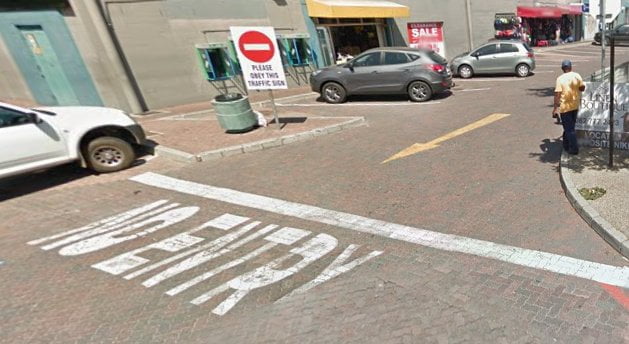
And there’s precedent for this just down the road in the Access Park Shopping Complex:

Kenilworth - Google Maps - Google Chrome 2015-05-19 025651 PM.bmp

Yes, please enjoy this screenshot from Google Maps, containing what is still one of the most bizarre traffic signs I have seen in South Africa anywhere. For those of you with utterly appalling eyesight, just under the big red NO ENTRY sign (and just above the words “NO” and “ENTRY” painted 2m high on the road) are the words:

PLEASE OBEY THIS TRAFFIC SIGN

Who is this aimed at, exactly? Most people will not even have considered not obeying the traffic sign in the first place (although maybe now you’ve sown the seeds of mischief). And if the people who weren’t going to obey the traffic sign in the first place weren’t going to obey the traffic sign in the first place, what makes you think they’re going to obey the writing underneath it asking them to obey it? I’m not sure where the logic comes in “Let’s ask them to do as it says, and then they’ll do as it says.”
Or are you expecting some sort of selective disobedience? Has some sort of psychological assessment of the average wrong-way-up-a-one-way-street driver been done? And if so, was this really deduced to be the best policy to halt their errant behaviour?

And you’re asking them nicely too – none of that straightforward “do this” of the “indicate when turning” signage. Manners maketh the man and they apparently maketh the more polite and therefore better adhered to road signage as well.

Personally, I can’t believe it works, but assuming it does, there’s still plenty of room just underneath the “indicate when turning” sign for another, stating: “we’d really appreciate it if you took notice of this request, please”.

And then, when leaving the traffic circle, a “thanks a lot” wouldn’t go amiss either.

Short

A quick post about our current predicaments:

There’s not enough electricity to go around. This is actually very old news, although South Africans continue to complain about it while doing nothing to save the damn stuff when they have it. It’s clear that generally, despite their lack of action to combat the problem, people are very unhappy about it.

The alternative, of course, is gas. We don’t have it plumbed to our houses here in SA like some other countries I’ve lived in, so it comes in big bottles. Well, it would if there wasn’t a shortage of it:

Dear Customers,
As you may have heard through the media, LP gas is currently in short supply in South Africa as a result of planned maintenance on a few of the major refineries in the country.
Please take the time to read the attached letter regarding the LP gas supply issues we are currently experiencing.

I’ll spare you the attached letter, which basically says there’s a shortage of gas, resulting in “unavoidable price increases”. Supply and demand etc etc. People are not going to be happy.

Anecdotally (hey, it works for Prof Tim), there’s also a shortage of diesel in Cape Town. My car doesn’t run on diesel. Mrs 6000’s car does run on diesel – when she can find some to put in it. Same with lorries delivering food and goods all over the country. Less diesel, higher demand, higher prices (although they are somewhat regulated in SA) = unhappy people.

And now, arguably the most serious of all, we have a shortage of water. Figures due to be released this morning will almost certainly indicate that the reservoirs supplying Cape Town are now less than half full. That’s not good, but ironically, it’s less than half the problem as well. The bigger issue is that it’s also not raining on the local farms:

A drought that has probably reduced South Africa’s corn crop for 2015 to the smallest in eight years is also putting at least half the country’s wheat harvest at risk, the largest grain farmers’ lobby said.
Farms in the Western Cape have had little or no rain since the start of the planting season in April and need showers before the end of May, Andries Theron, vice chairman of Grain SA, told reporters Thursday at an agricultural show in Bothaville.

The province, whose wheat fields are rain-fed, produces about 50% of the nation’s harvest of the cereal, data from the Grain Information Service show.
“We started planting in dry soil,” he said. “Usually, our rainy season would start in the middle of April, but it didn’t. We’ve got a hectic season on hand.”

And then this, from Agri Wes-Cape’s CEO Carl Opperman:

“This has been the driest summer the province has seen in many years. Rains that should have already fallen are desperately needed, especially by grain farmers.
“It’s a dry circle that we’ve got at the moment. We will be managing it, so we’re expecting rain in the future. It’s most probably going to be what we call ‘a dry winter'”.

Come now, Carl – drop the technical terminology, can’t you? You’re unnecessarily baffling us with bullshit there. Is there really no language you could have used so that us laypersons could understand?

Looking at the forecast for the coming week, our local grain farmers are going to remain disappointed.

And so… guess what? Less grain supply, no reduction in demand = higher prices. And that means unhappy people.

I’ve never been convinced that a single straw could break a camel’s back. But several big fat straws? Well, maybe we’re in for interesting times ahead.

Long Beach

Cape Town in autumn is a wonderful place to be. Sometimes, anyway. This morning was one of those times as Long Beach in Noordhoek revealed itself from the early mist during our pre-breakfast exercise. The spring tides of two weeks ago have left a huge flooded area at the top of the beach, and the lack of any significant wind made for some lovely views.

There were a few proper photographers with sturdy-looking tripods and big bags full of equipment doing their thing there, so it must have been “a good day” for taking photographs.
Of the 6 shots I have uploaded to Flickr from this morning (they’re in this album), this one is my favourite. Perhaps because many of the others appear a little washed out, or lend themselves to being monochromed, because of the low sun, the neutral beach and the grey mist. This one is surprisingly colourful – aided nicely by that splash of green on the left hand side.

I’d like to suggest that it was a deliberate inclusion, but I suspect that you would see through my tissue of lies rather quickly.