Not the shoe. I mean, honestly. This might not be a haute couture blog, but it is (mainly) a blog of decent taste.

No, this is one of the residents of Le Bonheur Crocodile Farm, a venue which was well-received by the kids.

Not the shoe. I mean, honestly. This might not be a haute couture blog, but it is (mainly) a blog of decent taste.
No, this is one of the residents of Le Bonheur Crocodile Farm, a venue which was well-received by the kids.
Given that IT’S THE MIDDLE OF BLOODY WINTER!!!!!1! here in Cape Town, we thought we’d take ourselves and the kids down to Camps Bay yesterday evening and enjoy some sundowners on the sand. A million (really? – Ed.) other people were also there, snapping away with their smartphones, because it was just that sort of beautiful evening which required instagramming, facebooking and twittering.
I refrained from doing any of those thing, but don’t think you’re going to get away without seeing some sunset action.
Here’s my last shot from my phone as we left the beach:

And there are several more on the camera just itching to be downloaded and shared, but the camera has gone to a crocodile farm with the wife and kids today. So you’ll just have to be patient.
Still. At least you’ve got a nice view while you’re waiting.
UPDATE: Here are those photos.
This is very cute. And great news for the environment. I like the environment, but not to extremes.
That said, I’d never eat a quagga. Probably.
A new Rau quagga foal was born about 10 days ago in the Nuwejaars Wetlands Special Management Area to parents Susan and Freddie.
And here it is:
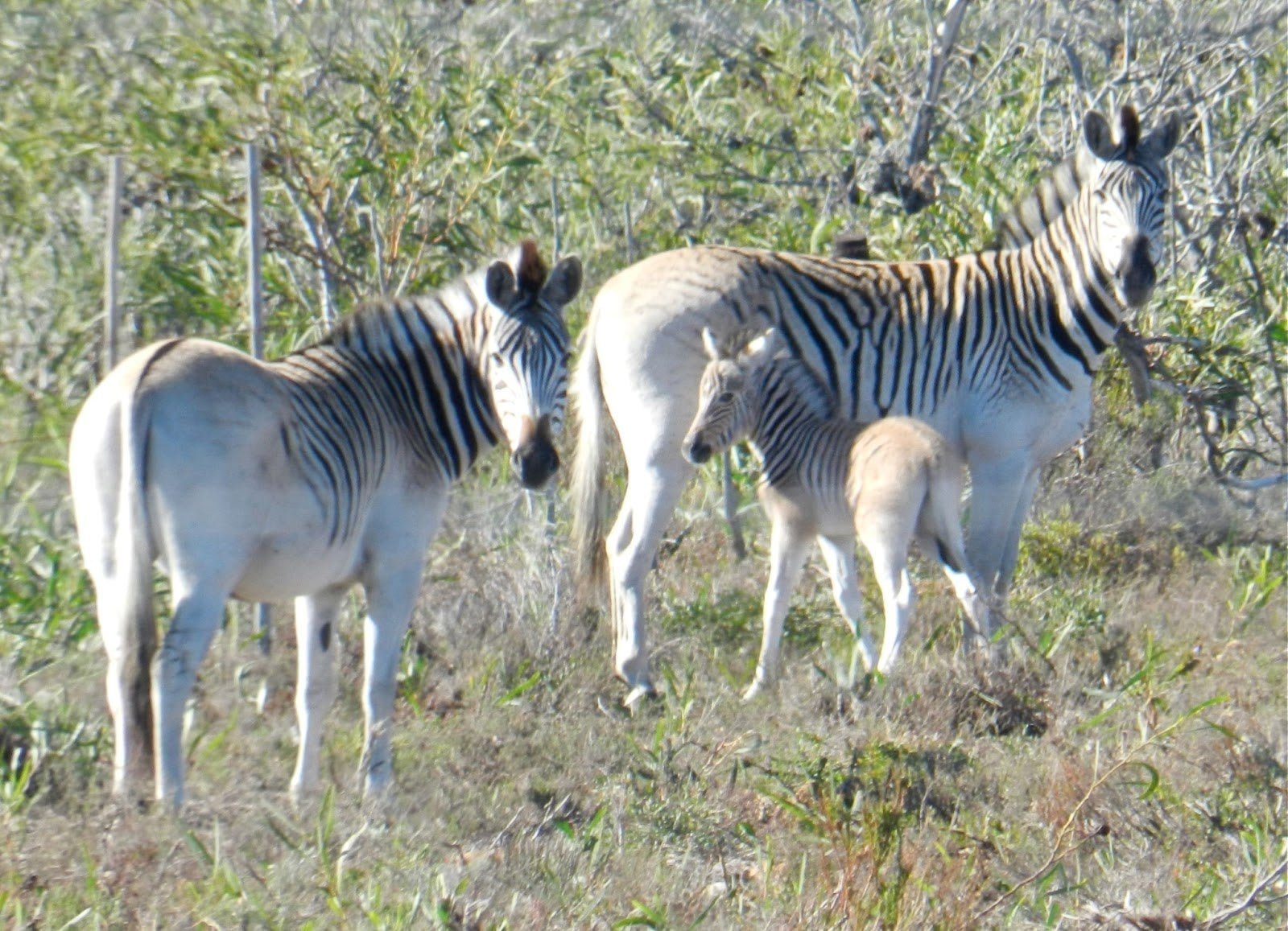
Awwwwww!
What’s a quagga, you ask? It looks like a a unfinished zebra. Wikipedia has all the answers:
The quagga (Equus quagga quagga) is an extinct subspecies of the plains zebra that lived in South Africa. It was long thought to be a distinct species, but recent genetic studies have shown it to be the southernmost subspecies of the plains zebra. It is considered particularly close to Burchell’s zebra. Its name is derived from the plains zebra’s call, which is heard like “kwa-ha-ha”.
This follows a typical naturalist trait of naming animals after the noises they make. They did ok with the Kittiwake, but they failed miserably with the Hadeda ibis, which should obviously be called the (ever so slightly less catchy) “Raap-Raap-Greer” ibis.
I can’t comment on the accuracy of the nomenclature of the quagga, because I’ve never heard one calling. Anyone?
A few others among you may have spotted that the quagga is extinct, which does make the news above seem a bit of a stretch, so let Wikipedia explain again:
After the very close relationship between the quagga and surviving zebras was discovered, the Quagga Project was started in 1986 by Reinhold Rau in South Africa to recreate the quagga by selective breeding from plains zebra stock, with the eventual aim of reintroducing them to the wild.
The founding population consisted of 19 individuals from Namibia and South Africa, chosen because they had reduced striping on the rear body and legs. The first foal of the project was born in 1988.
Once a sufficiently quagga-like population has been created, it will be released in the Western Cape. In early 2006, the third and fourth generation animals produced by the project were reported to look very much like the depictions and preserved specimens of the quagga. This type of selective breeding is also called breeding back.The practice of breeding back is controversial, since the resulting zebras will only resemble the quaggas in external appearance, but genetically they will be different.
Three quagga in the Nuwejaars Wetlands Special Management Area feature in the Top 10 of Quagga specimens in the Quagga Project (go look at this website – really interesting). Among them is Freddie – in fact – he ranks as the number one Quagga specimen in SA. So this is big news. Nice one Freddie.
This is now on my list of things to go and do next time we’re down in Cape Agulhas, and it doesn’t hurt that the Nuwejaars Wetlands SMA is just down the road from these places.
Photo credit: Mick D’Alton
File under: Press Releases, Almost Overly Reassuring.
Apparently, the water in some parts of Cape Town has been tasting a bit funny for a few days now. Cue widespread panic about it being poisonous and deadly and deadly and poisonous.
It’s not.
The slight odour and earthy taste is due to a chemical called Geosmin, which is produced by some naturally occurring bacterial and algae species in the reservoirs around Cape Town. It’s harmless.
It also happened last year.
The presence of Geosmin was confirmed during the routine water quality analyses and tests. Geosmin is non-toxic and not harmful to health.
In this instance, it is originating from the Theewaterskloof Dam – one of the Department of Water Affairs’ (DWA) dams from which the City draws water. It could be caused by the inflow of nutrients to the dam following heavy rainfalls, which increases the growth of the blue-green algae.
The water is perfectly fit for human consumption. Continual water quality monitoring by the City’s South African National Accreditation System (SANAS) accredited laboratory has revealed elevated but still extremely low Geosmin concentrations.
And they are fixing the problem:
The City has begun treating the water in the Theewaterskloof Dam with powdered activated carbon with the aim of returning and maintaining the concentration of Geosmin to below the normal human taste and smell threshold level.
Yeah – read that again. The deadly chemical will still be in there, it’s just that you won’t be able to smell or taste it. It’ll still be eating away at your insides like that heinous Dihydrogen monoxide you insist on consuming.
O.M.G.
And how much is that, exactly? Well:
The human nose is extremely sensitive to Geosmin. If you poured a teaspoon of Geosmin into the equivalent of 200 Olympic-sized swimming pools, you would still be able to smell it.
The general threshold for human perception is about 15 ng/l. However people with sensitive noses can detect these compounds in drinking water when the concentration is as low as 8 ng/l.
So, that’s 0.00000008 grams per litre of water. Frankly terrifying.
But hey. Here’s the expert scientific opinion (mine) on all this:
Stop being so dramatic, you desperate attention-seeking prima donnas.
Have a nice day.
So sang Dolly Parton, anyway.
I’m not sure that those still count as modern day working hours, but in the absence of any other more recent popular country pop music hit which includes a reasonable update, we’re going to have to assume that they do.
And, given that I placed my wine order with Getwine at 4pm yesterday and that they delivered at 10am today, that means that it took just 2 (two) working hours for my delicious wine to arrive on my doorstep.
Amazingly, that’s not even the fastest delivery I’ve had from them. That stands at an incredible 44 minutes, although to be fair, they were as surprised about that as I was.
If you want to enjoy great wine at decent prices together with that amazing service, simply click here and I’ll send you a referral.
Supplying really good wine at really good prices? What a way to make a livin’.
Disclosure: This is a personal recommendation and not a sponsored post.
No payment in cash or kind was made to me by Getwine.