After a really good night of braai’ing, beer and brandy, the last thing I felt like doing this morning was a Parkrun.
It’s often the last thing I feel like doing full stop, but at 7am this morning, it was an even less attractive option than usual.
But there’s more than one person in this marriage, and this was the occasion of Mrs 6000’s 50th Parkrun, and so I was up and ready to support her in this impressive achievement.
For the record, it was my 6th Parkrun, my first in almost 3 years, and my first in South Africa in almost 6 years. (I did say that it wasn’t my thing.)
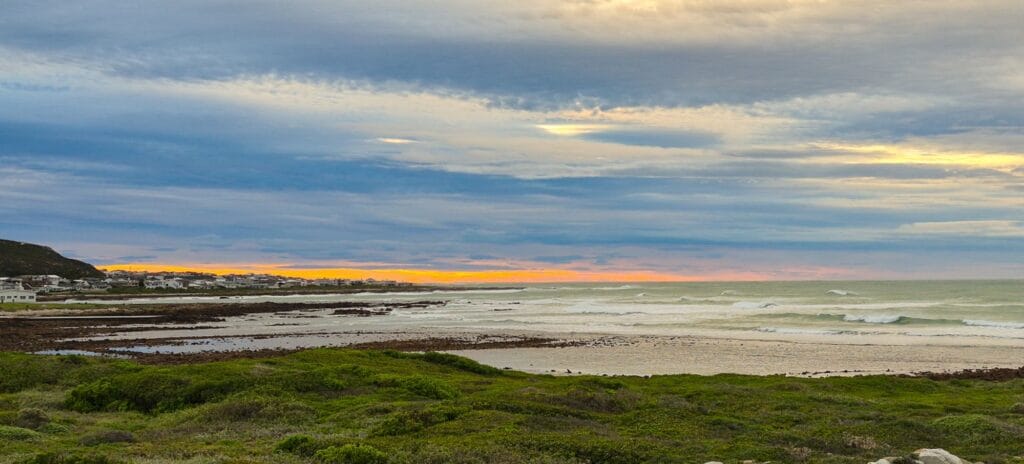
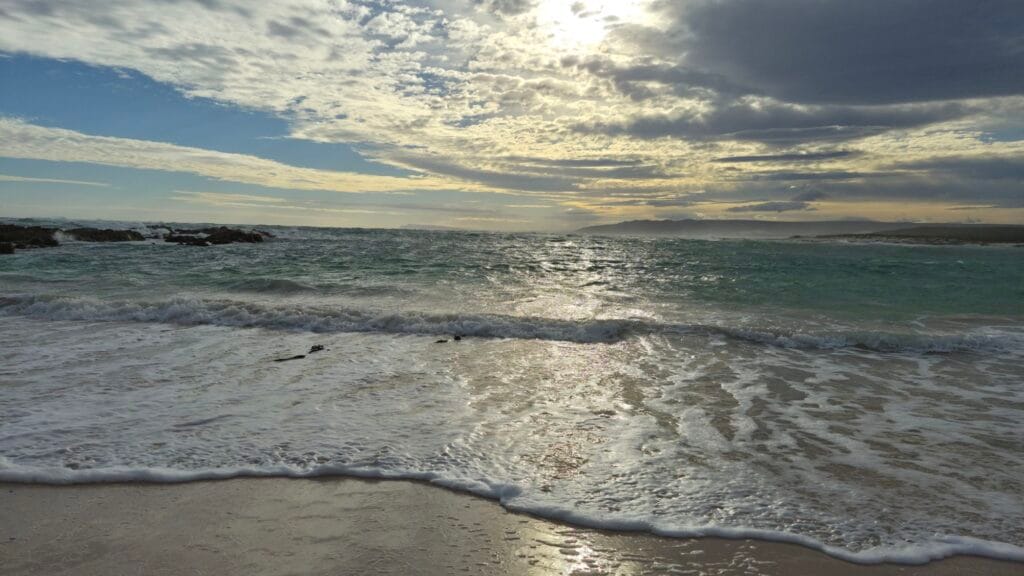
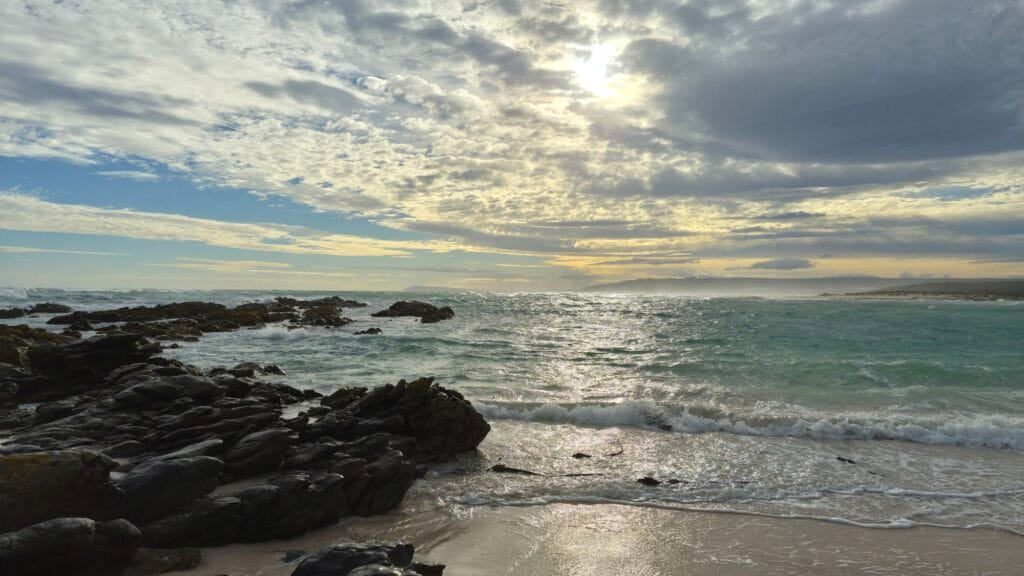
But the Agulhas sunrise wasn’t bad…
The run done, I gave my legs a stretch on a speedy 2½km to the lighthouse, where we grabbed some decent coffee at the new Needles restaurant.
Home, showered and breakfasted, I just have to stay awake for United’s last game of the season, and then I can sleep off the excesses of last night and this morning.
If you walk down onto the beach at Suiderstrand and take a right turn, following the coastline along and into the Agulhas National Park, you’ll come across a large log on the beach, about 1½km towards the cottages out at Piet se Punt. Just next to the rocky outcrop know locally as “The Washing Machine”.
It is a big log, so big in fact, that you can see it from space (with a bit of zooming in on Google Maps).
It’s been there for as long as we’ve been going to Suiderstand, and that’s 17+ years. And now, thanks to a bit of research, I found out that it’s actually been there from about the turn of the century, after a Swiss-owned, Panamanian-registered, 24,732 dwt freighter, the MV Sanaga, sank off the south of Madagascar on October 11th 1999.
What? Give us the details, please.
With pleasure.
The MV Sanaga was built in 1979 and was carrying a cargo of logs (see where this is going?) and stainless steel from Durban to China. The logs were teak and mahogany from West Africa, each one about 10m long and each weighing around 20 tonnes.
The MV Sanaga got into trouble, began taking on water and issued a Mayday call. The crew of 26 Indian nationals abandoned ship and were picked up by a passing Japanese container vessel.
The freighter was subsequently presumed foundered. And it seems reasonable that it took the steel down with it, while the logs… well… floated.
But that posed its own problems. The Agulhas current dragged the logs southwards and westwards along the coast of South Africa, where they caused many issues. In January 2000, at Blue Horizon Bay, near PE (as was), a woman and her grandson, playing in the surf, were seriously injured when a wave brought one of the logs down on them:
Iloma Cilliers was helping her grandson, Mark-Anthony Mayhew, out of the water when a wave lifted the huge log on to them and crushed them into the sand. Cilliers’s husband, Lowie, dug them out and they were treated for serious injuries in the intensive care unit of a Port Elizabeth hospital.
While elsewhere on the Eastern Cape coast, a 10 year old boy was knocked unconscious by a log while swimming, and sadly drowned.
Reports had been received of at least two other children who had suffered head injuries from being hit by logs in the surf at another Port Elizabeth beach.
They also posed a huge danger to shipping all around the South coast of the country. Several logs washed up in False Bay: at Cape Point, Strandfontein, St James, Kalk Bay and Fishhoek.
And – as we now also know – further east, in Suiderstrand.
As they found out in Fishhoek, you need a large crane to be able to shift these logs. Which makes this seem a bit silly:
Johan Scheepers, a customs and excise official, said people should not remove the logs from the shore: anyone wanting to salvage material washed up on a beach has to obtain a salvage permit and pay 15 percent duty on the value of the object. The logs are believed to be worth thousands of rands each.
Not something you’re going to be able to quietly slip into your back pocket. And since The Suiderstrand Log is in a National Park, not something you’d be allowed to quietly slip into your back pocket anyway.
That weight, and hardwood being what it is (hard), despite the very best efforts of the South Atlantic Ocean, and although there has been a lot of weathering over the last 26 years, it’s clear that the Suiderstrand log isn’t going anywhere soon.
WANT MORE LOCAL HISTORY? Other stuff that has washed up on the Cape coast from shipwrecks: Rubber Bales.
There’s a yellow warning out for potential severe thunderstorms and heavy rain over Cape Town and parts of the Western Cape tonight, and I couldn’t be happier. Everything is dry and brown and so very DUSTY.
Not only do we need some rain to alleviate the drought that we’ve been suffering, we need some rain just to give the place a nice clean.
It’s not a huge warning for Cape Town, but they have gone with “High Likelihood”, which is great news. No-one wants floods and stuff; just enough to wash away all the grime. But it must happen, please.
However, we’re looking at a different picture down in Cape Agulhas, where they’re playing with “High Likelihood” and “Significant Impact”. And no-one has forgotten the horrific floods of September 2023 (that one when Juan was a bit of a twat). They could do with the rain, but no repeat of those scenes.
I’ve checked our gutters are clear (and so should you), and I’ll be lobbing some fertiliser on the garden before bed tonight: might as well make the most of the opportunity.
But right now, with the sun still beaming in the cloudless sky, I’m going to watch some footy before the weekend is – once again, all too quickly – over.