Stam trolled by energy drink logo

Reading FC, Berkshire’s biggest football club, announced Dutch ex-defender Jaap Stam as their new manager yesterday.

There was a press conference, as there always is.
Filming was done, as it always is; photos were taken, as they always are.

This is my favourite:

353A81CA00000578-3638848-image-a-2_1465832859824

Well shot, Vagner Vidal. Well shot.

The only partially hidden logo is that of Reading’s chief sponsor, Thai energy drink company, Carabao. They’re quite an interesting lot:

In Thailand, home of the world’s leading energy drinks, this type of beverage was made to provide replenishment for lost energy. Carabao adheres to these basic principles and has therefore positioned itself as an energy drink for those who need replenishment.

Good plan.

Carabao’s position is based on the philosophy of its founding partner, Mr. Aed Carabao. Aed Carabao is a popular folk singer in Thailand who the vast majority of Thais regard as “The voice of the people”

The outspoken Aed Carabao, who Carabao Energy Drink is named after, started his movement in 1976 by creating emotionally gripping songs titled “Songs for Life“. Fame and popularity have not undermined the singer’s grassroots spirit. Understanding the hearts of his fellow men, Aed Carabao is always there to sing and speak up for the people.

Right. And if you thought that Mr. Aed Carabao was interesting, you shouldn’t overlook the drinks brand’s other founding partner “remarkable entrepreneur” Sathien Setthasit. He saw a gap in the Thai-German microbrewery market and went for it:

The first Tawandang German Brewery was launched in 1999 from an initiative to create the first Thai-German microbrewery in Bangkok that served original German beer with Thai food.

Niche.

But the rest, as they say, is history.

2009 Thabo Mbeki nails 2016 Social Media

Love him or hate him (or have no opinion of him because you’re dead as a direct result of his AIDS denialism), you have to admit that this quote from wor Thabs still works rather nicely more than 7 years after he quoth it:

“It seems to me that the unacceptable practice of propagation of deliberate falsehoods to attain various objectives is becoming entrenched in our country.”

Read it. Then read it again, and suddenly, you look at the UK’s EU referendum, the US election, the Orlando (or any other) mass shooting or terrorist incident, LCHF, SA politics, the #RhodesMustFall and #FeesMustFall movements (and by this, I mean both sides of those arguments), and virtually any other divisive subject in the world today, in a slightly different light.

It’s like we’ve lost the ability to argue reasonably and logically. Everything is immediately charged with emotion and ad hominem attacks, clouding (often conveniently) the real issues and rendering any sensible discussion virtually impossible.

But why? I have some thoughts. You lucky people, you…

Firstly, with “advances” in social media, it’s easier than ever to propagate stuff, and deliberate falsehoods propagate especially well. The individuals behind these deliberate falsehoods aren’t (always) stupid. In many instances, they’re well aware that the deliberate falsehood that they want propagating will be propagated. That’s the whole idea.
But why does that happen?

It’s happens because: secondly, people – even supposedly intelligent people – have a “share first, think later” mentality when it comes to something that fits their agenda. We’re lazy, in the most part. We can’t be arsed to check whether that attractively-presented stat on immigration is genuine or not – we’re outraged that so many/so few foreign people are being allowed into our country. Or whatever. And people must know this so that they can understand why we’re outraged and why they too must also be outraged.

And then, thirdly, the fact that these days, it’s seemingly unacceptable not to have an opinion on something. Things need to be polarised. You must feel this way or that. You need to agree or disagree, and if you don’t, then I’ll tell you why you should. For example, have you seen this attractively-presented stat on immigration?
Yeah. I know. Exactly. I was outraged.

These three add up to a slippery slope that I fear we are probably sliding down at an already unstoppable rate.

But it doesn’t even end there. Sometimes it’s not just bald-faced lies. Sometimes the unacceptable practice of propagation of deliberate falsehoods is more subtle and cynical. Omission of facts that don’t quite match with what I want you to believe. Selective reporting of the myriad reasons behind a particular incident, nudging you to consider and concentrate on one aspect far more than another.

The thing is though, if you are having to resort to the propagation of deliberate falsehoods in order to attain your various objectives, then surely you need to look again at whether those various objectives are worth attaining. How strong is your various objective really if you have to deceive people to convince them of its merit?

There is some light at the end of the tunnel. Light like fact-checking website AfricaCheck. But sadly, as the name suggests, they don’t stretch beyond this particular continent. Add to that the fact that the unacceptable practice of propagation of deliberate falsehoods to attain various objectives has already become entrenched in our digital culture and you’ll understand that they really can’t be omnipresent, let alone omnipotent.

So it’s up to us – you and I – to make the difference. To take just a moment to consider whether that thing we just heard is actually likely to be true. To critically evaluate the source, the fact, and the potential agenda before we take it as gospel. You can delve into it as deeply as you like, but if you’re not sure that it’s actually not a deliberate falsehood, maybe consider not propagating it.

It’s really nothing more than common sense.

I don’t expect to change the world with this post. It sometimes just seems that the voices of sanity are being lost, one by one, drowning in the ocean of crap that’s constantly being peddled and recycled by people desperate for us to agree with them, and who will hate us if we don’t.

I thought I’d just shout for help before I go under.

From on high

Here’s a HUGE satellite image of southern Africa, taken by NASA last week as the cold front swept over us:

It looks ok at this sort of size, but you’d be foolish not to go and have a play on the original version here – merely to see if you can spot your place of residence.

If it’s in Cape Town, though, that seems unlikely. Because cloud.

Aquarium weekend completed

Pretty much immediately after getting home from the sneak peek into the new bit of the aquarium, I headed down to Agulhas for a functional, pre-winter maintenance visit on the cottage. Truth be told, there wasn’t a lot that needed to be done, just really checking up on things. Still, it needed doing.

Before I headed back to Cape Town on Sunday morning, I took a wander along the beach, getting some fresh air in an effort to clear out my still-thick sinuses. I saw birdlife and a fisherman. I took some photos.

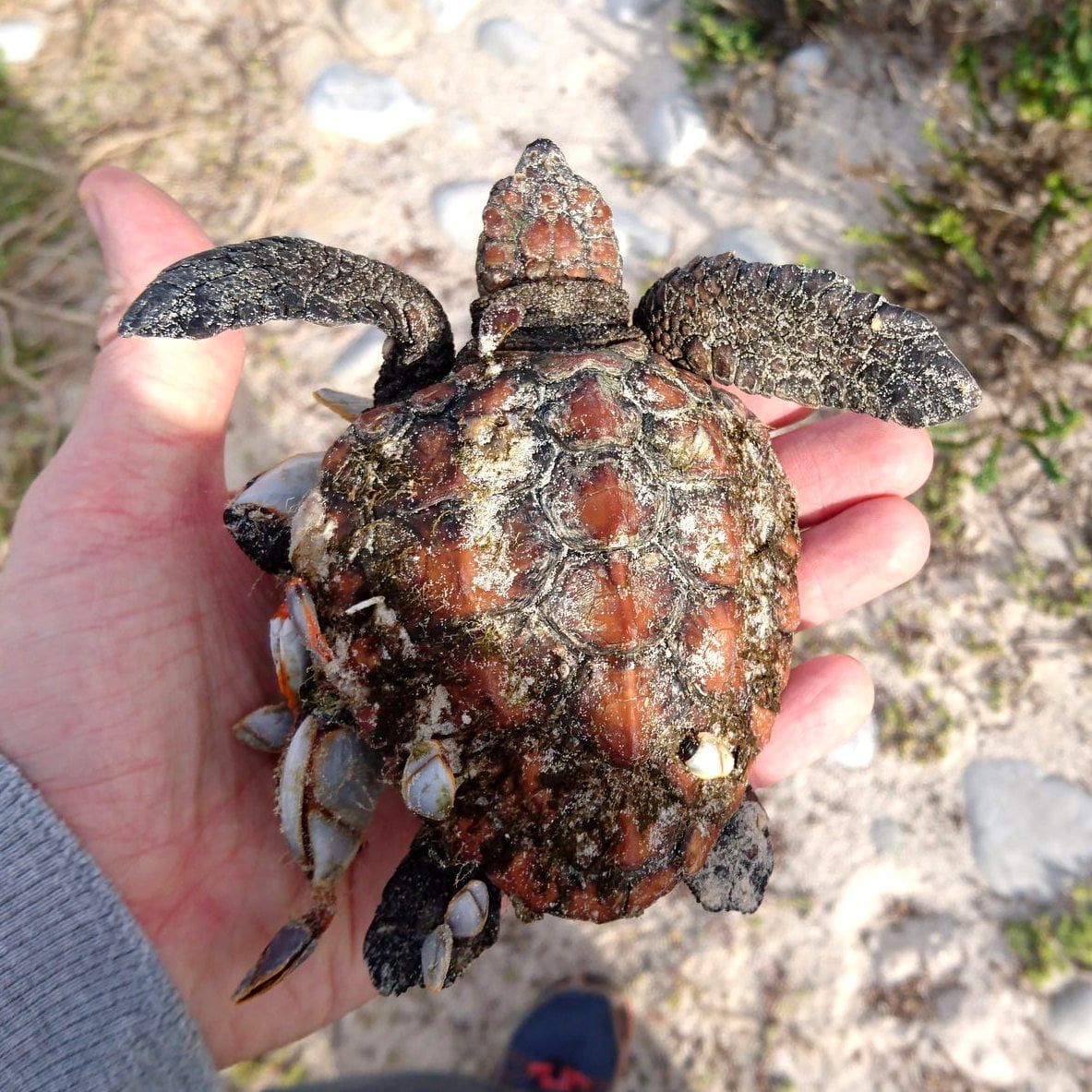
It was while I was ‘togging a couple of African Black Oystercatchers at Piet se Punt that I noticed the little fellow stuck upside down in the rocks by my feet. He was flapping feebly. But this was no bird, it was a loggerhead turtle hatchling. Picking him up, I immediately recalled that “a good throw back in” is not the answer. No, the advice should you find a little turtlet [is this right? – Ed.] stranded on the beach in the Western Cape is as follows:

The first thing to do is to remove the turtle from the beach and place it in a dry container where it cannot drown.
Keep it at room temperature to warm up slowly. These turtles are most likely suffering from hypothermia, which makes them weak; in most instances they are so weak that they cannot lift their heads.
Turtles breathe air, just like us, and if a turtle cannot lift its head out of the water, it cannot breathe and will drown.
Call us as soon as you can on 021 418 3823.
Remember to take note of where the animal was found. It will help us if you could let us know the accurate size and species of the turtle. That way, we can prepare a specific rehabilitation tank for it, before it arrives.

I did all of this. Textbook, mate.

27012785014_b592794045_k

2km back to the cottage, 1 ice cream tub and a 230km journey back to Cape Town, where I met up with two very excited kids, we found ourselves back at the Aquarium, where we handed Houdini (so-called because once warmed up, he mustered enough energy to get out of the tub and escape into the passenger footwell) over to aquarist and all-round turtle-repair specialist Michelle for rehabilitation.

Once he’s fixed up, well fed and a bit bigger, they’ll take him back to the warmer Indian Ocean on the east coast and he’ll be released in Spring/Summer, along with the approximately 200(!) others that they will probably get in during winter. Bearing in mind that loggerheads grow to an average of about 140kg (although the record weight is over 500kg!), that’s a lot of potential turtle to be sending back out into nature.

Hamba kakuhle, Houdini Turtle.

A problem shared

In great news for the shareholders of Grundheimer Schnauzerbeagle (Pty) Ltd and all the other pharmaceutical companies out there, I have infected my wife with my lurgy.

As the first signs of my recovery shone brightly like a light at the end of a two day long tunnel this afternoon, Mrs 6000 came home from a tough day at the office (and beyond) with a look that suggested germs, disease and – almost certainly – infection, had taken hold.

My insistence that I was merely testing the theories of Lister, Pasteur, Koch et al. (and al‘s theory was particularly good) don’t seem to have impressed her much. I may be in trouble here.

Still, it was just yesterday that she was telling me how good it was that I was ill this week, “getting it out of the way” before we head off on holiday next week.

Maybe if I tell her how fortunate she is to be feeling so rough right now, it’ll make her feel better.

Yeah. I think I’ll go do that now.