Tyre ski jump

You, like me, have often wondered which sort of tyre would fly furthest when sent down a (snow-free) ski slope. I know this, because a recent study on the causes of insomnia indicated that wondering about which sort of tyre would fly furthest when sent down a (snow-free) ski slope was given as a factor by almost 100% of respondents (n=1).

Don’t worry: you can sleep easy tonight: we’ve got you covered.

The six tyres you wanted to see tested are tested right here, and they’re each travelling at some considerable speed (like 140kph) when they reach the bottom end of the slope.

Yep, whether it’s the 11kg, low profile sports car tyre or the 225kg rubber from a monster truck, you’re going to know what sort of tyre flies furthest when sent down a (snow-free) ski slope, simply by watching this video.

And you also get to see what happens to the tyre once it has done its jump. Because stopping a tyre with that sort of mass, velocity (and therefore momentum) might prove to be quite a task.

So, so good.

Egyptian Space Dagger

New research suggests that the find of an “unusual” iron dagger entombed with King Tutankhamun might have come from outer space.

Seriously.

Italian and Egyptian researchers analysed the metal with an x-ray fluorescence spectrometer to determine its chemical composition, and found its high nickel content, along with its levels of cobalt, “strongly suggests an extraterrestrial origin”.

But those researchers then went off the obvious trail of the Stargate movie franchise – which would conveniently and completely answer all queries about the ESD – and instead reckon it came from “Kharga”. Sadly, it turns out that Kharga isn’t a planet in the Alpha-Centauri system (or something).

They compared the composition to known meteorites within 2,000km around the Red Sea coast of Egypt, and found similar levels in one meteorite. That meteorite, named Kharga, was found 150 miles (240km) west of Alexandria, at the seaport city of Mersa Matruh, which in the age of Alexander the Great – the fourth century BC – was known as Amunia.

But yes. Jokes aside, King Tutankhamun had a dagger that was made from space rock.

The iron dagger - picture 1

It would obviously have been better if the meteorite that they matched had been from somewhere on the other side of the world. Or one that they’d found on the moon or something. That would have got people talking.

But, that aside, an ESD in an ancient tomb?
Pretty cool.

The ship in the Heineken ad

The final?
Tonight is the final of the Champignon’s League, and I’m going to stick my neck out and say that the trophy will be heading back to Madrid. Astute? Yep. That’s me.

The ad?
This UCL final will will also mark the end of the Heineken ad which has been plaguing entertaining us since last September.
You know the one. Where the rag-tag motley crew of sailors that raid the contents of their cargo to rig up a technologically-unlikely solution to enable them to watch the footy from the middle of the sea.

And here’s the story behind the making of the ad.

We all had to cram in tiny cabins all day long, fighting gasoline smells and seasickness.

Oh dear. But could you watch the football?

The ship?
It’s called the Jules Edgar in the ad, but it actually turns out to be the Hilmi K – a Turkish general cargo vessel:

HILMI_K

According to MarineTraffic, the crew of the Hilmi K will be watching the final in port in Istanbul, so no need to jemmy open the containers and find an implausibly large magnifying porthole and a selection of smart dinner attire.

Oh, and the music?
That would be (then 18 year old) Rita Pavone‘s 1963 hit Viva La Pappa Col Pomodoro. The video is arguably better than anything Heineken gave us.

Goodness. Such footwork.
Reminds me of CR7.

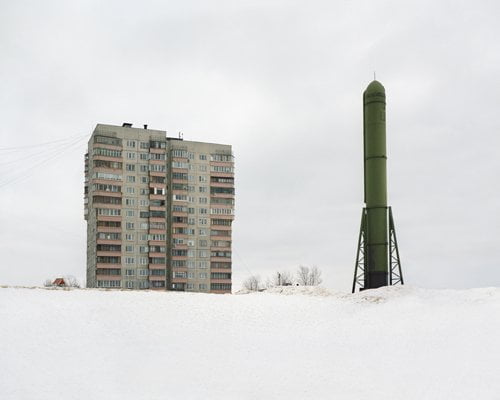
Snowy Russian Graveyard

But not for people; for old Soviet stuff.

6

Herewith the photography of Danila Tkachenko, which is engaging firstly because of its subject matter and the context thereof:

Tkachenko sees the Soviet Union’s aspirations and failures, and a rejection of the pursuit of political and technological utopias. “My project is a metaphor for post-technology apocalypse,” he says.

I would say that a lot of my photography is simply a reaction to pseudo-Marxist predispositions noting the currency of revolutionary recognition, together with the symbiotic link between national liberation and social emancipation. Or, at other times, because I think a flower looks pretty.

19

Secondly, I found this line interesting:

After identifying a location, Tkachenko would wait for fog or snow before shooting with a Mamiya 7. He favoured a small aperture and long exposure to create a dreamy, otherworldly feel.

You can do lots of things with exposure time and aperture size if you’re a good enough photographer (no, not me). But even that skill wouldn’t work were it not for the prevailing weather conditions. The combined results are stunning – depicting an monochromatic oxymoron of futuristic relics, lost somewhere in the clouds.

You can see the other 31 photos in the project here.