Crane crash

It might be a bit of an old-fashioned attitude, but if you are going to have national symbols, then surely how you choose to look after them is something of a measure of just how much pride you have in your country?

The King Protea is our national flower: it’s bold, it’s admired and revered.
The Springbok is our national animal: known for its agility and speed, synonymous with SA’s rugby wins.
The Blue Crane is our national bird: we’re killing it off.

Blue Crane numbers have decreased by between 27% and 49% in the last fifteen years: the patchy data available being indicative of just how little we actually care about what’s happening to these beautiful birds. And perhaps the more worrying aspects of this rapid decline are:
a) the fact that it is likely multi-factorial – with some of those factors being beyond our immediate control, and
b) the fact that over 60% of the remaining Blue Crane population is found in one single, small area – other Overberg wheat belt. Lose that population and really is game over.

As a result, the Blue Crane’s official conservation status has recently been officially changed to reflect this deterioration from Near Threatened to Vulnerable in the newly published Regional Red Data Book of Birds 2025.
Vulnerable reflects a higher category of threat – just below Endangered and Critically Endangered status on the Red List. This means that without significant conservation efforts, these species are likely to become endangered in the near future and face a high risk of extinction in the wild in the medium term.

As mentioned above, there are many reasons suggested as to why we are still losing Blue Cranes in this way. Aside from the problems attributed to climate change – a lack of rainfall (I know, I know) is a key driver for nest failure, and things are only going to get hotter and drier in the Western Cape – farming practices and power lines are also terrible news for Blue Crane numbers.

And while some mitigation has happened over the last decade, we’ve also chosen to build wind farms throughout the Overberg, with seemingly no thought for the Blue Crane. The turbines themselves are known for being dangerous to birds, and the additional transmission lines right through the most sensitive habitat areas of our national bird obviously increase the risks.

Collision with power lines remains the main threat to Blue Cranes, and ongoing mitigation is necessary, especially as new power lines are added to connect renewable energy to the grid. This is particularly a threat in the Renewable Energy Development Zones of the Overberg and Karoo.

Thankfully, there is now precedent for blocking construction of wind farms, but with South Africa’s ongoing issues with a stable electricity supply (and the disgusting pollution up North), there are many proponents for the expansion of wind power, as well. And the best places for those farms as far as wind goes, is right through Blue Crane habitats.

The fact that the Blue Cranes nest in wheat fields means that they are susceptible to danger from agricultural practices, such as mechanical implements (ploughing, harvesting), and the use of chemicals – targeted against rodents and other pests like geese.

Research has shown that Blue Crane breeding success in the Overberg has halved since the last published study 30 years ago. Pairs of Cranes now raise on average just 0.55 fledglings. You don’t need a maths qualification to see that those numbers will never sustain the population – especially with additional pressures such as power lines and the like.

There is some good news, some glimmers of hope.
Some farmers are displaying some of that apparently missing national pride, and acting as custodians for the Blue Cranes. Special Management Areas like the Nuwejaars Wetlands are connecting like-minded agricultural properties together, establishing safe areas and natural habitat for our wildlife, while still enabling famers to make a decent living.

But these sort of schemes are still a drop in the ocean, both in terms of area, and in terms of reducing the overall, numerous and external threats to the Blue Crane. And unless something – and no, I really don’t know what – is done to prevent this ongoing, dramatic crash in numbers, then in the very near future, we – like Mauritius – are going to have to choose a new national bird.
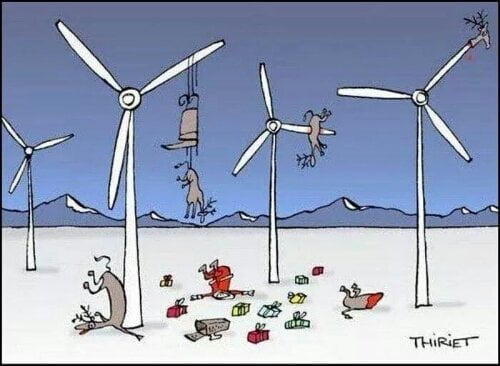
Have yourself…

… A merry little Christmas.

image

We all thought that killing our birdlife was bad enough, but apparently the local wind turbines have other targets at Christmas time.
Caledon is likely to be strewn with reindeer parts tonight. Great for biltong.

And while we don’t all believe in the story of babies in mangers and gift-giving shepherds, whatever you’re doing over the next few days, I hope it’s enjoyable and relaxing.

(Thanks Tina for the image)

Welsh Wind Turbine Fails To Impress

This just in from the BBC News website:

A wind turbine that cost the Welsh government £48,000 to buy has been generating an average of just £5 worth of electricity per month.
The turbine has been at its Aberystwyth office since it was built in 2009. It was one of several features that contributed to the building being rated “excellent” in an independent assessment of its sustainability.

At today’s exchange rate [weeps as he looks it up], that’s R82.48 worth of electricity each month from a wind that cost R791,762.21 to buy and install.

Oops.

But amazingly, the Welsh Government have defended the turbine’s performance, indicating that a mechanical error meant that it was only operating at 26% of its capacity:

Some improvements have been made and as of January this year it has been operating at 68%. But if it continues to operate at 68% capacity then it will generate 55.25 kWh per month – electricity with a value of £8.84.

Oh, well that’s SO MUCH better.

At that rate it would take around 452 years to offset the cost of buying and installing the turbine.

Magnificent value for money.

Apparently, the true issue lies in the siting of the turbine, away from clean air flows and… well… wind. And apparently, the Welsh Government were warned of this before the turbine was installed. But they went ahead anyway, probably on the grounds that:

1. It looks trendy.
2. It got their building a better green rating, and
3. It wasn’t their money that they were spending.

Mxm.

UPDATE: Maybe it got up to a tenner given the weekend’s weather:

A clean-up operation is under way after huge waves damaged Aberystwyth seafront and dumped shingle on the promenade during the weekend’s storms.
Local photographer Keith Morris said the scene resembled a war zone on Sunday morning with some seafront businesses hit by flooding.

Wales battled winds of 89mph (143kph) at the storm’s height on Saturday.
Gusts brought down trees and power lines leaving 10,000 properties across south and west Wales without power.

“I have not seen a storm as big as that for decades in Aberystwyth,” said Mr Morris. “There were big granite blocks lifted feet into the air. It did look a bit like a war zone on Sunday morning.”

(If it’s still standing, that is.)

Wind Turbine Kills Really Rare Bird – WHAT NEXT?

And continuing with matters electrifying

“OMG! We’re all going to die!” So say the environMENTALists anyway, citing global warming and coal and fossils and whatnot. Thus, they are all behind the wholly barmy plan to only generate electricity through “green” means, namely wind and solar. And while I have no issue with the renewable energy thing per se, their instance that it should be at the exclusion of everything else is short sighted and, frankly, stupid.
Also, it irritates the hell out of me (and there’s a lot in there) that I have to listen to their constant whining on the internet, which (here at least) is fuelled by dirty black stuff from Mpumalanga.

And anyway, as 40 birdwatchers found out this week,  renewable methods aren’t that green anyway, as they watched, dismayed, as an extremely rare white-throated needletail, sighted only 8 times in the last 170 years get killed by the fast rotating blades of a wind turbine in Scotland.

Dead. Not resting. Not pining for the fjords.
Dead. No more. Shuffled off this mortal coil. Gone to join the choir invisible.

About 30 birdwatchers travelled to the island to see the unusual visitor, which has only been recorded five times in the UK since 1950. However, they then saw it die after colliding with the wind turbine.

Birdwatcher David Campbell, from Surrey, told the BBC Scotland news website that the incident took place late on Wednesday afternoon. Mr Campbell, who is now making his way home to south east England, said: “We just watched the whole thing with dismay.”

Horrible. What a way to eliminate a species. And while the authorities say that they place wind turbines thoughtfully and carefully to prevent this sort of incident, it didn’t prevent this one, now did it?

However, while I blame the wind turbine, it does seem that Mr Campbell has a bit of a history around rare birds:

He added that on a previous bird watching trip he had seen a migratory wryneck hit by a train.

And I think we can probably work out who emerged from that little encounter more unscathed, can’t we?

But, Mr Campbell aside, there’s a serious message for South Africa here, especially since Eskom has just got the go ahead to build a monster 46-turbine wind farm  just down the road from the beautiful Namaqua National Park. I suspect that you, dear reader, can do the mathematics here.

The wind farm is to be called “Sere”:

…the Nama word for “cool breeze”

Does anyone know the Nama word for “widespread and horrific massacre of migratory birds”?
Just asking.

And then there’s the solar thing. Because the bunnyhuggers insist that wind is safe (which it’s obviously not if you’re a rare bird or if you don’t like explosions) and they also insist that solar is safe too. Why on (what’s left of the) earth would you believe them?

What if the last of our already endangered rhinos stumbles into its local solar array? I don’t think that it take a huge amount of imagination to see that it would almost certainly be cooked instantly. And while it would probably make a very tasty snack, it would be gone. Dead. No more. Shuffled off th… look, you get what I’m saying.

“Oh. That will never happen!” say the greenies.

Ja. Right.

Just like the white throated needletail “will never” fly into a wind turbine.

It’s plainly obvious from the white-throated-needletail-sliced-to-death-in-a-wind-turbine incident and the hypothetical rhino-scorched -by-concentrated-sunlight issue that we need to shelve these sort of dangerous projects until independent research has shown exactly how much of a hazard they are to our endangered species.

I’m almost tempted to launch an online petition.

Almost.

UPDATE: Does anyone have any data on wave power killing dolphins?