The electric car conundrum

Petrol is going up again next month and people are understandably searching for alternatives.

Look, electric cars are great. Some of them are even really cool. We saw loads of them in Bergen, each with the number plate prefix ‘EL‘ to signify the green credentials of both the vehicle and owner. And that’s not unusual for Norway. Check this article from 2 years ago:

Norway, with a population of only five million, now has on its roads 35,000 electric vehicles (EVs), which also represent 14.5 per cent of new vehicle sales. Figures show another spike last month with 1,346 sales.

Onward and upward. What nice people, concerned about CO2, the greenhouse effect and climate change. But hang on, it seems that the electric car boom is driven by tax breaks, subsidies and privileges, rather than altruistic environmentalism:

Those benefits are incredibly generous, including exemption for VAT and car tax as well as access to bus lanes, free parking, free toll-road use, free ferries and employment tax benefits. A recent study suggested this equals as much as £1,000 a year in savings over the life of an EV.

Never mind. A by-product of this apparent greed is fewer car fumes in the city. Winning all round.
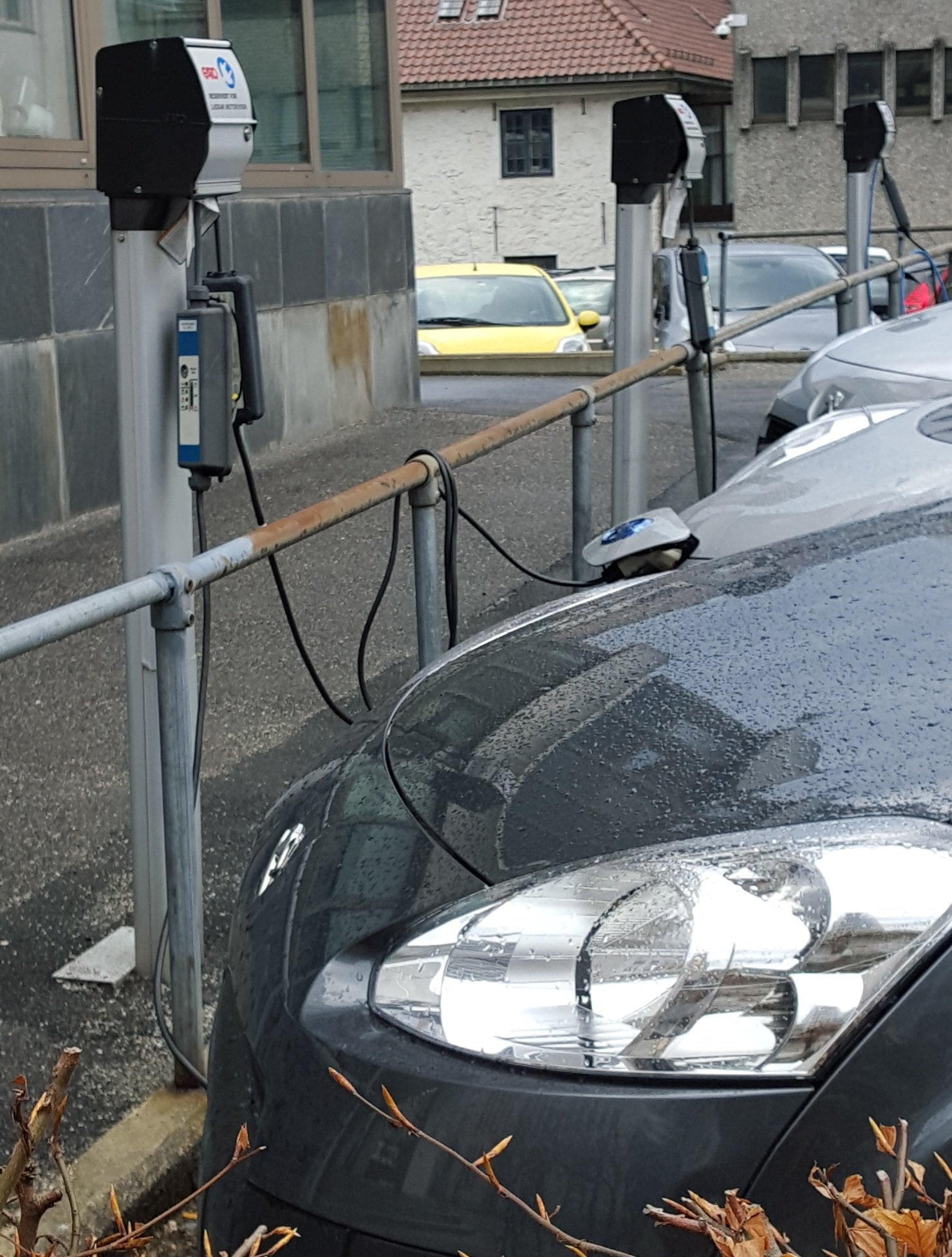
ecbergenEVs plugged in at the Bergen rådhus

One drawback with electric cars, however, is that they require electricity to run. Bugger. But in Norway, this is fine, because almost all of their plentiful electricity comes from the plentiful water falling down the plentiful waterfalls on the side of the plentiful mountains. And that’s very clean and green.

In South Africa, we don’t have enough water or big mountains to work this way. We do have shedloads of fossil fuels though, so we make our electricity by burning those. Thus, following the electrical supply audit trail upwards, when you plug in your EV in Cape Town (and good luck with finding somewhere to do that, by the way), it’s basically running on coal, like an old steam engine. Filthy.
So, right now, there’s really no environmental benefit to driving an EV in South Africa.

And they’re massively expensive. Massively, massively expensive. Like solar panels. But more so.

There is some evidence that people don’t think past what’s immediately in front of them though. Look at these guys, for example: Scootours. Now, this looks like a very, very cool idea, and one that I am determined to try. But their claim that it’s green? Well…

Fullscreen capture 2016-05-20 090012 AM.bmp

Yes. Going down a hill “propelled by gravity” is environmentally neutral. Well done.
But that vehicle taking you to the top of the runs? Fossil fuels, mate. And the laws of Conservation of Energy mean that the whole uphill thing will be especially dirty, heading up Kloof Nek and generating all that potential energy for you and your huge scooter.

I suppose that the thing with electric cars is that you would need to measure the amount of damage that burning petrol is doing versus the coal to make the electricity for your EV. But that difference is likely to be minimal. There was the option of buying clean power by subsiding the 4 wind turbines near Darling, darling, but they proved to be so inefficient that the company went bust.

Darling Wind Farm was one of the first two wind farms in South Africa. It is located 70 km (43mi) north of Cape Town, between Darling and Yzerfontein on the west coast of South Africa. It is an Department of Energy demonstrator site with the 4 turbines constructed. The second phase, 6 additional turbines, was never completed.

Darling Wind Power company is subject to liquidation. The DWP Board adopted a resolution to liquidate the company. Expected to operate at 28% capacity and deliver 13.2 GWh per year, it has only been delivering 8 GWh per year at 19% capacity.

Awkward.

OK. Once we get our clean electricity sorted (hello nuclear) and the price of cars with big batteries comes down to at least reasonable levels, we can revisit the electric car in South Africa. But these things aren’t going to happen before petrol goes up by a Rand per litre in a fortnight’s time.

And so that’s why you need to try out our massively efficient public transport system [cue laughter] or start walking.
Keeping The Lights On

One of the benefits of being over in the UK recently was that I was able to pick up the latest copy of Private Eye magazine. I used to be a subscriber, but found that the postal delay rendered much of the content dated and irrelevant. If ever there was a case for a publication having a digital edition, Private Eye are it. Topical satire simply doesn’t age well.

But I digress. Often.

There was a column in it written by ‘Old Sparky’, entitled “Keeping The Lights On”. It was very interesting to read it as a SA resident. It’s probably a bit long to add into a blog post, to be honest, but I’ve never been one to abide by the petty unwritten rules around blogging, so here is it, in its entirety – I’ll see you for more comment on the other side:

WHEN the authorities make contingency plans against predictable disasters, we all applaud their foresight. Which catastrophes they are thinking about, however, can be revealing and give cause for concern; and right now the government is working on the possibility of a five-day nationwide power blackout – putting all its breezy denials of the lights going out into perspective.

As frequently noted here, energy policy since the dreadful Energy Act 2008 has resulted in the safety margin between reliable electricity generating capacity and peak demand becoming progressively and dangerously tighter. A 20 percent margin would be considered comfortable; but this winter it will only be 1.2 percent – down from 4.1 percent last year – before the National Grid takes special short-term measures.

Homes and hospitals
The grid has recently been bolstering its emergency resources with banks of diesel generators and the right to switch off industrial customers. Publicly the government always insists “the lights will stay on” – in homes and hospitals, that is. But it’s a costly, third-world way to run a grid in a supposedly advanced economy: and now we know they obviously don’t think it is guaranteed to work.

Papers seen by Private Eye indicate that the Cabinet Office and Treasury combined are planning for a scenario in which there is a five-day nationwide blackout with only small stand-by generators working. The detailed consequences they envisage include:

  • No landline telephones available to businesses or homes
  • Mobile phones with voice-only service (not data)
  • No street lights, traffic lights or public transport
  • Two-thirds of petrol stations closed
  • Shops open only sporadically and unreliably
  • ATMs unavailable, with cash running out fast

This would most probably happen in winter. It goes without saying that such a situation would also bring about ghastly accidents and loss of life, with the emergency services much constrained in their ability to cope. The implications for industry, commerce and public order are grim, too. If it’s any comfort, the German authorities – based on their own crazy energy policy – are looking at very similar scenarios.

With all this at stake, as prudent as it may be to plan for potential calamities, it would surely have been better to render the blackout scenario redundant by properly ensuring security of electricity supply. The current combination of intermittent wind farms, ageing nukes, fast-closing coal-fired power stations and mothballed gas-fired plants doesn’t do that: and privately the government knows it.

Yeah. We think that SA is the only one with problems like these. But there’s a real danger that the UK could experience some form of load-shedding this winter as well. (Regular readers shouldn’t find this news surprising.)

When similar ‘disaster’ plans made by Eskom and the SA Government became public knowledge, there was considerable disquiet and some small degree of panic (probably mainly thanks to scaremongering headlines). Sales of tinned goods reached heights not seen since 1994 and we all waiting to be plunged into dark, apocalyptic anarchy.

It didn’t happen.

Yet.

SA signed up (or didn’t sign up, depending on whom you choose to believe) for 4 new nuclear power stations, designed and supplied and ostensibly run by a foreign power – Russia. (Ironically, the UK has pretty much done the same thing with China and France.)

The cost of this SA/Ruskie venture? A tidy One Trillion Rands. It’s a lot of money, but the issues are not specifically around the cost, but (as you will read here) mainly around the safety of nuclear power stations and the potential for widespread corruption. Thing is though, the safety issue isn’t actually an issue – one only has to look at the still completely unexploded Koeberg Power Station to see that. And the corruption thing, while entirely valid, has got very little to do with this specific deal, and would be a problem no matter what large scale civil engineering project was being undertaken, and by whomever. That’s how these things work in SA. It’s sad, but it’s true.
So your plans for a ‘super clean’, ridiculously big, massively inefficient solar plant would attract the same problem. Your unpretty, flying thing killing, massively inefficient wind turbine plan will also be loaded with backhanders. But Greenpeace will probably choose to ignore that.

Large scale projects are expensive. Producing electricity is expensive. It’s something we have to accept though, because these are things that we need. People with trendy, fleetingly zeitgeist ideas like diverting that Trillion Rand to tertiary education are missing the rather obvious point that without some form of generating more electricity, there will be nothing for their newly graduated thousands to do in an economy that’s lying in small bits and pieces all over the bottom of Africa.
Yes, of course this situation could definitely have been better managed – it could still be better managed – but we need to do something, because otherwise we’re going to end up implementing that Eskom blackout plan.
And that is not a road we want to be going down.

PDF of the Private Eye article.

QsOTD

Quotes Of The Day – yes – plural. Like London buses, these things.

First off, some succinctly put insight into the world of the fad diet and the public reaction to it:

Nutrition is a complex minefield of information with plenty of vested interests playing their part. There is also a lot of legacy popular thinking around (read: stuff people just accept without any critical thinking).

That’s Joe Botha, speaking sense at Memeburn. Sadly, immediately thereafter, he does rather ruin it all by detailing his “lose weight quick” plan based on the enforced dietary timetable of our distant ancestors. (Save your time and bandwidth.) But, in typical Tim style, I’m going to take those lines (and only those lines) that suit my agenda and quote them here.

And then this from Australia’s Galileo Movement on Stellenbosch University’s latest breakthrough in renewable energy:

The industrialisation of our landscape for inefficient power production.

And yes, this is exactly the issue with solar and wind power right now. I know we need to make the switch away from fossil fuels, I completely accept that. But right now, there are simply no viable renewable alternatives out there:

The issue is the inefficiency of these technologies. And exactly how much space and how much of our environment do we really want to give up to this “inefficient power production”? Yes, SA has a lot of spare space, but that’s a good thing. It doesn’t mean that we need to fill it with solar panels and wind turbines.

aeg-power-solutions

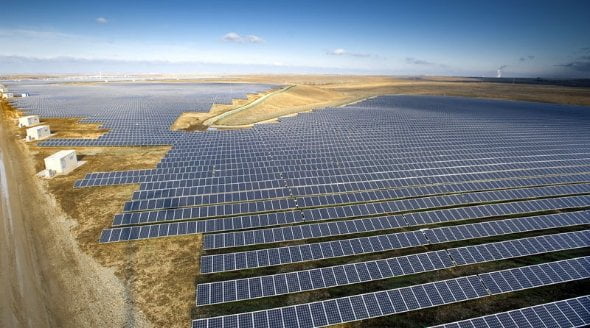
And we’d need to, if we were to come anywhere close to solving our well-documented long term power shortages. That Stellenbosch project needs a mirror surface area of 220m² (never mind the space in between and around them, nor the same for the tower in the middle) to provide electricity for “about” 30 houses. But not at night, obviously.

Simply not good enough.

I’m not blaming the science or the scientists here. They’re doing their best. They’re progressing, developing, and they’ll get there. But renewable energy remains expensive:

The researchers have calculated Germany’s rapid switch to renewable energy sources like wind and solar is adding another €28 billion a year to the electricity bills of consumers and businesses.

And inefficient:

What happens at night?
As there is no light at night, no energy will be produced. The PV plant will import electricity from the utility to keep operations on site going.

Ooops. The simple fact is that we’re just not there yet.
And that’s why we can’t (and shouldn’t) be making the switch right now.

If only there were some clean, efficient, proven method of producing electricity that we could use.

World’s Biggest Windmill

Not really, but still – nice story: they’ve put a couple of VAWTs on the Eiffel Tower in Paris. Well, they couldn’t really put them on the Eiffel Tower anywhere else, could they?

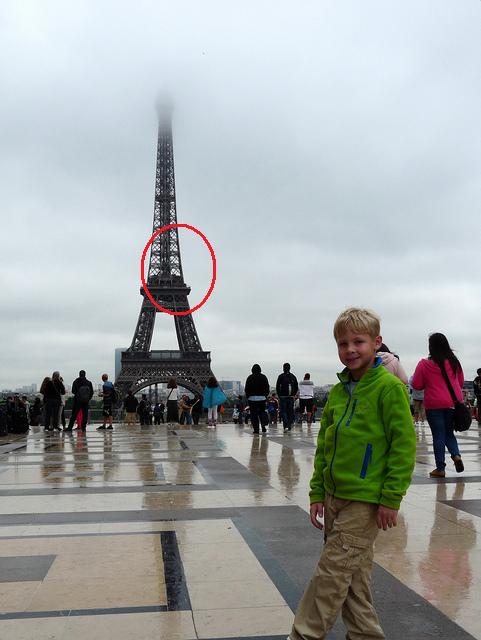
If you’ve ever seen the Eiffel Tower in real life, you’ll know that it’s not small. Here it is with its head in the clouds in the height of summer, 2012 with the boy wonder in the foreground, and a handy indicator of where the turbines have been fitted just above the 2eme étage:

7473130232_86e6c6fed1_z

Amazingly, despite their hugely elevated position, they’re not even at the height of the wind turbines in Caledon just up the road from Cape Town. Suddenly, Gustav’s big project doesn’t seem quite so huge. Or maybe wind turbines are just generally horribly invasive. Hey, you decide.

The 10,000 kilowatt-hours of electricity they’ll produce each year is about enough to self-sustain the commercial section on the tower’s first floor, but not much else.

Look, it’s something. And I do understand that this is really all just about visibility. To be honest, short of putting a set of huge blades on the top of the tower itself, it’s probably about as good as it’s going to get. Especially in a country which produces around 80% of its electricity from nuclear. But while wind is good because it’s renewable, it’s may not be quite as green as you think. Here’s an interesting “back-of-the-envelope calculation” by Popular Science magazine on which are the nastiest forms of electricity generation if you happen to be, say… a bird (as one of the endangered Blue Cranes near Caledon might self-identify, for example).

bird-deaths-per-1000mwh

You can read more here, but the gist of it is that Coal is downright evil (we knew this), solar plants fry birds:

Rewire reports that during the test, operators fired up a third of the 110-megawatt facility’s mirrors, concentrating sunlight on a spot 1,200 feet off the ground. Over a six-hour period, biologists counted 130 “streamers,” or trails of smoke and water left behind as birds ignited and plummeted to their deaths. Rewire’s anonymous source said that at least one of the birds “turned white hot and vaporized completely.”

and we already knew that wind turbines kill birds and bats.

Sadly, despite our current (no pun intended) electricity woes, it seems like nuclear isn’t the er… cleanest option for SA either (although not necessarily for environmental reasons).

So we have the choice of evil coal (which we’re going to use), the horribly inefficient and not-ever-so-nice-after-all solar and wind, or the allegedly dangerously corrupt nuclear.

Or we could do fracking… Now there’s a good idea.

More Parisian flickritude

Capetonian woman continually surprised by events

News just in:

Capetonian Margaret Wilson (61) of Diep River, has admitted to being “almost permanently bewildered” by what she describes as “a continuous stream of surprising events” which she claims are plaguing her life.

Yesterday, my son-in-law asked if I had registered the card in my cellphone. I asked him why I needed to do this and he told me that I would be cut off if I didn’t. Who makes these silly rules up at the drop of a hat?
If they are going to do these things then they should at least tell you by sending you text messages, taking out full page advertisements in the newspapers or mentioning it on Carte Blanche or Cape Talk. If it wasn’t for Graham, I would never have known.

Mrs Wilson, who lives alone, was further incensed by the news that electricity prices would rise in Cape Town on July 1st:

I thought Graham was making this up when he told me. They did this last July too, although I’ll be surprised if this trend continues and they do it again next year. It’s going to cost me much more: since that silly loadshedding ended, I’ve been using as much electricity as I can to make up for the bits I missed. It’s difficult sleeping at night with all the lights on, but at least it keeps the burglars away.
But I don’t know where I am going to find the money. If I had known about this, I would have saved up. It’s like the petrol – you never know where you stand with that. They seem to change the price every few weeks. They should publicise these things. It’s very confusing.

When asked if she ever watched the news, Mrs Wilson said yes, although she only watches the SABC news in Afrikaans – which she doesn’t speak – “just to check Riaan Cruywagen is still alive”. She also mentioned that she only bought newspapers in order to line the bottom of her cats’ litter tray:

Pickles and Fifi just don’t seem to want to go out at the moment and I can’t say that I blame them. It’s been so cold and wet for the last few weeks. I really don’t like these cold snaps – we had them last year as well as I remember – while that football tournament was on. It just seems to get cold for a few months before it gets warmer again. Those weather people on the telly are no good either – they just say it’s going to be cold – they never tell you why. Still, I prefer this weather to when it’s too hot. I can’t stand the heat, you know?

Mrs Wilson is looking forward to watching the Super 15 semi-final from Newlands on Saturday.

Graham is going along. We love the rugby. It will be great to hear the whole crowd getting behind the local team.
I’ll be very surprised if they don’t.

(I’m submitting this post to the Southern Suburbs Tatler.)