It’s all gone a bit Eskom

I was trying to top up with electricity this afternoon. Most of South Africa operates on pre-paid meters, and so it’s very easy to buy units from shops, but it’s even easier to buy it online from your banking app.

Except when it’s not.

Because, shockingly (no pun intended): electricity is unavailable.

At least, it’s “currently unavailable”, lol (no pun intended).

To be fair, we haven’t had any loadshedding for a while now. It’s been over 200 days. And, while we were rightfully rather grumpy with Eskom about the whole loadshedding thing, which cost the country billions and billions of Rands and was awful, dangerous (and occasionally a bit frightening) to live through, we should tip our hats to the people in charge (no pun intended) who have done what needed to be done to fix the problems.

Now all they need to do is talk to my bank about sorting out their “Electricity – unavailable” issue.

Thank goodness the solar has been working hard all day, so we’ll be fine for the night.

Talking of which – we were even pulling in 2W from the moonlight at midnight over the weekend:

Because of course moonlight is just reflected sunlight.

Which makes you wonder how vampires wander around with impunity on cloudless nights.

Another 74 horror movies ruined, just like that.

A better day

I’m on the mend, and some nice drugs quickly made my unmanageable headache manageable this morning, so I’ve been up and about and trying to catch up with all the jobs I’ve missed out on doing this week. The sun has kicked in as well, meaning that I feel (somewhat) more confident in prepping the garden and our outside spaces for Spring and some nicer weather.

The only dissention at this change in season seems to be coming – vocally – from the local Cape Rain Frog population. They’re much happier when it’s wet and cool. These blue skies and warm sunshine aren’t for them. They’re letting us know.

I’m still a little short of oomph, so things aren’t going as quickly as they could be, but on the plus side, at least the sun has charged up the house batteries and meant that I can do some energy-heavy tasks like washing the washing machine. Our Bosch machine has a special programme for this, which is 90 minutes of splashing around clean water at 90oC. Super effective, but not something that you want to be paying for via your meter. Hence today being a good day to do it: we’re dragging 3000W in at the moment, more than 80% of it going straight there.

I know. Sounds like an odd one until you see the colour of the water that’s supposedly “cleaning” your clothes. I’m well aware that even with your own Spring cleaning programme in full swing, you’re not looking for a sign to wash your washing machine, but if by any chance you were, then this is it.

Anyway. Lawn done, washing machine done, energy (mine) depleted. Time to sit down (and probably fall asleep) in front of the football.

Let’s make electricity

Shall we? Well, we need to.

We’re short of electricity. We have been for a long while. Things have been better recently, but that’s mainly due to the economic downturn rather than any huge increase in generating power.

So, we need more electricity so that when things pick up again (lol!), we are ready to go and there are no further instances of “rolling blackouts” or “loadshedding”.

Much has been made of the SA Government’s insistence of going down the nuclear route. Currently, we have just one nuclear power station, just up the road at Koeberg. The alleged R1 trillion deal with Russia would add several more, and also the opportunity (so the cynics say, at least) for massive kickbacks, corruption and general naughtiness.

The cynics may well be right. But their fears are not what this post is about.

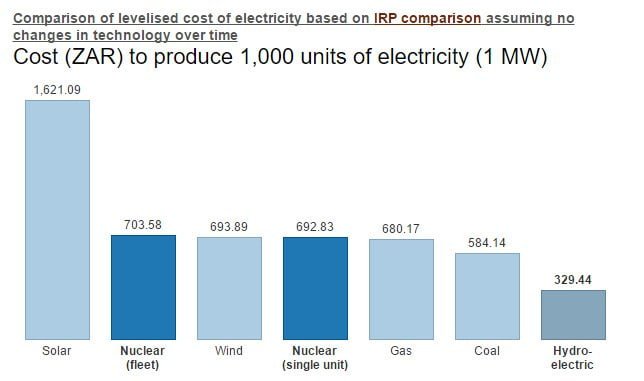
Brian Molefe, group chief executive of Eskom, allegedly recently stated that nuclear was “the cheapest option” and a local fact checking website went after him on that claim. They found, perhaps unsurprisingly, that his alleged claim was incorrect. But his inaccuracy is not what this post is about.

Here’s a screenshot of a graph that Africa Check’s data generated (geddit?):

Fullscreen capture 2016-08-25 120214 PM.bmp

And you can see that Brian was incorrect. Naughty Brian. Well done, Africa Check.

Thankfully, one thing everyone can agree is correct is that South Africa needs to generate more electricity. Oh, and that we really can’t afford to pay any more for it. So, what exactly are our options?

There’s hydroelectric. Clean, renewable, easy, cheap. It would be lovely to run our country with electricity from mountain streams and melting snow. But we don’t have mountains streams and melting snow. In fact, we have a few issues with the amount of water we have available for anything full stop. Put simply, there just isn’t enough water to make HEP a viable option.

There’s coal. Coal is cheap, we have lots of coal and we have lots of big coal-fired power stations. But coal is filthy. It makes shedloads of greenhouse gases and a billion other pollutants that no-one wants. Greenpeace says no to coal, and it’s just about the only thing I agree with them on. Going forward, coal should not be on the table (or in the furnace) for generating electricity.

Next up is gas. It’s there with wind and nuclear as a level levelised cost. Now, I happen to know that just under the Karoo is (conservatively estimating) about 450 000 000 000 000 cubic feet of shale gas. And I’d tap that gas. We could drop coal, drop our carbon emissions and make lovely, relatively clean, relatively cheap electricity. Except the green people aren’t happy with the plan to extract the shale gas. We’ve covered this… er… “extensively” on 6000 miles… I don’t think I need to go into again. Shale gas would be brilliant for SA. But the bunnyhuggers are determined that it won’t happen.

There’s nuclear – right there. Reasonably cheap, very clean, super reliable. Look at Koeberg – running without any big problems since 1984. There may be issues about corruption, but whatever methods we choose, this is electricity generating infrastructure on a massive scale. Sadly, there will always be those opportunities.

Still, wind looks like an option. Until you do the sums, that is. Remember that the nuclear option is for 9.6GW of electricity generation. Now look at this:

At 3MW per massive 145 metre (90m hub + 55m blade) turbine, you’d need 3,200 turbines! And that’s assuming 100% efficiency. Wind farms don’t do 100% efficiency. Wind farms only do about 30% efficiency (and I’m being nice here). So basically 10,000 turbines to guarantee that 9.6GW figure. If you’ve seen the blot on the landscape that is the Dassiesklip Wind Farm near Caledon, you’ll see how much of an eyesore just 9 (nine) turbines can be. And how much space they take up.
Dream on.

Look at the left hand side of that bar chart. Realistically, you’d probably have to rule out solar on the grounds of price. Oh, and also, the ridiculous scale required:

To achieve the 9.6GW capacity planned for this nuclear thing, we’d need something about 33 times the size of the current largest solar park in the world. That would cover 32,043 hectares and would cost about $33 billion.

So, no. Nuclear might not be the cheapest option for generating electricity in South Africa. And Brian Molefe shouldn’t be saying that it is. But until someone comes up with any other viable option – and I really don’t see anything reasonable on the table or anywhere close – it might well be the best option for electricity generation in South Africa.

Whether you like it or not.

Keeping The Lights On

One of the benefits of being over in the UK recently was that I was able to pick up the latest copy of Private Eye magazine. I used to be a subscriber, but found that the postal delay rendered much of the content dated and irrelevant. If ever there was a case for a publication having a digital edition, Private Eye are it. Topical satire simply doesn’t age well.

But I digress. Often.

There was a column in it written by ‘Old Sparky’, entitled “Keeping The Lights On”. It was very interesting to read it as a SA resident. It’s probably a bit long to add into a blog post, to be honest, but I’ve never been one to abide by the petty unwritten rules around blogging, so here is it, in its entirety – I’ll see you for more comment on the other side:

WHEN the authorities make contingency plans against predictable disasters, we all applaud their foresight. Which catastrophes they are thinking about, however, can be revealing and give cause for concern; and right now the government is working on the possibility of a five-day nationwide power blackout – putting all its breezy denials of the lights going out into perspective.

As frequently noted here, energy policy since the dreadful Energy Act 2008 has resulted in the safety margin between reliable electricity generating capacity and peak demand becoming progressively and dangerously tighter. A 20 percent margin would be considered comfortable; but this winter it will only be 1.2 percent – down from 4.1 percent last year – before the National Grid takes special short-term measures.

Homes and hospitals
The grid has recently been bolstering its emergency resources with banks of diesel generators and the right to switch off industrial customers. Publicly the government always insists “the lights will stay on” – in homes and hospitals, that is. But it’s a costly, third-world way to run a grid in a supposedly advanced economy: and now we know they obviously don’t think it is guaranteed to work.

Papers seen by Private Eye indicate that the Cabinet Office and Treasury combined are planning for a scenario in which there is a five-day nationwide blackout with only small stand-by generators working. The detailed consequences they envisage include:

  • No landline telephones available to businesses or homes
  • Mobile phones with voice-only service (not data)
  • No street lights, traffic lights or public transport
  • Two-thirds of petrol stations closed
  • Shops open only sporadically and unreliably
  • ATMs unavailable, with cash running out fast

This would most probably happen in winter. It goes without saying that such a situation would also bring about ghastly accidents and loss of life, with the emergency services much constrained in their ability to cope. The implications for industry, commerce and public order are grim, too. If it’s any comfort, the German authorities – based on their own crazy energy policy – are looking at very similar scenarios.

With all this at stake, as prudent as it may be to plan for potential calamities, it would surely have been better to render the blackout scenario redundant by properly ensuring security of electricity supply. The current combination of intermittent wind farms, ageing nukes, fast-closing coal-fired power stations and mothballed gas-fired plants doesn’t do that: and privately the government knows it.

Yeah. We think that SA is the only one with problems like these. But there’s a real danger that the UK could experience some form of load-shedding this winter as well. (Regular readers shouldn’t find this news surprising.)

When similar ‘disaster’ plans made by Eskom and the SA Government became public knowledge, there was considerable disquiet and some small degree of panic (probably mainly thanks to scaremongering headlines). Sales of tinned goods reached heights not seen since 1994 and we all waiting to be plunged into dark, apocalyptic anarchy.

It didn’t happen.

Yet.

SA signed up (or didn’t sign up, depending on whom you choose to believe) for 4 new nuclear power stations, designed and supplied and ostensibly run by a foreign power – Russia. (Ironically, the UK has pretty much done the same thing with China and France.)

The cost of this SA/Ruskie venture? A tidy One Trillion Rands. It’s a lot of money, but the issues are not specifically around the cost, but (as you will read here) mainly around the safety of nuclear power stations and the potential for widespread corruption. Thing is though, the safety issue isn’t actually an issue – one only has to look at the still completely unexploded Koeberg Power Station to see that. And the corruption thing, while entirely valid, has got very little to do with this specific deal, and would be a problem no matter what large scale civil engineering project was being undertaken, and by whomever. That’s how these things work in SA. It’s sad, but it’s true.
So your plans for a ‘super clean’, ridiculously big, massively inefficient solar plant would attract the same problem. Your unpretty, flying thing killing, massively inefficient wind turbine plan will also be loaded with backhanders. But Greenpeace will probably choose to ignore that.

Large scale projects are expensive. Producing electricity is expensive. It’s something we have to accept though, because these are things that we need. People with trendy, fleetingly zeitgeist ideas like diverting that Trillion Rand to tertiary education are missing the rather obvious point that without some form of generating more electricity, there will be nothing for their newly graduated thousands to do in an economy that’s lying in small bits and pieces all over the bottom of Africa.
Yes, of course this situation could definitely have been better managed – it could still be better managed – but we need to do something, because otherwise we’re going to end up implementing that Eskom blackout plan.
And that is not a road we want to be going down.

PDF of the Private Eye article.

Fracking v Solar v Wind discussion

This from the Guardian:

Researchers at Manchester University have found that fracking causes less toxicity to humans and marine ecosystems and uses less resources than solar panels and wind turbines.
Their study, which measured the environmental impacts of fracking and compared it to other energy sources, prompted a story in the Times under the headline: Fracking ‘greener than solar panels’.

What follows is a discussion involving study authors, some experts, some interested parties and some of the general public. It makes for an interesting read, but it’s quite long, so I’ve taken a couple of points out of it which I think are of particular interest. The first being this question:

What do you think we can do to make the public discussion about fracking more rational, and less emotional? Do you think it [the discussion] needs to be more evidence-based?

I may have mentioned this exact thing over three years ago, right here. And as (report author) Laurence Stamford says:

Definitely. The shale debate is almost entirely based on rhetoric and hearsay (although this also applies to most topical issues e.g. nuclear). What we’re hoping to do here is simply to add some numbers and some neutral, evidence-based discussion to allow people to make informed judgements.

This is undoubtedly the best way to make informed judgements. But there are problems with this approach, namely that (predominantly) the bunnyhugger side know that in the struggle for hearts and minds, the hearts are generally the ones that win through. Appealing to people’s emotions will always be more successful in attracting supporters to your cause, so why bother with the uncomfortable truth of facts and figures that don’t support your case?

The flip side is that those facts and figures need to be independently sourced – or at least independently audited and verified – if we are going to consider them. All too often (and not just in the case of fracking), a bit of digging reveals that research, papers and reports have been funded by organisations with a specific interest in the subject under investigation.

Then there’s the interpretation of information by the media. The Times reported this study under the headline: “Fracking ‘greener than solar panels’, which Stamford says was not what he feels the study says:

“That makes it look like we are saying that solar panels are all around worse than shale gas, which… is not really what we’ve said. We are certainly not trying to say that shale gas is greener than renewables.”

He says it would be more accurate to say:

“For certain environmental problems shale is better than solar, whereas for others solar is better than shale.”

The lesson from this one? Don’t believe everything you read in the newspapers. Who knew?

And then what factors should be considered when comparing electricity generation technologies? Well, ideally, all of them, but then how much weight should be given to each – once again, there’s no easy way of answering that.

Interestingly, the major environmental concern related to solar was not investigated in the study. According to the solar industry, the turning over of agricultural land to solar farms is the biggest environmental public and policy obstacle the industry faces.

Yep – 6000 miles… covered that one too.

All in all, it’s an interesting study – albeit that people’s views on it have already been tarnished by that Times story – and a worthwhile discussion. A reminder on what we should be striving for when considering various forms of electricity generation and that the case for “renewables” isn’t always as clear cut as the anti-frackers would have us believe.