The best bits of a bad job

I’m not going to get into the Charlie Hebdo thing. I don’t have the time or careful articulation to express my feelings accurately. I even had to call it a “thing” to avoid using a term that might be considered inappropriate by one side or the other. And therein lies the problem: people are taking sides.

An incident which should perhaps have the power to be either divisive or uniting seems (disappointingly, but maybe unsurprisingly), being used exclusively as the former, rather than the latter. An opportunity (albeit a difficult one) missed?

There are about a million (I counted and read them all) different “thinkpieces” about the whole thing already, but here are a couple of them which I found most interesting, with a nice passage from each:

From Jacques Rousseau, on free speech:

…it’s a glib, and oftentimes lazy, inference to draw that it’s “religion” that causes these things. I would think it rare that religion per se makes you homicidal, but that instead, folk who are capable of such things will find religious inspiration for doing them.

If your religion allows you to be led to such barbarism, there’s barbarism in you to be exploited. That doesn’t mean that religion X (or ideology X) cannot be a causal factor in barbarism more often than religion or ideology Y.

and:

Other issues are perhaps not as easy or unambiguous as we might prefer. For starters, the right to express a view doesn’t always mean it’s a good idea to do so.

Yes. Just like Julius and his “Shoot the Boer” song:

What does it achieve when role models sing Dubul’ iBunu?
And yet these individuals make a conscious decision to do these things. Why? Where is the value in that?

It’s more than just the lack of any positive worth in these actions that depresses me. It’s the fact that these things are divisive and harmful and yet they are completely avoidable. Julius Malema, Councillor Greyling et al. simply need to make better decisions.
So, rather allow Malema to sing Dubul’ iBunu and then rejoice when he chooses not to.

And then this, on the possible deeper motives for the attack, from Informed Comment:

Al-Qaeda wants to mentally colonize French Muslims, but faces a wall of disinterest. But if it can get non-Muslim French to be beastly to ethnic Muslims on the grounds that they are Muslims, it can start creating a common political identity around grievance against discrimination.

Most of France will also remain committed to French values of the Rights of Man, which they invented. But an insular and hateful minority will take advantage of this deliberately polarizing atrocity to push their own agenda. Europe’s future depends on whether the Marine LePens are allowed to become mainstream. Extremism thrives on other people’s extremism, and is inexorably defeated by tolerance.

It’s an interesting theory. And already, there are reports of “grenades being thrown into a mosque” near Paris.

So what can we take from this?

1. The preservation of the right to free speech is imperative, and
2. One cannot and should not conflate the views and actions of (religious) fundamentalists and extremists with those of everyday followers of religion.

But then there’s this sort of thing:

…rendering those two ideals completely and immediately incompatible. (And angering me quite a lot, as an aside. I’m not about to depict Muhammad, but that’s only because I don’t see any value in doing so (see my wish for Julius above), and most certainly not because Farah says I’m not allowed to.)

So, here’s a third thing we kinda all knew anyway:

3. This isn’t going to be sorted out any time soon.
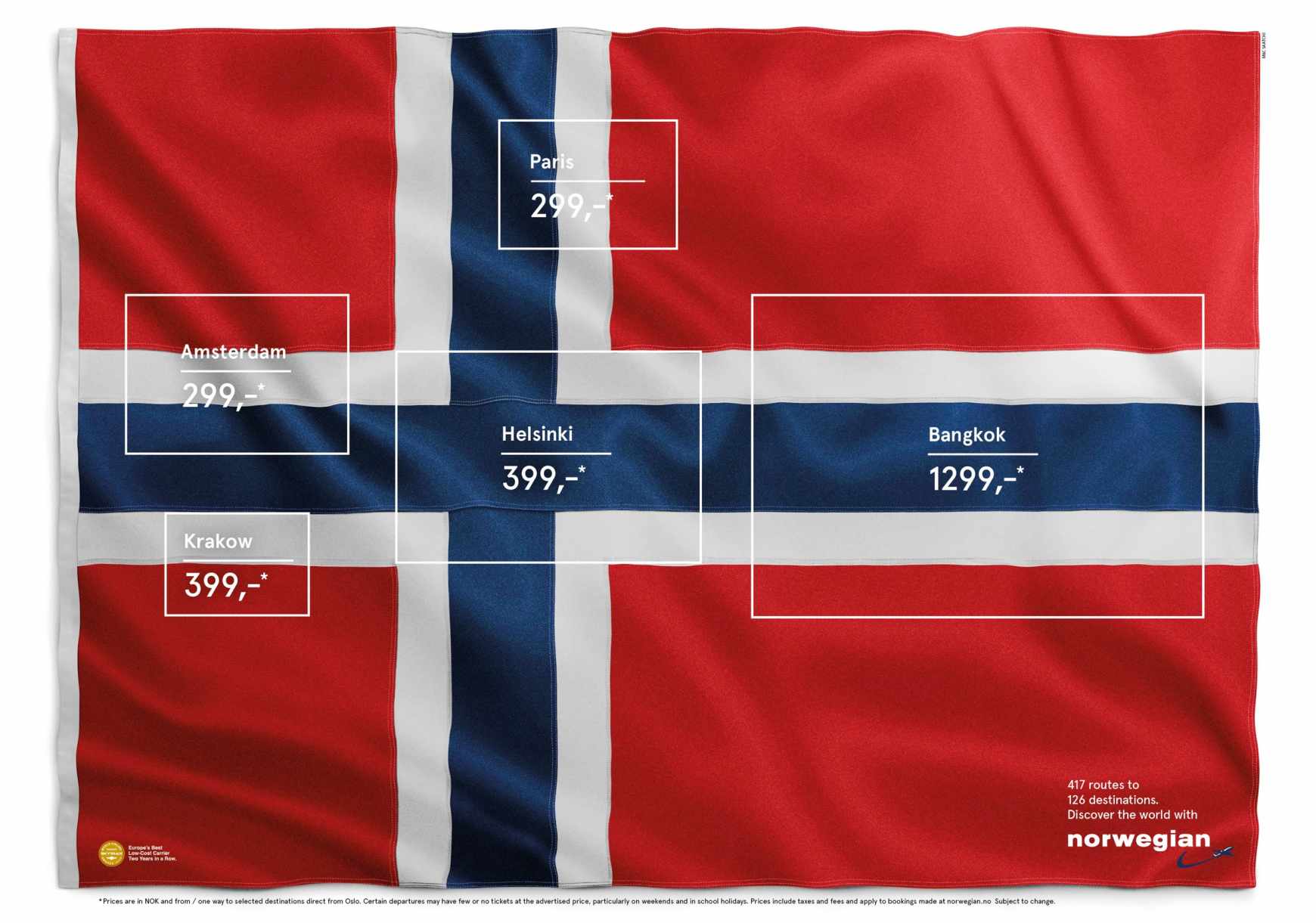
Clever Norwegian Airline ad

This is very nifty, especially if you are vexillologically inclined. A simple print ad, with prices and destinations highlighted as part of the airline’s national flag:the_flag_of_flags_aotw

Simple and effective, although comparing prices to distance traveled is (as ever with airlines’ fare structures, it seems to me) less straightforward.

The power of online petitions

Ugh. I’m not getting back into the poisoned chalice that is the Ched Evans saga, but when I read this opinion piece in the Spectator, I couldn’t help but share. But this sharing (and in fact the column itself) is less about the specifics of the Ched Evans case and more about the disproportionate amount of power wielded by people “signing” online petitions.

According to Melanie McDonagh:

The online petition is simply a 21st Century version of the lynch mob

and I’m inclined to agree. It’s so easy to type your name into a box on a webpage, with no recriminations and no responsibility.

Feeling morally superior? Time to sign an online petition.

You don’t even need to be informed. Just read what your friend thinks on Facebook, click a link and your voice is added to the other 0.04% of the UK population who have done the same. Would these people be as vociferous if they actually had to do something in order to make their point? Of course not.
Traditionally, such a tiny minority would (rightfully) hold absolutely no sway on the status quo. If a political party polled 30,000 votes in a general election, it wouldn’t even come close to getting one of the 650 seats available in the UK Parliament.

And yet, an online petition with just 150,000 “signatures” was enough to make Sheffield United reconsider their options. And one fifth that number now seem to be telling Oldham Athletic what they can and can’t do and who they should and shouldn’t employ.

The fact that under his parole conditions, Evans is not allowed to seek employment overseas means that in pandering to the tiny numbers of people in these online lynch mobs, together with the effect they have on the media, the club sponsors and the “famous” fans, clubs are essentially prevented from allowing Evans from earning any kind of living. That shouldn’t be allowed to happen.

…the notion that the online mob can exercise a veto over the employment prospects of someone who has served his sentence and is entitled as a principle of justice to re-enter society – now that’s morally repulsive.

I’m not saying that just because only a few people have any given opinion, that they shouldn’t be allowed to state their case. That’s their right and they are entitled to their opinion. The problem comes when their minority point of view is immediately assumed to be the correct and rightful standpoint simply because of their loud and threatening behaviour.
The UK is nearing a tipping point regarding the reaction to online activities such as petitions and alleged “offensive” behaviour. We’re giving too much credibility to the views of online slacktivists.
In addition, the social media explosion of recent years has left the lawmakers flat-footed and now it seems that they’re coming up with unnecessarily draconian measures just to be seen to be doing something, lest the lynch mob turn on them for their perceived inactivity.

It’ll all end in tears. Not the Ched Evans thing – that’s already enough of a mess. No, the weight we are giving to tiny online petitions and their lynch mob tendencies.
We’re on a very slippery slope and it’s getting steeper by the day.

UPDATE: A tweet:


Yep.

And while we’re making examples of alleged role models, what future now for WBA and England striker Saido Berahino as he is charged with drink driving?

Rite of Passage note

Just a quick note to record this moment for posterity. My boy and I have just played his (and therefore our) first game of EA’s FIFA15.

While we’re certainly not a family of gamers, this is an important moment for him, and obviously for me too. It’s basically 20 years *weep* since I played my first FIFA game.

He chose to play as Sheffield United (proud dad moment, right there) and I was randomly assigned Luton Town by the Sony machinery.
For the record, the score at 90 minutes was 1-1, thanks in part to a late defensive error by the Luton centre back and the lightning quick reactions of a pixelated Marc McNulty.
The penalty shootout which followed was a tense affair, with the Blades amazingly triumphing 1-0.

Happy days. Everyone’s a winner.
Except Luton.