Sharks gonna shark

Increased shark activity is expected through spring into summer say the City of Cape Town. The primary reasoning behind this increased shark activity is that sharks are more active during these periods of the year.

I know. I was also amazed.

Sharks are generally pretty good neighbours. Since I have lived here, there have only been three or four fatal attacks in and around Cape Town, and notably, every single one of them has been in the sea: an area which – as a human – is actually wholly avoidable if you should so choose. Although the sample size is tiny, I have extrapolated LCHF-style and worked out that you can probably evade a fatal shark attack by not going in the sea – no matter what sort of stunts the sharks might try to pull.

104622601_-xlarge_trans++SF3OlhOp98XhhoAH2-66KtnceQF6mUdUpwUq3NtgRDo

But if you are determined to go into the water, then the City has helpfully published seventeen ‘general shark safety tips’ to reduce your risk of being eaten. These include (but are not limited to):

“not swimming if you are bleeding”,
“not swimming, surfing or surf-skiing if there has been a whale stranding nearby” and
“paying attention to any shark signage on beaches”

That last one makes good sense, but one can’t help but wonder that, given the alleged intelligence of the Great White, they might not use it to their advantage. I’d therefore be immediately suspicious of paying any attention to any shark signage reading:

“Come on in. The water is lovely. And absolutely no sharks have been sighted here. Ever. Seriously. Go on – have a swim!” or
“Please ensure that you bathe thoroughly in Braai Sous before entering the water. Nothing too spicy. Thanks.”

or similar. That looks iffy.

If you want to read more on sharks, shark-spotting, shark safety and shtuff like that, have a look at the City’s press release or visit the sharkspotters website.

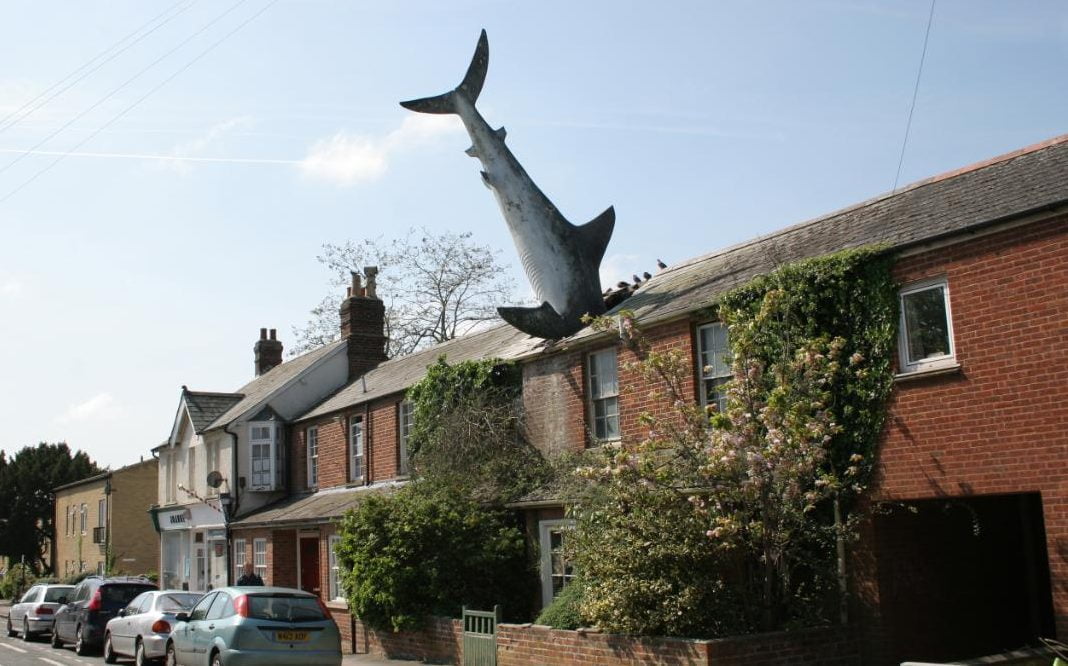
Above, the infamous Headington Shark.

I got 90% problems…

…and the SABC is behind all of them.

SABC COO, Zuma stooge and media clown Hlaudi Motsoeneng recently decreed that all SABC radio stations would now have to abide by a new local music quota. This populist move brought SA into line with other international broadcasting behemoths like Canada, Mexico, the Philippines and Jamaica. The only difference is that those national broadcasters chose what many considered to be reasonable quotas – maybe between 30% and 60%. But Hlaudi almost went full North Korea, insisting that 90% of the music played on SABC radio stations would have to be locally produced.

Don’t get me wrong. I do understand the reasoning behind a) The local content rule and b) The ridiculously high percentage Hlaudi chose. (It’s ‘trying to assist the local music business’ and ‘because he’s a desperate, populist goon who hasn’t got a sodding clue what he’s doing, save for serving his allegedly (but almost certainly) corrupt boss like the pathetically weak, pointless, trivial, obsequious lickspittle that he is’, for those of you at the back who are struggling to keep up.)
There’s even a pisspoor song with a cringeworthy video thanking the SABC and all-round professional brown-noser Motsoeneng for the wonderful new quota:

Sweet baby cheeses.

The choice of radio station in the laboratory is 5fm – a national popular music station run by the SABC. It’s generally middle of the road stuff, fairly meh, but equally fairly inoffensive. There’s no Afrikaans, not too much talk, and it’s neither Death Metal, nor RnB-orientated. It’s not full of god-botherers. It’s a decent compromise. Or rather, it was.

Previously, 5fm used to play a mix of local and international music. It wasn’t something I’d particularly concentrated on back then, because it just worked. I’m recalling that it probably looked (sounded?) something like this:

  • Best of Local Music
    Best of International Music

But then, in May, in came Hlaudi’s ridiculous 90% rule, and now the playlist is formulated more like this:

  • Best of Local Music
    Rest of Local Music

If Hlaudi wanted to introduce us to more local stuff, then well done, he did. If he wanted to increase sales, that’s failed badly. I’m now more convinced than ever that a lot of local music is actually dreadful. And in order to make sure that the best stuff is played, it’s played in every show. Now, don’t get me wrong, I know that there was always a pool of songs which was played in every show, but this pool now seems to be smaller, and the extra space is filled up with local crap.

I do get that musical taste is subjective, but the reaction to this 90% change has been generally negative, and it’s widely expected that listenership figures will drop. Anywhere else, this would be an issue, but that’s not how Hlaudi works – he just gets more money from government, who get more money from taxpayers. Insult to injury, anyone?

And yes, we could look (listen?) elsewhere, but there’s nothing that works quite as well as the old 5fm did, otherwise we’d have been listening there instead. There was a niche that it occupied, which was why we went there. It’s gone.

I wonder what the DJs think about this. Obviously, those who have commented on it have commented positively. Given the way Hlaudi operates, you can understand why you might not want to publicly express dissent at any part of his Glorious Masterplan.

I’m not employed by Hlaudi’s organisation though, so I can tell you that it’s shit.

Tit

There’s a hint of spring in the air. That’s good, because spring is nice and warm and a forerunner of summer (yes, that happens here too). It’s not so great because we still need quite a lot of winter rain to fill up our dams.

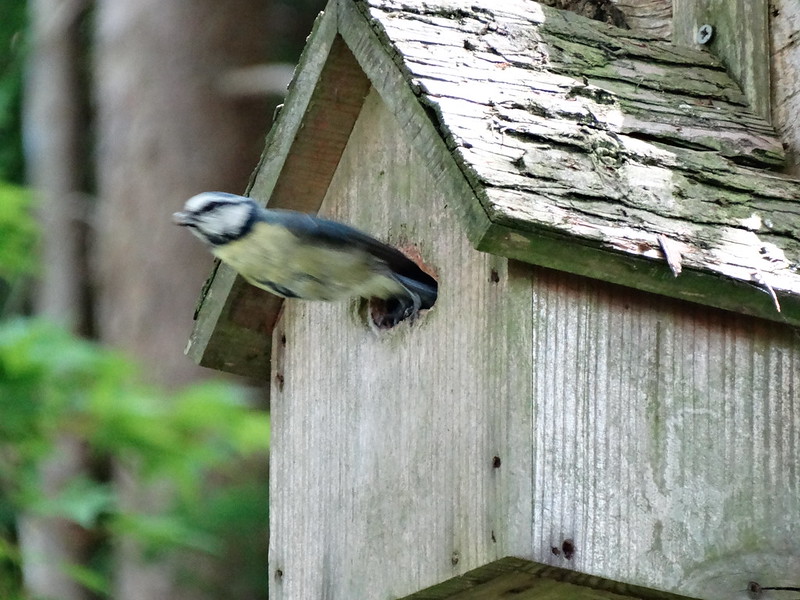
Here’s spring-like quota photo of a Eurasian Blue Tit (Cyanistes caeruleus) exiting a nesting box last spring in Sheffield:

I’ll admit that I couldn’t remember the scientific name for this little guy, so I had to look it up. On the page was this:

Fullscreen capture 2016-08-26 022854 PM.bmp

Yeah. Bit generic, that second one.

Interestingly, the Common chaffinch (Fringilla coelebs) continues to be a problematic invasive species but only in certain parts of the Southern Suburbs:

The chaffinch was introduced from Britain into several of its overseas territories in the 19th century. In South Africa a very small breeding colony in the suburbs of Constantia, Hout Bay and Camps Bay in Cape Town is the only remnant of such an introduction.

I was shocked when I saw one in Bergvliet last year. Seeing a chaffinch was shocking, but worse was the sudden realisation that I was in Bergvliet.

Let’s make electricity

Shall we? Well, we need to.

We’re short of electricity. We have been for a long while. Things have been better recently, but that’s mainly due to the economic downturn rather than any huge increase in generating power.

So, we need more electricity so that when things pick up again (lol!), we are ready to go and there are no further instances of “rolling blackouts” or “loadshedding”.

Much has been made of the SA Government’s insistence of going down the nuclear route. Currently, we have just one nuclear power station, just up the road at Koeberg. The alleged R1 trillion deal with Russia would add several more, and also the opportunity (so the cynics say, at least) for massive kickbacks, corruption and general naughtiness.

The cynics may well be right. But their fears are not what this post is about.

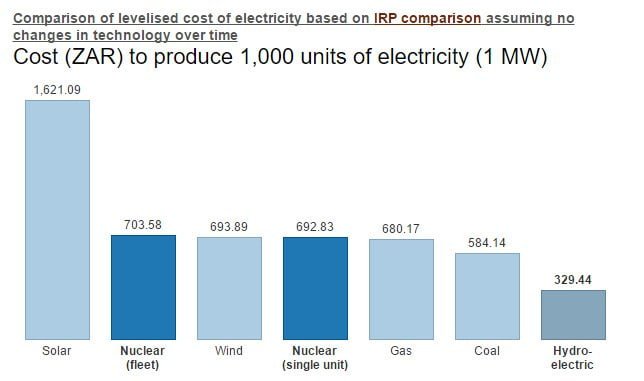
Brian Molefe, group chief executive of Eskom, allegedly recently stated that nuclear was “the cheapest option” and a local fact checking website went after him on that claim. They found, perhaps unsurprisingly, that his alleged claim was incorrect. But his inaccuracy is not what this post is about.

Here’s a screenshot of a graph that Africa Check’s data generated (geddit?):

Fullscreen capture 2016-08-25 120214 PM.bmp

And you can see that Brian was incorrect. Naughty Brian. Well done, Africa Check.

Thankfully, one thing everyone can agree is correct is that South Africa needs to generate more electricity. Oh, and that we really can’t afford to pay any more for it. So, what exactly are our options?

There’s hydroelectric. Clean, renewable, easy, cheap. It would be lovely to run our country with electricity from mountain streams and melting snow. But we don’t have mountains streams and melting snow. In fact, we have a few issues with the amount of water we have available for anything full stop. Put simply, there just isn’t enough water to make HEP a viable option.

There’s coal. Coal is cheap, we have lots of coal and we have lots of big coal-fired power stations. But coal is filthy. It makes shedloads of greenhouse gases and a billion other pollutants that no-one wants. Greenpeace says no to coal, and it’s just about the only thing I agree with them on. Going forward, coal should not be on the table (or in the furnace) for generating electricity.

Next up is gas. It’s there with wind and nuclear as a level levelised cost. Now, I happen to know that just under the Karoo is (conservatively estimating) about 450 000 000 000 000 cubic feet of shale gas. And I’d tap that gas. We could drop coal, drop our carbon emissions and make lovely, relatively clean, relatively cheap electricity. Except the green people aren’t happy with the plan to extract the shale gas. We’ve covered this… er… “extensively” on 6000 miles… I don’t think I need to go into again. Shale gas would be brilliant for SA. But the bunnyhuggers are determined that it won’t happen.

There’s nuclear – right there. Reasonably cheap, very clean, super reliable. Look at Koeberg – running without any big problems since 1984. There may be issues about corruption, but whatever methods we choose, this is electricity generating infrastructure on a massive scale. Sadly, there will always be those opportunities.

Still, wind looks like an option. Until you do the sums, that is. Remember that the nuclear option is for 9.6GW of electricity generation. Now look at this:

At 3MW per massive 145 metre (90m hub + 55m blade) turbine, you’d need 3,200 turbines! And that’s assuming 100% efficiency. Wind farms don’t do 100% efficiency. Wind farms only do about 30% efficiency (and I’m being nice here). So basically 10,000 turbines to guarantee that 9.6GW figure. If you’ve seen the blot on the landscape that is the Dassiesklip Wind Farm near Caledon, you’ll see how much of an eyesore just 9 (nine) turbines can be. And how much space they take up.
Dream on.

Look at the left hand side of that bar chart. Realistically, you’d probably have to rule out solar on the grounds of price. Oh, and also, the ridiculous scale required:

To achieve the 9.6GW capacity planned for this nuclear thing, we’d need something about 33 times the size of the current largest solar park in the world. That would cover 32,043 hectares and would cost about $33 billion.

So, no. Nuclear might not be the cheapest option for generating electricity in South Africa. And Brian Molefe shouldn’t be saying that it is. But until someone comes up with any other viable option – and I really don’t see anything reasonable on the table or anywhere close – it might well be the best option for electricity generation in South Africa.

Whether you like it or not.