From Space

Here’s an image of South Africa from space, via NASA’s Modis/Terra satellite. Modis is Moderate Resolution Imaging Spectroradiometer (I know – it doesn’t quite work, does it?)

With its sweeping 2,330-km-wide viewing swath, MODIS sees every point on our world every 1-2 days in 36 discrete spectral bands. Consequently, MODIS tracks a wider array of the earth’s vital signs than any other Terra sensor. For instance, the sensor measures the percent of the planet’s surface that is covered by clouds almost every day.

That’s conveniently just about the width of South Africa, allowing this sort of shot:

rsz_dsc_0954

Click through for hugeness and detail.

You can see that we were having a wonderful day in Cape Town (although I spent it in a lab, in a car and at Tygerberg Hospital, rather than chilling at a bar by the beach).

I’m hoping to be able to get a repeat image to compare when the cold front comes through on Thursday evening (it’ll be dark, I know) and through Friday morning.

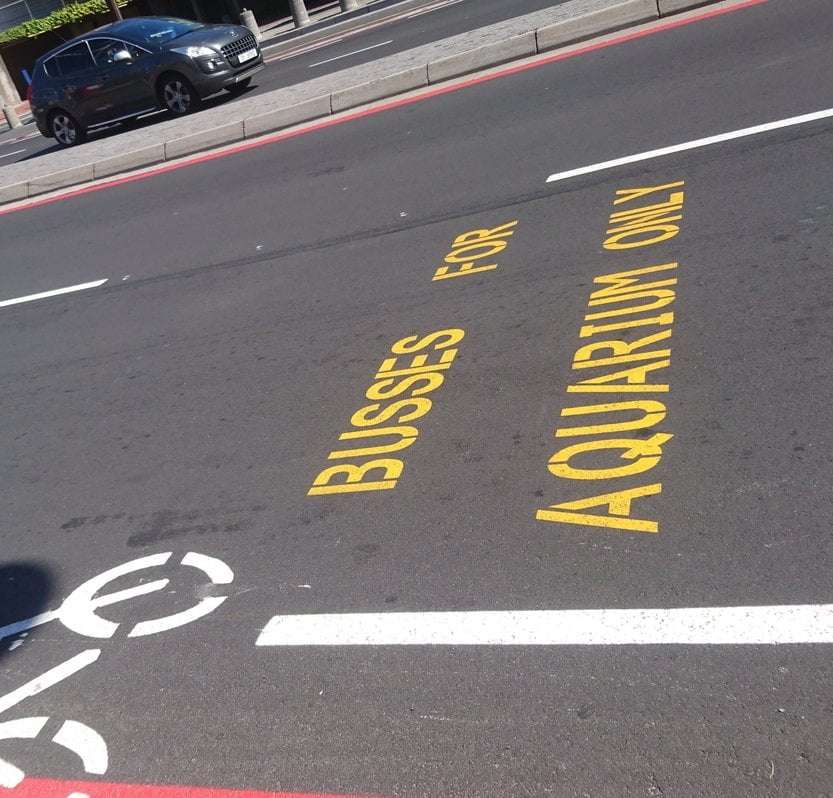
Bussessessses

Meanwhile, at the Waterfront, the left lane on Dock Road is reserved for specific vehicles:

rsz_dsc_0954
The only problem being that the accepted plural of the word ‘bus’ is ‘buses’. That’s not to say that the erstwhile road painters are entirely incorrect though, merely that they are wildly out of date:

In 21st-century English, buses is the preferred plural of the noun bus. Busses appears occasionally, and dictionaries list it as a secondary spelling, but it’s been out of favour for over a century. This is true in all main varieties of English.

As I mentioned yesterday, visiting Ye Olde Aquarium was on our list over the weekend, before catching the last stagecoach home.

The bird table incident

The weekend started well. I had a bit of stuff to do in the lab on Saturday morning, so I went and did it and then dragged the beagle for a moderate 5km around the neighbourhood. By that time, Mrs 6000 had come home from the important shopping she had been doing, announced that she felt like death (to be honest, she didn’t look like Death – no hooded cloak, no scythe) and went to bed.

We haven’t seen her since.

Still, while the cat is horrendously viral upstairs, the mice will do their own thing, and yesterday’s own thing was climbing trees on the school field and having very good ribs, very good burgers and very average chili poppers from Eat Out The Box. Today, with little or no improvement in the condition of the Matriarch, we hit the Waterfront for Cave Golf (more on that sometime soon), a quick Aquarium visit, and then Woodies burgers and Sushi Hut sushi.

Later, there was beagle bathing and some back garden tennis, which culminated with me smashing my head into a bird table fabricated from a 7kg chunk of pottery slung at an awkward height from a tree in the back garden. Awkward in that it was slung pretty much at exactly my head height. The obvious disadvantage to this set up was evident this afternoon as I saw stars, planets, comets and myriad other heavenly bodies as I fell to the floor wondering who exactly I was, and cursing the idiot who put it in such a stupidly dangerous position.
The obvious advantage was that it was a really convenient height when I put it up several years ago.

And now, another evening alone, contemplating a week ahead full of deadlines (it’s coming, Sam) and with just the beagle and a brandy for company.

And a headache, the likes of which I haven’t known since I can’t remember when.


In fact, I can’t remember much right now.

That’s not how you get cholera

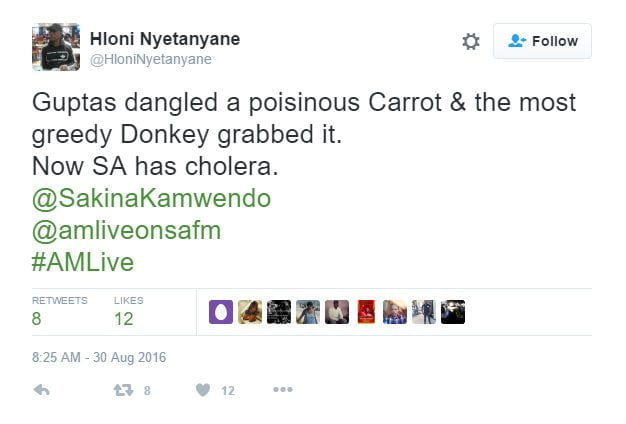
Look, as a description of the current state (and oh, what a state) of affairs in SA right now, this tweet is pretty accurate.

Fullscreen capture 2016-09-05 104312 AM.bmpHowever, as a description of how you get cholera, it’s wildly inaccurate. That is, unless the carrot in question has been washed in cholera-infested water.
And I wouldn’t put anything past the Gupta family, to be honest.

Cholera is an infectious disease that causes severe watery diarrhoea. It’s spread via the faecal-oral route. That means that the bacterium in question – called Vibrio cholerae – er… “exits” the body of a cholera sufferer and somehow ends up being ingested by another individual. This is often via it getting into the drinking water system through poor hygiene and inadequate water treatment though.
You don’t get it from eating carrots (with the caveat above firmly in place, that is).

And anyway, even if you did cholera from eating carrots, there’s no evidence that donkeys can get cholera. In fact, in their 1996 book “Cholera and the Ecology of Vibrio cholerae“, Drasar and Forrest cite a 1974 study by Sanyal et al. in which 195 animals (including donkeys), living in a cholera endemic area in India were routinely tested for the bacterium over a period of a year. Pathogenic V.cholerae was only isolated from 3 cows, 2 dogs and 2 chickens. (NB – no donkeys).

And then, even if the donkey did eat the carrot and you could get cholera from carrots, and even the donkey could get cholera, it’s a big stretch to suggest that the entire nation would then become infected with cholera, just because a donkey got it from a poisinous [sic] carrot. Just what was this donkey doing? How on earth would it successfully have infected 55 million people? That’s biological warfare on a massive scale. I’m not sure anyone could carry that out, let alone a lone donkey, who, lest we forget, is allegedly rather unwell.

So, no. As an accurate account of the source of a cholera infection and how it might be spread, this tweet is rubbish.
As a metaphor of what Jacob Zuma and his friends have done to South Africa though – pretty good.