Track A Shark

Thanks to the wonders of modern technology, plus a little bit of cash from those hard working sponsors, you’re now able to track basking sharks off the coast of the Isle of Man. They’ve tagged 4 sharks and they are following them around (electronically) because:

This scientific data is useful to government to enable them to make informed wildlife management decisions.

I’ve been following Mister Tailor for a few days now:

129183

He’s:

a 5.5m male, named for his unusually shaped tail fin that slopes gently backwards rather than standing tall like most caudal fin tips.

So there you go.

Basking sharks are huge, much bigger than your average Great White, but as plankton eaters, they are completely harmless to humans.
My personal hope is that Mister Tailor’s wanderings unwittingly draw a diagram of the circuitry and mathematics required to design and build a time machine. But I suppose that’s quite unlikely.

Elsewhere on the wildlifetracking.org site, you can follow birds, bees (ok, not bees) and other animals all around the world.
(Hint: The geese are especially cool.)

Sunset won’t get any earlier

We’re in the grips of midwinter here in Cape Town. It’s hell. Almost, anyway.

But the good news is that the shortening of the days is almost over and we are nearly able to look forward to SUMMER!
This week, the sun has been setting at 17:44, but despite the fact that the shortest day (our winter solstice this year is at 07:04 on Friday, 21 June) is actually still a couple of weeks away, the sunset won’t be getting any earlier now, 17:44 is the earliest it’s going to get this year.

The time of sunset in most major cities around the world used to be calculated by astronomers using complicated algorithms, but for Cape Town these days, a guy in a white coat just pops down to Green Point Promenade and counts the number of Instagrammers, before calling the results back in to HQ.

Because of the tilt of the earth on its axis, the sunrise does continue to get a little later until the end of the month, but by that time we’ve already gained another 4 minutes of light in the evening, so I think that we can basically say that summer is pretty much already here.

Some few facts for you:

Cape Town’s shortest day this year is 21st June, with 9h 53m 35s of daylight.
The longest day will be the 21st December, when the sun will rise at 05:32 and set at 19:57, giving us 14h 25m 03s of daylight. If you really think that you can do a lot more with those 4½ hours of light, you might want to consider using artificial light sources to lengthen the useful time each day during winter.

However, the latest sunset next summer will be on the 3rd January 2014, at 20:01. On this day, the sun will be “just” 147,098,000 km from Cape Town, compared with 152,094,000 km on 5th July 2013.

That’s a difference of about 5 million km. Wow. No wonder it gets warmer.

Data from here.

An Absolute Pearl!

Oh shucks, this is wonderful.

Many thanks to The Guru for alerting me to this one. And those thanks may seem strange given that “this one” is actually the:

DRAFT REVISED POLICY FOR THE ALLOCATION AND MANAGEMENT OF FISHING RIGHTS IN THE OYSTER FISHERY: 2013

which isn’t something you’d want to thank anyone for sticking in your inbox, right?

But that would all change once you got to Section 4.1 (c) on page six, under the heading “Objectives”.
And that change would be brought about by reading these words:

Co-manage oyster fishery with other spheres of government and the fishing industry in a manner that recognizes government priorities, strategic objectives of the spheres of government, the interests of fishing industry and most importantly in a manner that would please, praise and glorify the one who provided and gave man the power to rule over the fish (including oysters)

I’m sorry, what was the “most importantly” bit again?

I know you won’t believe me, so in an effort to convince you that this is genuine, here’s the passage in question:

oysterand for those continuing skeptics, here’s a link to the original document (and I’ve popped it here too , just in case it disappears from the DAFF website).

Looking at the objectives around (c), it’s easy to understand where the DAFF are wanting to take this. (a) is important, if still politically charged, (b) is an absolute no brainer and (d) is just pure common sense: symbiosis twixt oyster and man, albeit with a slight leaning towards the latter when it comes to overall benefits involving Tabasco sauce and lemon juice.

Indeed, even (c) begins with the best of intentions. In a democratic society, one cannot simply ignore the policies, aims and responsibilities of the leadership which was voted in. But then, even pleasing, praising and glorifying JZ et al pales into insignificance when compared with “the one who provided and gave man the power to rule over the fish (including oysters)”.

Note that the bracketed phrase is important, because this is a government document and must be accurate at all times – oysters are not fish, they are saltwater clams; marine bivalve molluscs of the species Crassostrea gigas (in the commercial sector, anyway).

Far be it from us to please, praise and glorify the one who provided and gave man the power to rule over the fish, because suggestions of that sort of behaviour would have absolutely no place in a draft policy document about allocation and management right within the oyster fishery.

And what fools we would appear then, hey?

This being a draft document, it seems likely that the “most important” part of Section 4.1(c) will probably not make the cut and get through to the final policy document. And that’s not just sad, it’s potentially dangerous too, for what ‘the one’ giveth, he can taketh away just as easily. Which would surely leave all the power with the fish (including oysters).

That being the case, I’d like to be the first to say that I, for one, welcome our piscine overlords.

UPDATE: Jacques points out that there is a serious side to this too.

GeoGuessr will ruin your day (but in a nice way)

It wasn’t so long ago that we told you about Pointless Pointing. And yes, that kept us amused for a short while, but it was ultimately pointless, as the name suggested, and we here at 6000 Towers wanted a bit more of a challenge.

Step forward GeoGuessr.

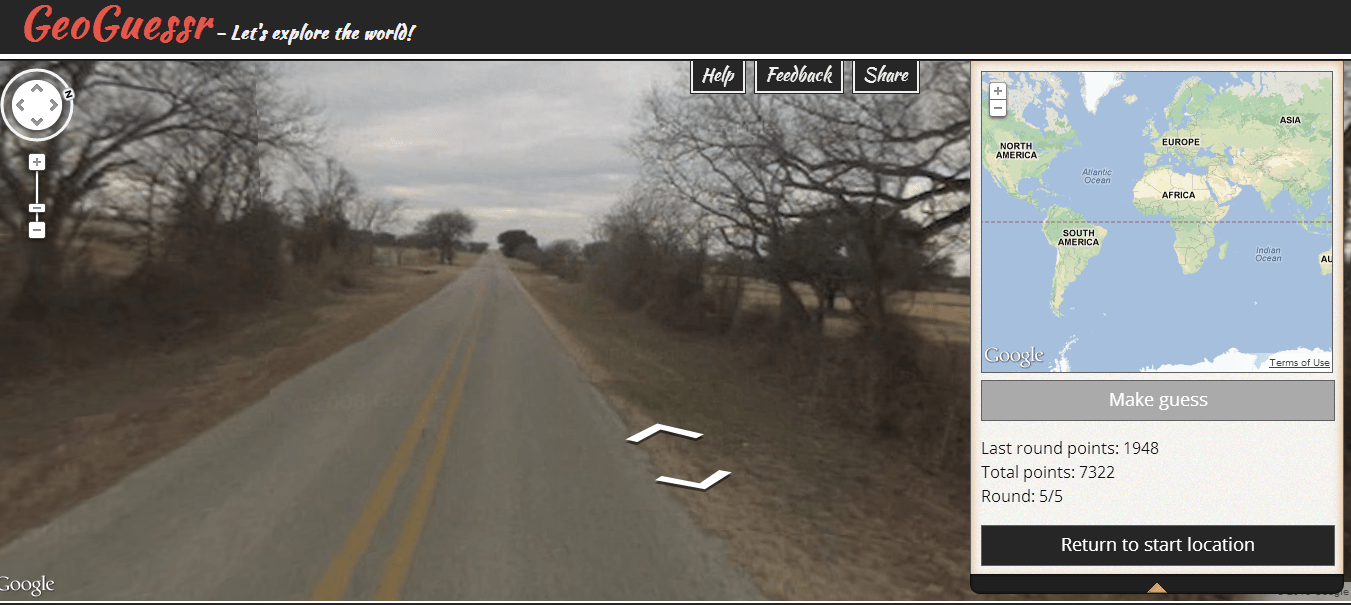
Armed only with a random Google Streetview shot (and some are far more useful than others), you are tasked with choosing where on the planet the image is from and you score points based on how close your guess is.
On occasion, you might get lucky by spotting a flag or a roadsign; others you may have to work out using clues from architecture, vegetation or road markings.

ggs

I guessed at Oklahoma for this one, but it was “just down the road” in Texas. Good effort though.

So far, I’ve been as far afield as Alaska, Hawaii, Australia, Brazil and Finland (in just 2 tries) and my current best score is 11,318 – now 14,781.

So go and have a Geoguess: because you probably had no plans for the rest of the day anyway.

EDIT: This:

from xkcd hits the mark perfectly.

Global Flight Paths

This is rather pretty.

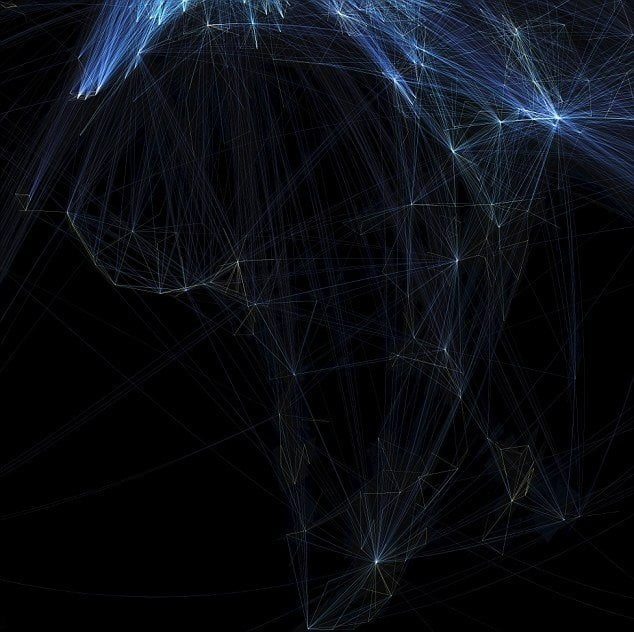
africaflight

via The BBC:

Michael Markieta, a transportation planner at global engineering and design firm Arup, has spent the past year developing visualisations of flight paths crossing the globe.
There are currently more than 58,000 flight paths criss-crossing the globe, but each individual airport services only a limited number of others.

The information is interesting, but the real beauty comes in the actual maps. It’s worth noting that there are no land masses or countries marked on the maps (more of them via the link above) – the flight paths trace the outline of the continents.

Just a reminder that you can track flights live – a mesmerising experience – via the link here.