Time on Shale Gas

Another sensible article on shale gas, its value in the energy demands of the modern world and the environmental dangers of its extraction? Surely not.

But yes, it is.
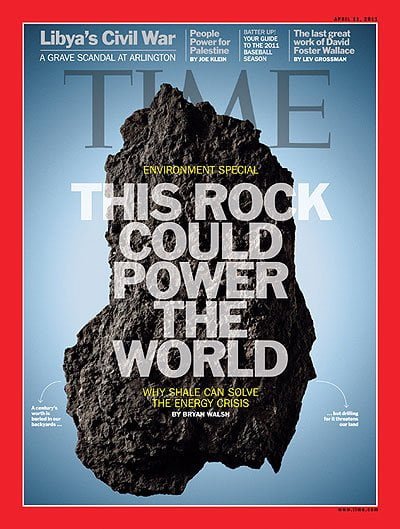
Bryan Walsh gives us a few thousand words on the natural gas boom (poor choice of word, I guess), the need for alternative energy sources, the benefits and the difficulties that it has brought to the communities where drilling is taking place and the the awkward balancing act between powering and protecting our lifestyles.

Along with the Scientific American article I pointed to here, this has to rate as one of the most balanced pieces of reporting I have read on this often hyped and unnecessarily emotive subject.
Walsh takes in both sides and, importantly, doesn’t conclude by coming down on either. After all, that’s not for a journalist to do: that’s the politicians’ decision based on the evidence set down before them.

And, once again, I must stress that I am not fighting for the oil companies here – merely for people to have all the information laid out objectively in front of them before they choose sides in this debate.

“The gas is out there, and it can be accessed,” says Dean Oskvig, president and CEO of Black & Veatch’s energy business. “But we do need to solve the environmental issues surrounding that extraction.”

If that can be done right, shale gas really could change the way we use energy for the better. But even if it does, the industry will still fundamentally remake parts of the U.S., and of the world, in ways we won’t always like. But that’s the price of extreme energy, and it’s one we’ll continue to pay until we can curb our hunger for fossil fuels or find a cheap, reliable and clean alternative to them.

Opponents of fracking will pay heed to the 1,218 violations issued the Pennsylvanian Department of Environment “for offences ranging from littering to spills on oil sites” last year, but what this article emphasised to me was that fracking is as safe as any other industrial process if it is done properly. The vast majority of issues around pollution stem not from wells exploding or aquifers being polluted (a “huge concern” for the Karoo groups, but as Walsh mentions, there are actually no proven instances of the latter), but from the mismanagement of waste water. That such a simple part of such a complex process can be the cause of so many problems is inexcusable, but it should also be easy to remedy.

Walsh also compares the localised pollution from fracking with the more generalised pollution of coal-powered electricity generation: a methodology which is especially relevant while the problems at Japan’s Fukushima-Daiichi nuclear plant continue.

The economic benefits are also taken into account – from both sides. Obviously, while there is profit for the comapnies doing the drilling (otherwise they wouldn’t be doing it, durr) there have been both positive and negative economic effects on local communities:

“I think it’s been a good thing overall,” says John Sullivan, a commissioner for Bradford County. “But I just wish we could keep the economic benefit and minimize everything else.”

As Walsh says: “Good luck with that”.

Sullivan’s pipe dream is an ironic parallel to those who feel that we can produce enough energy through renewable sources such as wind and solar to bypass the need for fracking – either here in SA or anywhere else in the world. Yes, of course, I agree that that would be the ideal solution, but it really isn’t possible given the demands of our society. And yes, of course, I agree that it would be ideal if we could radically alter those demands, but as Eskom’s call for saving electricity back in 2008 proves, you’re smoking your socks (an environmentally damaging activity, incidentally) if you think that’s going to happen, as well.

Anyway – despite Time’s horrible habits of linking to other articles in big red letters every two lines, putting adverts everywhere and breaking it up into five pages – this is an informative article which weighs up both sides of the fracking debate and is well worth a read, either as a first introduction to the subject or for those seeking more facts and figures and further questions posed by our need for alternative energy sources.
Don’t say I’m not green!

There are those who come onto this blog and accuse me of hating the environment. Maybe it’s because they have misread, not read or simply misunderstood my viewpoints on whales, dolphins and natural gas extraction.

It’s not the case. I do care deeply for the environment and I do all that I (reasonably) can to protect and cherish it, including worm farming, recycling and saving electricity wherever I can. And I’m also going out of my way to champion Fairview Cheese & Wine Farm’s latest green initiative: The Goat Rapid Transit system or GRT.

With the rising price of petrol and wine farms becoming increasingly focused on reducing their carbon footprint, this initiative presents numerous benefits to wine loving visitors and the environment alike. It aims to offer a safe and sustainable alternative for visitors travelling to the farm. Fairview currently attracts close to 250 000 visitors to its Paarl cellar door each year, most of which travel to the farm by car or bus. From today visitors and staff can take a train from Cape Town to Paarl station, from where the GRT will operate at regular intervals.

Twenty-four custom-made wagons have been built by artisans from the Paarl region. “I am delighted to be involved in the revival of the art of wagon making in the area,” says Fairview owner Charles Back, “given the legacy of the art form in the region, previously known as Wamakersvallei (Wagonmakers Valley). Not only will this re-establish this historic industry, but it is also an opportunity for Fairview to utilize the unproductive goats in their 700-strong goat herd. “We will be making use of the billies and the does with smaller udders, as these are normally stronger than their high milk producing counterparts” added Back.

Ongoing training has been conducted by farm manager Donald Mouton over the past couple of months. This has ensured that the goats are fit enough to pull the wagons and have become accustomed to the traffic on the road.

Fine work by Fairview and especially by Donald, I’m sure you’ll agree.

I can only hope that they extend this service across the Paarl region – perhaps encouraging the Cape Town Lion Park and Stellenbosch’s Giraffe House to join them – a move which will not only allow visitors to reduce their carbon footprint on the wine tour, but will surely also reduce the incidence of drink-driving in the area. And, in the case of the lions, probably resuce the incidence of tourists as well.
Meanwhile, you can enjoy the animals, the amazing scenery and the wine.

Fracking follow-up

Arguing over whether people actually read stuff before commenting on it (they don’t) is so last week, and thus it’s time to add a couple more thoughts from my fracking post, which was ever so trendy (like Lewis Pugh was last week).

Firstly, there were a couple (literally two) objections to my use of the term “bunnyhugger” to describe those of a green persuasion. Now, I rebuffed these objections by questioning exactly what could be insulting about saying someone cuddles rabbits. But apparently, it’s a derogatory term. Aside from the fact that perhaps I wished to be derogatory, I would point out that “bunnyhugger” is merely a derivative of “treehugger”, which is a common term by which environmentalists refer to each other. See environmental website treehugger.com, for example.

Putting this neatly in perspective: I have called people worse.

Secondly, I found another good (fairly well balanced) article about natural gas and fracking. Since these sort of articles seem to be few and far between, I thought I would share it. It’s from MIT and weighs up the needs, the pros and the cons of natural gas and shale gas extraction.
Give it a read – at least until you get to the first bit where it says natural gas is good, then you can stop and throw rocks at me.

Thirdly, we may all be saved from fossil fuels forever anyway, thanks to the all new, all singing, all dancing (disclaimer: it neither sings, nor dances) artificial photosynthetic leaf:

The artificial leaf uses nickel and cobalt as catalysts to split water molecules into hydrogen and oxygen by facilitating oxygen-oxygen bonding.
Oxygen and hydrogen molecules are then sent to a fuel cell that can produce electricity. If the device is placed in a one-gallon bucket of water in bright sunlight, it can reportedly produce enough electricity to power a house in a developing nation.

The one immediate flaw I can see in their plan is that many people in developing countries don’t have buckets.

Oh, or water.

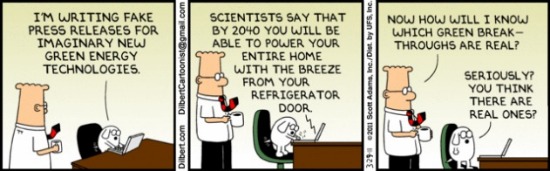
Finally, a word of caution from Dilbert on green technologies:

Dilbert on clean energy innovation | Grist

And did you know it’s illegal to have wind turbine in your back garden in Cape Town?
It must be true, because I heard it on Cape Talk last night.

Jo Flo

Incoming from my Dad:

Did you know?

Former Blade Jostein Flo is one of very few players to have a move or specific tactic named after him. In Norwegian, it is called “Flopasning” – translated into English as “The Flo Pass”. It gained prominence during a period of the early 1990s when the Scandinavians were ranked as the world’s second best team and utilised a very basic ploy of full-back, usually on the left, sending up a long diagnonal ball up to the totemic Flo.
Though a striker, he would raid down the right using his height to his advantage by heading the ball on for a central midfielder or striker who knew their job was to dart through and test the opposing keeper. Something of a long ball tactic eschewed by purists, it proved highly effective for a prolonged period as defences struggled to formulate a plan and is still used by many Norwegian clubs.

I did, actually.

This was taken from Darren Phillips’ The Sheffield United Miscellany and holds particular relevance for me since I apparently, allegedly resembled the lanky Norway striker (and notably not his more famous younger Chelsea-playing brother Tore André) in those early 1990s. It all came about when a friend in Halls at Newcastle University looked at the poster of my beloved Blades on my wall and asked why I was on it.
Turns out that after a few drinks and in poor light, one tall blond bloke looks very much like another tall blond bloke.

I never really saw it myself – I was far more handsome.

But the nickname stuck and you’ll still see me in one of my Sheffield United shirts – or that of the 5-a-side team I play for here in Cape Town – with the name “Flo”  proudly across my back. Back then, it was very popular with fans at Bramall Lane as it was only three letters long and therefore cost less to have on your shirt. His squad number at the Blades was 12, but 21 has always been my lucky number, so I turned that around a bit.

I didn’t know this though:

Jostein Flo was a very good high-jumper during his youth and remains on his country’s list of all-time best practitioners of the ‘Fosbury Flop’ with a leap of 2m 6cm in 1987.

Use it, don’t use it…

Too close to home

Several emails and tweets asking why I am not blogging about the Luke Fairweather story.
It’s a reasonable question. Thanks for asking.

Occasionally  – just occasionally – there are topics which I would LOVE to blog about, but am unable to. These are generally specific and local issues which are linked somehow to what we in the blogging sector call “Real Life”.
One of the rules that I have laid down for myself and to which I still rigidly adhere is that my blogging must not negatively impinge on my “Real Life” or that of my family or friends (and relationships with those individuals).

The Luke Fairweather case is one of those times. Despite me having strong feelings on this story, Mr Fairweather and I shared a mutual friend (a regular reader, he claims) (and I have no reason to doubt him) and thus this one falls neatly into that “too close to home” category because my respect for my “Real Life” friends and their thoughts come ahead of airing my views on here.

There’s more on the Fairweather story from IOL here and a brilliantly concise, yet sensitive blog from Jacques Rousseau here.