Management speak

Corporate nonsense, isn’t it?

Keep it simple, stupid. Just say what you mean. It’s a meeting, you’re not “touching base”. You wrote someone an email, you didn’t “reach out” to them. You finished that report, you didn’t “close the loop”.

I’m instantly wary of people using management speak. They’re trying to hide something, whether it’s their innate stupidity, a lack of self-confidence, or some bad news. That’s why I was suspicious when I saw this update from the Cape Wheel at the V&A Waterfront:

u wot m8?

“Restructuring your ticket options”? Those options being an adult ticket or a child ticket. That looks very similar to what’s currently on offer. That’s not “restructuring”, that’s “applying a non-varying approach”.

What has changed then, as beagle-eyed readers will already have noticed, is the price. Here’s where we stand currently:

And “focussing in on the paramount datum”:

We learn then that basically, “restructuring our ticket options” actually means increasing the prices for a ride by an impressive 20%.

As an aside, inflation in South Africa is currently running at 6.4%.

So that’s a pretty hefty restructuring.

In the spirit of these linguistically disguised augmentations, I’ve just told Mrs 6000 that I’m going to be “restructuring my alcohol consumption options” over the summer holidays. The beverages of choice will remain wine, beer and brandy, so I guess that – like the Cape Wheel’s ticketing options – some other parameter variable (see comments below) of the alcohol consumption will have to change.

I wonder what that could be.

Level 3 Water Restrictions For Cape Town

Yep. “Just” 11 months after putting the Level 2 water restrictions in place, and with a disappointingly dry winter behind us, the City’s Mayco has approved the implementation of Level 3 restrictions from 1st November 2016. That’s because you and I haven’t saved enough water this year.
Victim-blaming hat on:

Cape Town residents as a whole did not achieve the consistent 10% reduction in water use that was mandated from 1 January 2016. If we continue to use water as we did on Level 2 restrictions over the coming summer months, the dams are at risk of falling to 15% by the end of the summer period. Following on, if we experience poor rainfall next rainy season, we could find our dams at approximately 50% this time next year.

The dam levels have slipped slightly again this week – their second successive weekly fall, and although it’s not by much, it’s still not by much the wrong way. Unless something dramatic happens, our “high” at the end of winter will have been a worrying 62.5%.

Chez 6000, we’ve already been washing with a bucket on the shower floor to collect the “spare” grey water, which then goes on the garden each morning. But apparently it’s simply not been enough.
“SO MANY BUCKETS THOUGH!!!!” he wailed.

In basic terms, what these means is that the more water you use, the more you will pay – at higher tariffs too, but if you can reduce your usage by 20%, you should pay no more than you are already paying (but for less water, obviously).
Oh – and there are some other really important additional new rules too:

 – Watering/irrigation (with drinking water from municipal supply) of gardens, lawns, flower beds and other plants, vegetable gardens, sports fields, parks and other open spaces is allowed only if using a bucket or watering container. No use of hosepipes or automatic sprinkler systems is allowed.

– Cars and boats may only be washed with water from buckets.

– Manual topping up of swimming pools is allowed only if pools are fitted with a pool cover. No automatic top-up systems are allowed.

– No portable play pools are permitted to be used.

What remains to be seen is whether any of this will be policed or whether the city will simply rely on those higher bills to deter excessive water usage. Since that approach evidently didn’t work on the Level 2 restrictions, I wonder if they will actually be doing something about people not obeying the rules this summer?

…please don’t take a picture

Channelling Michael Stipe:

It’s been a bad day…

…please don’t take a picture.

Student protests” which suddenly(?) seem to be much more than just student protests, a staff member involved in a nasty RTA (he’ll live), the political puppetry of Jacob Zuma and his apparently relentless agenda to ruin the entire country via the Punch & Judy Show which is the National Prosecuting Authority versus the Finance Minister, the fact that I was already feeling rather crap – physically and mentally – before all of this nonsense started.

And it’s not even midday yet.

I do like that REM song though. They need to update the video to HD.
Doing it over an actual news report in SA today would be a good idea.

But equally thoroughly depressing.

Artist stuck

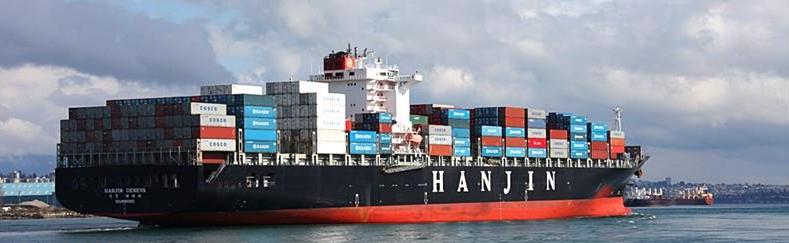
Oh dear. An artist “in residency” on board the German-registered, 278.82m long container vessel Hanjin Geneva is stuck “several hundred kilometres off the shores of Japan” (it’s actually about 50, according to Marine Traffic, but that doesn’t sound anywhere near as dramatic…) after the ship’s owners went bust.

HANJIN_GENEVA

Now, the 150-strong fleet of the Hanjin Shipping Company find themselves barred from entering ports worldwide after the company filed for bankruptcy. There’s the double edged sword of the company not being able to pay for berthing fees, together with the worry that the vessels may be seized by creditors.

And poor artist Rebecca Moss is caught in the middle of it all.

As her Canadian sponsors Access Gallery point out:

The immensity of this news, as devastating as it is for the hundreds of workers affected, emphasizes many of the residency’s core concerns, indicating both the precarity of globalized capitalism and our dependence upon systems that we neither see nor understand. It also underscores the considerable role that contemporary artists may play in bringing such situations to our attention in provocative and transformative ways.

Sure. We’d probably never have known about the bankruptcy (Hanjin owe $5, 400, 000,000) if it wasn’t for Rebecca. And all the articles on news sites around the world. Apparently, a press release saying that an artist is stuck on a boat is what passes for a “provocative and transformative way” of bringing the financial woes of a shipping behemoth to our attention.

Mind you, they did title the press release

The Precarity of Artmaking in a Globalized World

Ok then.

Those familiar with Rebecca’s performative and video-based practice will know that it draws on Henri Bergson’s theories of the comedic, wherein comedy is understood to arise in moments of friction between a mechanical system and the nature into which it is inserted.

Like her work High Tide (Sausage) – a 32 second video in which a balloon attached to a stick becomes detached from the stick and blows out of view.
Or Jelly – a 97 second video in which the artist walks down a road, pushing a jelly in a shopping trolley, with predictably catastrophic results (for the jelly).
And who could forget Power Ballad – a 101 second video featuring lumps of concrete rotating on a record turntable which is placed on various beaches in Essex while Elton Johns I’m Still Standing plays in the background.

Indeed, I can think of no-one better to inform us of the financial collapse of a shipping company with the loss of over 5,000 jobs worldwide (and the financial implications for their families) than a woman who once rolled up some clay on a Southend Pier.

If only there was some worthwhile function that these sort of people could perform.

Let’s make electricity

Shall we? Well, we need to.

We’re short of electricity. We have been for a long while. Things have been better recently, but that’s mainly due to the economic downturn rather than any huge increase in generating power.

So, we need more electricity so that when things pick up again (lol!), we are ready to go and there are no further instances of “rolling blackouts” or “loadshedding”.

Much has been made of the SA Government’s insistence of going down the nuclear route. Currently, we have just one nuclear power station, just up the road at Koeberg. The alleged R1 trillion deal with Russia would add several more, and also the opportunity (so the cynics say, at least) for massive kickbacks, corruption and general naughtiness.

The cynics may well be right. But their fears are not what this post is about.

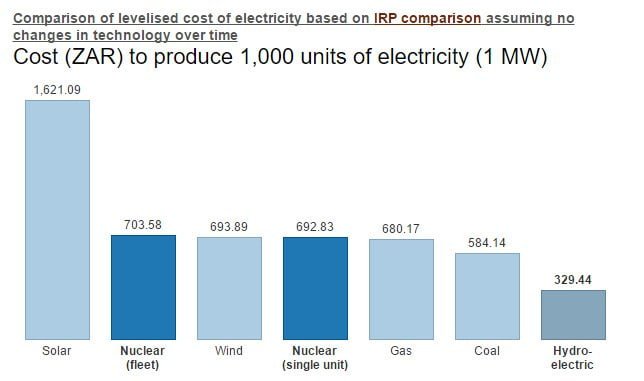
Brian Molefe, group chief executive of Eskom, allegedly recently stated that nuclear was “the cheapest option” and a local fact checking website went after him on that claim. They found, perhaps unsurprisingly, that his alleged claim was incorrect. But his inaccuracy is not what this post is about.

Here’s a screenshot of a graph that Africa Check’s data generated (geddit?):

Fullscreen capture 2016-08-25 120214 PM.bmp

And you can see that Brian was incorrect. Naughty Brian. Well done, Africa Check.

Thankfully, one thing everyone can agree is correct is that South Africa needs to generate more electricity. Oh, and that we really can’t afford to pay any more for it. So, what exactly are our options?

There’s hydroelectric. Clean, renewable, easy, cheap. It would be lovely to run our country with electricity from mountain streams and melting snow. But we don’t have mountains streams and melting snow. In fact, we have a few issues with the amount of water we have available for anything full stop. Put simply, there just isn’t enough water to make HEP a viable option.

There’s coal. Coal is cheap, we have lots of coal and we have lots of big coal-fired power stations. But coal is filthy. It makes shedloads of greenhouse gases and a billion other pollutants that no-one wants. Greenpeace says no to coal, and it’s just about the only thing I agree with them on. Going forward, coal should not be on the table (or in the furnace) for generating electricity.

Next up is gas. It’s there with wind and nuclear as a level levelised cost. Now, I happen to know that just under the Karoo is (conservatively estimating) about 450 000 000 000 000 cubic feet of shale gas. And I’d tap that gas. We could drop coal, drop our carbon emissions and make lovely, relatively clean, relatively cheap electricity. Except the green people aren’t happy with the plan to extract the shale gas. We’ve covered this… er… “extensively” on 6000 miles… I don’t think I need to go into again. Shale gas would be brilliant for SA. But the bunnyhuggers are determined that it won’t happen.

There’s nuclear – right there. Reasonably cheap, very clean, super reliable. Look at Koeberg – running without any big problems since 1984. There may be issues about corruption, but whatever methods we choose, this is electricity generating infrastructure on a massive scale. Sadly, there will always be those opportunities.

Still, wind looks like an option. Until you do the sums, that is. Remember that the nuclear option is for 9.6GW of electricity generation. Now look at this:

At 3MW per massive 145 metre (90m hub + 55m blade) turbine, you’d need 3,200 turbines! And that’s assuming 100% efficiency. Wind farms don’t do 100% efficiency. Wind farms only do about 30% efficiency (and I’m being nice here). So basically 10,000 turbines to guarantee that 9.6GW figure. If you’ve seen the blot on the landscape that is the Dassiesklip Wind Farm near Caledon, you’ll see how much of an eyesore just 9 (nine) turbines can be. And how much space they take up.
Dream on.

Look at the left hand side of that bar chart. Realistically, you’d probably have to rule out solar on the grounds of price. Oh, and also, the ridiculous scale required:

To achieve the 9.6GW capacity planned for this nuclear thing, we’d need something about 33 times the size of the current largest solar park in the world. That would cover 32,043 hectares and would cost about $33 billion.

So, no. Nuclear might not be the cheapest option for generating electricity in South Africa. And Brian Molefe shouldn’t be saying that it is. But until someone comes up with any other viable option – and I really don’t see anything reasonable on the table or anywhere close – it might well be the best option for electricity generation in South Africa.

Whether you like it or not.