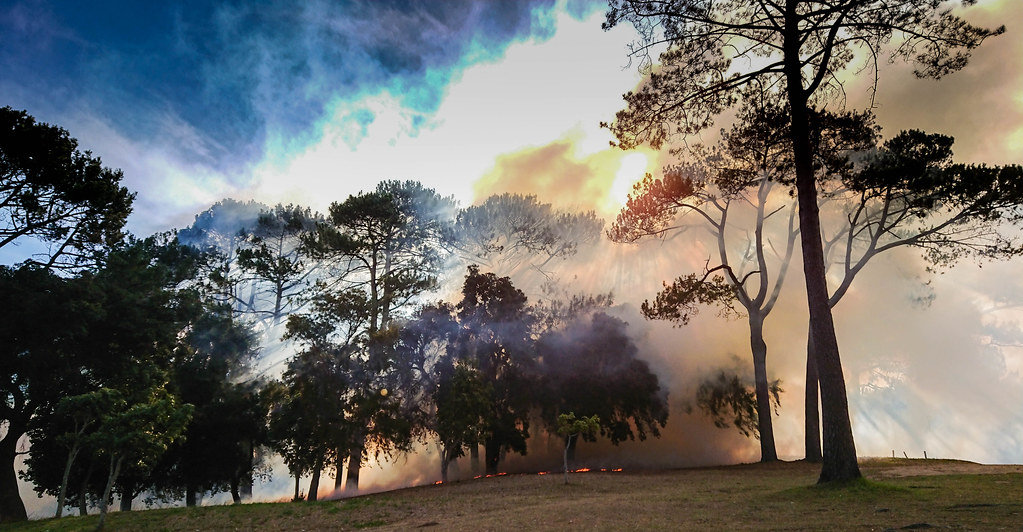
A fire

I was heading back up towards the homestead from the magnificence of the Claremont CBD with the boy yesterday evening when we spotted some smoke (lots of smoke) billowing up from somewhere local. Well, we could have gone straight home, or we could have gone fire-chasing.

We went fire-chasing.

Since this had been a quick trip down to a local fitness centre, mostly populated by children, I hadn’t brought my camera with me. It’s just not the done thing. But that was a bit of a drawback when we inadvertently went fire-chasing. Still, I think my phone did ok, all things considered.

The fire was in Trovato Park, just above where the M3 goes over the top of Edinburgh Drive. There’s quite a population of homeless folk that live there, and the fire crews present were certainly of a mind that they were the cause of the blaze. It had taken on the dry grass and pine needles very quickly, and had leapt up the trunks of at least three of the trees in the park.

That said, it wasn’t much of a blaze and was already under control when we got there. The smoke was more of an “all mouth and no trousers” affair, although with the sun heading down over the mountain, it did allow for some nice shots through the trees, and prime Instagram fodder.

You can see my mini set of 9 very similar images* here.


* because of the nature of what I was ‘togging, it was rather difficult to get any other angles. I would have got burny feet syndrome. 

Groote Schuur Quagga News

Fair warning: it’s sad news.

But first, what are a Quagga?

Wikipedia says:

The quagga (Equus quagga quagga) is an extinct subspecies of plains zebra that lived in South Africa until the 19th century. It was long thought to be a distinct species, but genetic studies have shown it to be the southernmost subspecies of plains zebra.

That are nice. And what can like to be the Quagga Project?

The Quagga Project is an attempt by a group in South Africa to use selective breeding to achieve a breeding lineage of plains zebra (Equus quagga) which optically resemble the extinct quagga (Equus quagga quagga).

And thus, Quagga Project quaggas are dotted all around the Cape. Some of the most successful here, and (definitely) some of the most local just across the road from Groote Schuur Hospital.

Here’s a really poor photo I took of one back in 2014.

An aside: My, how my photography has improved. Or maybe it hasn’t, and I’m just more selective in what I choose to upload.

Or maybe both.

You decide.

Anyway, it seems that I’m not going to be able to improve on any previous photos of quaggas on the Groote Schuur Estate any time soon:

The animals at Devils Peak/Groote Schuur Estate have been moved due to uncertainty over their water supply during the water restrictions being imposed on Cape Town. Quagga and zebra need to drink daily and even a short interruption to their water supply could have devastating consequences. They have been moved to Elandsberg Farms near Wellington and Groote Post near Darling where they have joined other groups of Quagga in the wild. There are natural water holes on both these properties and the Quagga Project felt it would be safer to keep these animals there.

This is no surprise to me. I’ve been watching the Estate getting browner and browner for the past few months, and I hadn’t seen a quagga there for weeks. I usually see them twice a day: up at the top of the fields in the morning and then right down by the bottom of Hospital Bend each evening. Cape Town traffic being what it is, there’s generally plenty of time to watch them as you don’t drive past.

Sadly, it sounds like it’s a permanent move:

Those animals have been moved to other herds – the best known one, a lovely stallion called Khumba, is now on a farm on the west coast where he will hopefully father the next generation of Rau quaggas.

While that means less fun when driving to and from town, especially for my daughter, it does sound like the best thing for the quaggas. And hey, maybe another family road trip is called for out to Groote Post (conveniently located on  the Groote Post wine farm), or maybe a visit to the Nuwejaars SMA (conveniently located all around the (perennial favourite) Black Oystercatcher wine farm)?

What’s not to like?

No more quaggas on the mountain, that’s what. 🙁


Religion and Rain

It’s been a hectic few days in South Africa as we all await the allegedly imminent departure of corrupt old bastard Jacob Zuma. In fact, by the time you read this, he may already have departed.

Or not.

But all of that excitement has been taking our attention away – as much as anything ever can – from the water crisis, which has now apparently been solved.

Or has it?

As reported earlier in the week, Day Zero “The Day When The Taps Will Be Turned Off” and/or “The Day We May Have To Queue For Water” was moved back by almost a month. This was due to quite a lot of the Eikenhof Dam in Grabouw being released into the Palmiet River to feed into the Cape Town supply, while at the same time the agricultural sector announced that they would be using less water over the next few months.

Or was it?

Because while it seems fairly obvious that these interventions will have a marked effect (like for example, moving Day Zaro back about a month), arrogant and loudmouthed charlatan Pastor Mboro says it’s all down to him.

I want to pray for dams in Cape Town and prove that prayer works. On April 12 the dams will not be on 0%. They (anyone who has predicated that day zero will be on April 12) are not God. The problem is that they didn’t consult with God. To show how effective my prayer is they have now moved the date from  12 April to 12 May.

What a dickhead.

The thing is, other loudmouthed charlatans have a different view on things. Take Angus Buchan for example. He must be amazed that Day Zero has moved out, because he told us this week that:

God is angry with Cape Town

And why?

He’s had enough! …Of the abuse of women and children, gangsterism, lawlessness – He’s had enough!

Well, haven’t we all?

This has opened a right can of worms though, because other areas not suffering with drought include Johannesburg, which isn’t exactly known for being the most law-abiding place on the planet.
Also Nottingham, and that’s a real scummy dump.

But pointing out that sort of thing doesn’t fit the narrative, so we’re expected to ignore it.

Angus’ mass prayer meeting, “paid for by God and guarded by gangsters” (I know, right?), will:

…come against crime, murder, disrespect for human life, prostitution, alcoholism, drug addiction, racialism and hatred.

and will be held in Mitchells Plain:

because it is the hottest place in South Africa.

The SA Weather Service begs to differ:

But who cares about facts when you have faith?

Sadly Angus can only get to us on March 24th, so I guess that we’ll have to rely on Pastor Mboro to fill in the gaps in the intervening seven weeks or so. Although some people might be wondering why Angus is coming anyway, given that it was only in a couple of months ago in November that there was this:

By March next year there will be no drought in the Western Cape and the dams will be full, said well-known lay preacher and potato farmer Angus Buchan as he prayed for “spiritual and physical rain” in Parliament on Friday.

So that March 24th date doesn’t quite fit.

His prayer followed shortly after he alleged that a woman rose from the dead after he prayed for her.

Oh. OK then.
I think we’ve found the level.

What an arsehole.

So, to sum up: we’ve got Mboro til May 12th, Angus from March 24th (although also from March 1st) and… oh… and the Department of Water and Sanitation this weekend:

Yep. Devoid of any other practical plan aside from filling the pockets of her corrupt colleagues, the Minister has resorted to begging us to pray.

What a completely useless individual.

The really, really irritating thing is that we are actually forecast some rain on Friday night. Normally I would be over the moon, but sadly, this is going to be used by each and every one of these dubious characters as firm evidence that God is listening and acting. The fact that He’s been well on his way to killing every plant in the Western Cape for the past three years will escape them, as will the fact that previous efforts of this kind (and there have been many) have completely failed to make any difference at all.

I predict some quotes:

Pastor Mboro: “I came to Cape Town, Day Zero was moved back a month and then it rained as well. Boom. My latest DVD is available in the foyer. Mind my R2 million BMW on your way out.”

Angus Buchan: “I said I was coming to Cape Town, Day Zero was moved back a month and then it rained as well. And I raised a woman from the dead. Boom. My latest book is available in the foyer. Don’t be gay.”

Minister Nomvula Mokonyane: “I said to pray because I needed to avoid giving any practical assistance to the DA-led Western Province, Day Zero was moved back a month and then it rained as well. Frankly, I’m rather annoyed.”

What’s actually happening is that a cold front is hitting the Cape.

But it was sent by God, obviously.


Giving back

Many of us in Cape Town are trying our hardest to save water and adhere to the 50 litres per person per day limit imposed by the city council, and that’s to be applauded. But there is one family going above and beyond to help avert “Day Zero” when the city is set to become the first major developed city to run out of water.

This is their story.

__________________

Etienne van der Merwe wakes up each morning at 5:30am.

“I don’t need an alarm,” he tells me, “I’ve always been the sort of person that likes to get up and go.”

Etienne and his family, wife Hentie, and children Johan (18) and Charlize (15), live in a small but comfortable house in Durbanville in Cape Town’s Northern Suburbs. As I arrive, I note the dying plants and brown lawn. Like the rest of the population, the van der Merwes have been affected by the water crisis which is currently gripping the city. Three years of low rainfall, coupled with an alleged lack of foresight by the authorities have left Cape Town teetering on the brink of disaster.

“It’s been very difficult,” says Etienne. “But we are very fortunate to have access to clean running water anyway. There are many in our country who would consider this a luxury. I want to try to give something back.”

And that’s exactly what Etienne and his family are doing.

Each Monday morning, before sunrise, the taps in the van der Merwe household are turned on, and a total of 1400 litres  – 50 litres per person per day – is decanted into a collection of containers and drums in the kitchen and porch, before Etienne sends his son outside to turn off the water main again.

“This is more than enough water to get us through the week,” explains Hentie. “We wash with a skoppie en waslap [a basin and face cloth], we share the water, we flush the toilet once a day using rainwater when there is any, or greywater [water that they have used for washing] the rest of the time. It’s hard work, you need to be disciplined, but for some people, this is everyday life. We can manage.”

“Since we started this routine, we’ve never run out,” Etienne tells me proudly. “There’s always some left over at the end of the week.”

Etienne and Hentie van der Merwe

Many of the city’s residents are equally active in their efforts to save water, but it’s what the van der Merwes do each Sunday evening that makes their efforts so special. I join them on what has become a weekly pilgrimage.

It’s 4 o’clock on Sunday afternoon, and the van der Merwes have just returned from the afternoon service at their local church.

“It’s important that we keep faith, that we believe God will right this situation,” says Etienne. “People’s livelihoods and our society depend on it.”

He’s in the kitchen, moving the empty pans, pots, bottles and drums to one side.

“See here. This week we have almost 80 litres remaining this week. This is what we are giving back.”

I help him and Johan lift two full 25 litre containers and a collection of old soft drink bottles into the back of their bakkie [a pick-up or ute], and climb in. Hentie insists that I sit up front with Etienne, while she sits with her children in the back. Etienne pulls out onto the suburban road outside their house and heads for the freeway. We’re bound for Theewaterskloof, the largest dam in the region with a capacity of almost 500 billion litres, set in the mountains about 100km [63 miles] north-east of Cape Town.

The traffic is light, but Etienne’s pick-up has seen better days and the drive takes us  over an hour. We stop just outside the farming village of Villiersdorp on a viaduct over the reservoir. The view is shocking: what used to be a picturesque body of water is now little more than a stream surrounded by sand. The viaduct is made up of 12 arches. Only the centre arches now straddle the water. The strong wind whips up the dust from the extended banks of the dam, forcing us to shield our eyes.

The Theewaterskloof Dam bridge

The family stares grimly at the scene for a few moments.
“Each time we come here, there’s less water and more sand,” Charlize remarks, sadly.

Etienne and his son are dragging the containers out from the back of the truck, and between them, they lift the first one onto the concrete barrier on the side of the bridge, remove the cap and begin to pour the water back into the reservoir below.
It’s not an easy task, and the wind blows spray back into our faces and onto the road, but Etienne and Johan persevere and most of the contents of the container end up in the water below.

“It’s not much,” he admits, “but it’s something. If everyone in Cape Town could come and pour some water back into the reservoir, it would fill it back up. It would make a really big difference. I’ve already started to promote the idea in my local community, but people don’t take this situation seriously. They laugh at me and they say it’s a waste of time and effort. But I believe that we need to work together. This is my contribution.”

Having poured the family’s excess water back into the Theewaterskloof Dam, we head back to the van der Merwe home, where I bid farewell to this extraordinary family who are going to extraordinary lengths to save their community.

Later, sitting in my hotel room in the city centre, I resolve to do my bit as well by not having my usual cup of tea before bed.
And I have to say, it feels good to be making a difference, and suddenly I understand just how the van der Merwes must feel every day.

__________________

Story originally posted in UK Community Values magazine (January 2018).
Author: David Brooks.
Reproduced in full for the benefit of my South African readers. 

Day Zero moved back

As agricultural water use is throttled (and with all the implications thereof), Cape Town’s impending Day Zero has moved back almost a month to 11th May.

Interestingly, Day Zero is now described as:

The Day We May Have To Queue For Water

rather than the previous incarnation, which was:

The Day The Taps Will Be Turned Off

And there is obviously some debate as to whether this good news should have been announced. But if the City wasn’t to announce this, would they not be accused of scaremongering once the media got hold of the story. They tried to slip it out – there wasn’t much of a fanfare to be honest – but such is the massive public interest in the water crisis, it was never going to slip under the radar. But will this stay of execution now result in residents using more water as they see the problem as having been solved? Quite possibly, although it clearly isn’t.

As one twitter user (it was The Guru) quipped though, we’re still very much lost in the woods, and nowhere near out of them.

That said, it might all be sorted after the weekend, as the National Department of Water and Sanitation are motivating for a 3 day weekend of prayer and mediation [sic]:

Obviously, this will work and Day Zero will become just a dot in the distance. One wonders why they didn’t just do this before and save us all this bother. To be fair, I’d just settle for a 3 day weekend. They’ll probably argue that including Friday allows for Islamic involvement in the process, but the more cynical amongst us have surely already noticed that there is some rain in Cape Town’s forecast for Friday:

which might actually be a double bonus:

Looks like next week is party week. So lit fam.