Dyson

An abandoned factory in Sheffield apparently makes for an interesting photo subject. I know this because I saw karl101’s photo album on flickr and then I looked around some more and found some more photos here and here.

article-2569304-1BDFC34B00000578-831_964x641

I’ve lived the  Urbex life both vicariously and fairly regularly on this blog through people like silentUK and longexposure.net, and that’s been fun, but there’s obviously additional local interest for me in this one.

The company was founded by John Dyson who began mining clay and making bricks in the early 1800s. From the very beginning the business was a success. The 1834 Sheffield trade directory lists “John Dyson – Brick Maker, Stannington” which indicates that he ran the business on his own. However, by 1838 the business was listed as “John Dyson and Son – Black clay miners and firebrick manufacturers, Griffs House, Stannington”.

Dyson’s were manufacturers of refractory material, ceramics for the steel industry – basically making the tiles which lined the inside of the furnaces and ladles used in steelmaking – they also produced fire backs and other household ceramic bricks for the likes of Agas, fires etc.

As with all industry these days, however, China does it more cheaply. But rather than going under like so many other British businesses have, Dyson reacted to this by building a plant in Tianjin in China. They still supply “technical ceramics and thermal technologies” to those people and industries who need technical ceramics and thermal technologies.
I guess 2015 China is a far cry from even the 1970s in Sheffield, though:

I worked at Dyson in 1970. When I was there we mostly made teeming refractories for steel making. They lined the blast furnaces, ladles and moulds. The pipes for “uphill” teeming were stamped out in wet clay (mined from the local Ughill quarries) in drop stamp moulds. Every so often, someone would be a bit slow taking his hands out of the way of the stamp and would lose the end of his fingers. Almost everyone in the factory was missing bits of fingers, crushed by the stamper.

Eina.
123

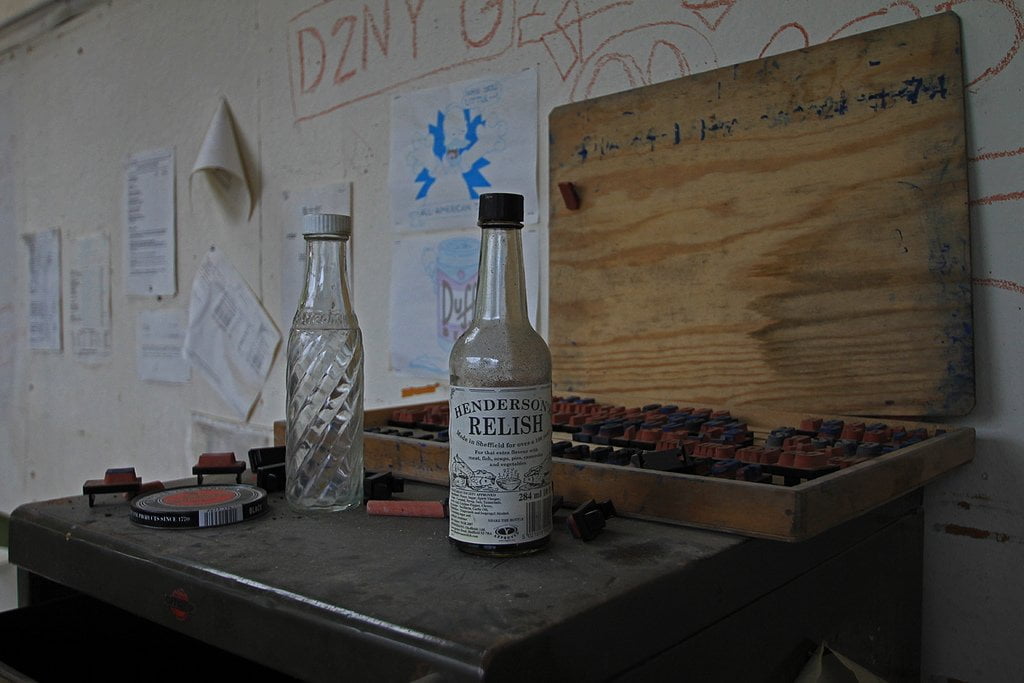
Given the number of photo albums and sites devoted to it, I guess that the Dyson Ceramics factory in Sheffield must be the most accessible derelict factory in the world. What’s interesting to me is the respect with which it appears to be treated by the explorers and photographers. Easily mobile items (like the bottles and stamping kit above) appear in photos from both 2010 and 2014 – people are going in there to take photographs, not souvenirs.

Space Station eclipse photo isn’t real

After the asphyxiated Capetonian dog, I’ve discovered that there’s even more fakery and hoaxism on the internet.
Hoodathunkit?

Lookie here: https://gizmodo.com/this-mind-blowing-image-of-the-eclipse-cant-possibly-be-5912184

Says Gizmodo’s Jesus Diaz:

It’s a 3D rendering made in Terragen 2 by DevianArt user ~A4size-ska. It took 38 hours to render. The image of the Milky Way was added later in Photoshop. You can get the high resolution original here. It’s beautiful anyway.

Think first, share second, people…

I knew it the moment I saw it. It was just too similar to this astronomically impossible “Summer Solstice at the North Pole” image, which is obviously also not what it claims to be, but was also a digitally constructed picture, built in Terragen

c3e71f57cb735d61328627d12ea375ef

Thankfully, Jesus does share an REAL image of the moon’s shadow on the earth, taken from the International Space Station. Sadly, given the unlimited imagination and lack of astronomical restrictions of the images above, dare I suggest that it’s a little underwhelming:

17ney6wiq4muzjpg

Did I really just say that about a photo from the ISS? I think I did.

It’s all good though, because space ‘tog Don Pettit has previously given us this amazing stuff.

just Panama things

I say Panama, you say…?
Well, it’s going to be one of two things: “hats” or “canal”. OK, or possibly “Jack’s”  if you’re Capetonian and into dockside seafood.

The Canal famously goes right through Panama twixt Panama City and… er… Colon, so that’s a valid Panamanian thing (also, it’s ‘currently being extended’, but… but how?).
The hats, however, infamously actually originate from Ecuador, which is but one Colombia away from Panama, but isn’t Panama. They are definitely hats though.

There is another Panama thing. A biggie, too. The Disease. If you’ve ever had Panama Disease, then frankly I’m amazed that you’re reading this. Not just because it’s invariably fatal, but moreover because it only affects bananas.

Fusarium oxysporum – that’s your problem, right there. It’s untreatable. And it’s been an issue for a while, prompting lines like:

The banana industry was in a serious crisis, so a new banana thought to be immune to Panama disease was found and adopted, the Cavendish.

But now even the trusty, sturdy Cavendish is becoming threatened by a new variant of Panama Disease: “Tropical Race 4”.
And it’s serious. Because Banana Business is Big Business: R5.7 BILLION Business each year in North Queensland alone. NQ is panicking a bit, because the catastrophic Northern Territory banana crash of 1997 – yes, caused by that fungal bastard – is still very fresh in the memory. The NT banana industry has never really recovered either, because the Fusarium spores can hang around in the soil for 30 years or more, just waiting for their next bananary host to be planted and then killing it, and with it, the local industry.
The concern is that NQ may well go the same way.

We’re not immune here in South Africa, either.

Fusarium wilt (Panama disease) is responsible for severe Iosses of Cavendish bananas in two of the six production areas of South Africa: Kiepersol and southern KwaZulu-Natal (KZN). The disease first occurred in KZN in 1940, and from there spread to Kiepersol with infected plant material, where it resulted in 30% Ioss of banana fields between 1991 and 2000.

The biggest problem with bananas, aside from their irritating habit of being green when I want to buy them in Woolies, is that they reproduce asexually. Poor things. Asexual reproduction doesn’t allow for much genetic variation though, and so if Daddy banana is wilting (careful now), Baby banana is going to get it too. Bad news for bananas generally.

Unfortunately, I don’t have the answer. But that’s kind of the point here. No-one has the answer: it’s another case of us so-called brilliant humans being outwitted by a microbe. Now, not only it it the case that we are all going to die horrible deaths soon, we’re not going to have any bananas to eat while we’re doing it.

Depressing physics…

It’s not just South Africa. Everything slowly descends into chaos.

Seriously. Whenever atoms are in any given structure or arrangement, they are displaying unnatural organisation. The universe doesn’t like that and it fights back by reducing everything slowly and surely into chaos.
That’s not such a difficult thing to consider when you’re thinking about a radioactive isotope, but then someone goes and makes this (equally valid) observation:

Depressingly, it’s all true.

Snoopy is rapidly disintegrating and so am I.
And before you start feeling all superior, so are you.

Stellenberg High School at Newlands

A bit of detective work has helped me find out which school was responsible for “those displays” at Newlands during the rugby on Saturday.

Step forward Stellenberg High School – brilliant.

sths   sths2
Amazingly, people seemed to be watching the rugby as well and there’s not much other documented evidence of their displays. If anyone has any better photos or videos of their performances on Saturday, please get in touch. Meanwhile, here’s an example of the kind of thing they were doing:

This is er… “flashing”: exposing your school blazer or shirt/blouse to “flash” black or white to make a design or symbol.
It seems that a) Flashing is a Northern Suburbs thing, and 2) Hoërskool Stellenberg are pretty damn good at it.