The Varying Prices Of A Prime Circle Concert Ticket

We were going to go along to see Prime Circle on Thursday night, but something came up, so we’re not going  to do that any more.

That said, if we were desperate to catch them on their acoustic tour of the Western Cape, there are/were several other opportunities:

prc

But look at those prices. Some few variations, no?

I recognise that venue costs and ticket sales may differ from place to place, but can a difference of 108.3% for the same concert really be justified? Prime Circle are well established on the local scene and I’m sure they’ve rehearsed ahead of time. I can’t honestly believe that they will be 108.3% better this Thursday in Hout Bay than they were last Friday at the Waterfront.

As musicreview.co.za pointed out, lovely though they may be, R250 for 60 minutes with a local band is a bit of a stretch:

…we find it disturbing that a South African band (and obviously the events organiser and venue behind it), could think that it is appropriate for live music goers to spend R250 on an ‘unreserved seating’ ticket, with absolutely no perks and no support acts for a 1 hour performance on a Thursday night.

But then, it is at an ever so trendy, local ‘farmers’ market‘, where people mysteriously seem willing to pay extra for stuff just… because.

Anyway, as I pointed out, we’re not going along, but if you’re planning on doing so, then maybe go last week and not on Thursday. As a couple, I’m sure you could find something reasonable to do with the R260 you’ll be saving.

* (un)surprisingly, there are still many tickets available for Thursday evening.

Angry lady attempts to shut “homeless” bench issue stable door after by-law horse bolted in 2010

MOAR OUTRAGE!!!!!!1!!

Listening to Cape Talk 567 yesterday afternoon, as is occasionally my wont, I heard “writer, journalist and stand-up comedian” Marianne Thamm accuse Cape Town City Council of making an “fascist and unacceptable” decision. (oh, the drama!)
What they (well, actually what the Good Hope Subcouncil) had done was agreed on a motion to remove “problematic” benches on Government Avenue and find designers to “create pieces of functional art that would encourage sitting rather than sleeping”. [link]

Please note: This isn’t a blog post about whether or not this is a good idea. This is a blog post about misplaced and mistimed outrage.

You can listen to Ms Thamm’s mini-rant on soundcloud. The first voice you’ll hear is sycophantic presenter John Maytham who in his introduction makes this all about street people when actually, it’s not, and then professes his enjoyment of talking with Ms Thamm.
Let’s listen out for an impartial and tough interview then.

Anyway, enough preamble. Let’s fast forward to about 55 seconds into the interview.
Ms Thamm has the floor:

I get the point, people say somebody else wants to sit there, well you’ve lost out: somebody’s having a nap, on the bench that he’s allowed to lie on.

I’m afraid I’m going to have to stop you there, Marianne. Because you’re actually factually incorrect.

Let’s have a quick check of the Cape Town bylaws (a copy of each of which is available on the City’s website) (maybe use the free wifi in the Company’s Garden to access it) (although you might have to stand up), shall we?

The Public Parks – 2010 bylaw, Section 11, subsection 1, part (j) clearly states:

(No person shall, in a public park —) lie on a bench or seating-place or use it in such a manner that prevents others from using it;

Again, I’m not saying that this is or isn’t a good idea for a bylaw. I’m just stating that it actually is the prevailing bylaw.

See, the issue, as Councillor Dave Bryant sees it, is that:

if you have someone falling asleep on the benches for a long time it means many other people can’t use that public space for a while.

So John Maytham’s follow up point: “if there was a family of three Dutch tourists sitting on the bench, you wouldn’t be able to sit there” is moot, because they wouldn’t be breaking the bylaw, because they would be using the bench to sit on, not to lie on.
And even then, when he suggests that, were you to find said trio of Dutch tourists occupying your seating area of choice, you should go and find somewhere else “like a cafe chair or the grass” to sit, well, that’s fine. As it would be for homeless people too. Because yes, you can go and sit somewhere else. Sitting isn’t the issue. Lying on the benches is the issue.

What the Council is proposing is to replace the benches with “pieces of functional art” (or, “chairs” as you may know them) which encourages people not to break the existing bylaw. Having “chairs” prevents people sleeping on the benches, which avoids the local law enforcement officials having to get shirty with them and thus removes a point of potential conflict.

Ms Thamm is barking up the wrong tree (incidentally, there’s lots of stuff about trees in the 2010 Public Parks bylaw too).
What she should have done is complained about the silly “fascist” bylaw when it was promulgated, back in September 2010. There’s a very clear explanation of the bylaw formulation and approval process plan on the city’s website, which includes, ever so clearly at Step 5, public participation.
But you didn’t bother to object then, when the public was asked for its opinion, you just start moaning now, three years too late.

Stable door, bolted horse.

Her protest plan (thankfully not involving poo) of having “a nap-in” is belated at best. And it’ll be even more belated because she’s going to wait for it to get a bit warmer so that people will join in:

…when the sun comes out, because no-one wants to lie on a bench in the rain

Right on, sista! A luta continua once spring comes along!

And then, the pièce de résistance: her suggestion that the annual Infecting The City project should provide some benches for the homeless. Yes! They could do that if they weren’t so involved in spending their time and our public money on wrapping sodding bog roll around trees on the station concourse.

Maybe, the City will look again at this. Maybe they won’t. But all in all, this a hilarious and embarrassing episode for everyone concerned. Especially the ever so outraged Ms Thamm.

UPDATE: Some clarification here.

I like this archipelago and this water tower

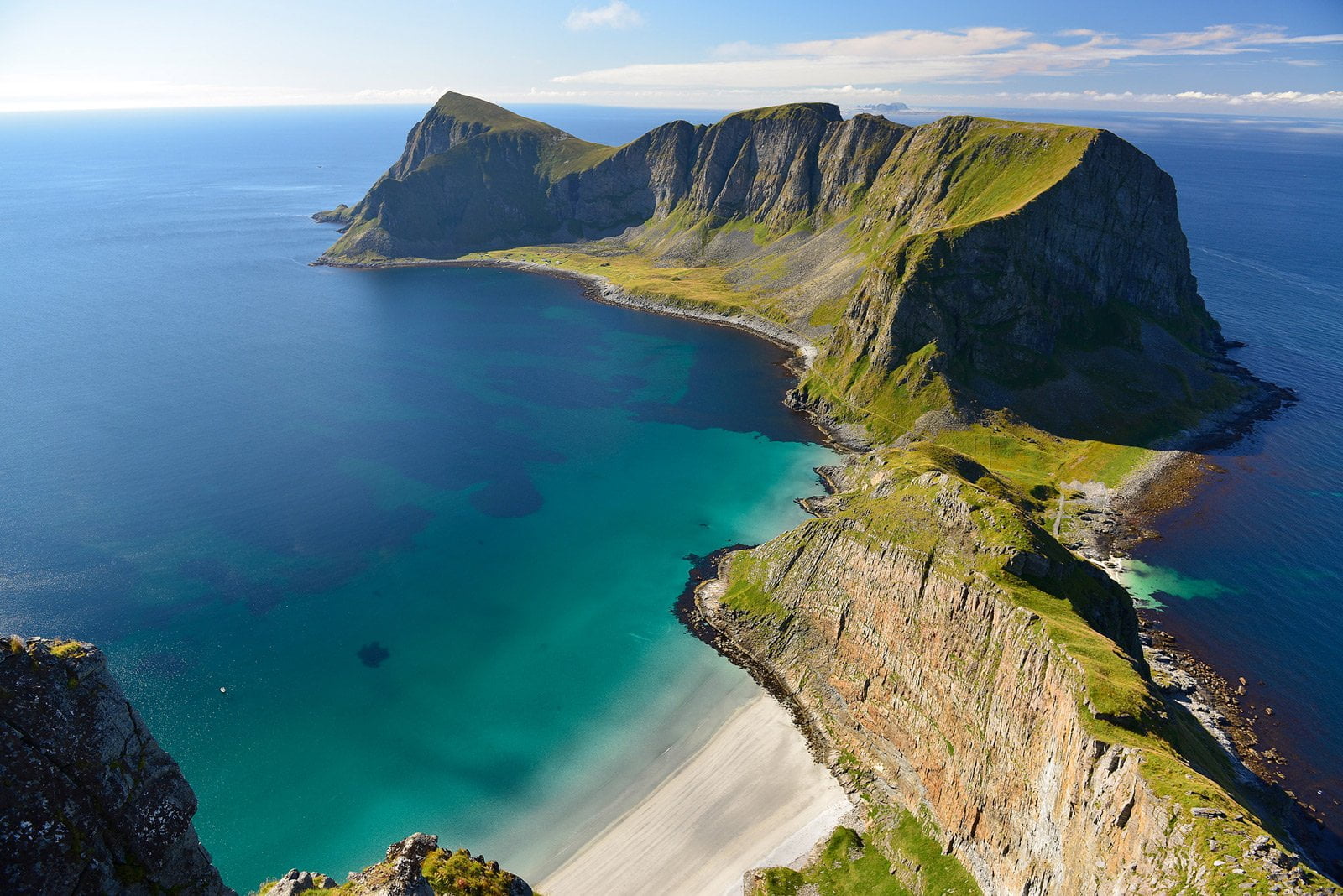
Firstly, this image of Værøy in Norway. It looks like somewhere I’d like to go.

435377

It turns out that Værøy is the last island in the Lofoten archipelago in Nordland, Norway.
It has a lighthouse and a whirlpool. Yes, really:

The Moskstraumen (whirlpool) is located between the Lofoten Point of Moskenesøya (Moskenes municipality) and Værøy, at the small island of Mosken. It involves strong tidal currents flowing through the shallows between these islands and the Atlantic Ocean and the deep Vestfjorden, creating eddies and whirlpools, the largest one having a diameter of some 40–50 meters (130–160 ft) and inducing surface water ripples up to 1 meter (3 ft 3 in) in amplitude.

And then (in old news for people in the UK), this converted water tower in Kennington, featured on the 100th episode of Grand Designs – which was screened yesterday in South Africa. And I fell in love with it. Just wow.

tower15

I know it’s been up for sale for a while, so I don’t know if it’s still available. But the longer it stays on the market, the better, because if I’m honest, I’m struggling with the last little bit of the R75,717,850.00 asking price. *weeps*

This will probably not end well

There are people who have examined the complex politics of South Africa in minute detail and there are others who have studied the mining industry of the country for many, many years.
These people have earned the right to use the moniker of “expert” in their particular field.

I are not these people.

I can, however, like to venture my opinion on the current situation regarding the wage demands and negotiations surrounding SA’s gold mining sector. And my opinion is that I don’t think things are going to work out very well.

That’s because generally, wage negotiations in SA seem to go pretty much the same way:
Employer offers low percentage – let’s say, for example 5%. Unions demand higher percentage – maybe 13%.

There are strikes, strife, usually a bit of violence and some threats. And then, after a while, and a lot of posturing, they meet halfway. Which would be 9% in this case. The overall increase just about enough to drive inflation up a bit further, but for the individual workers, not usually enough to make up for the pay they missed out on while they were striking. Perhaps the latter is why they then demand a bit more the next time around.

Of course, if I can work this out, then the employers and the unions are probably also aware of it. Thus, they come out with more extreme percentages as their starting points. Which brings me neatly back to current events in gold mining.

The employers – citing falling productivity, the lower price of gold and spiraling costs – have suggested 4%. Not a massive decease on their usual offerings, but then they don’t have a lot of space to place with. That’s not the case for the unions though. Although they have certainly outdone themselves – and each other – this time.

Solidarity (not the Polish one) has demanded 10%.
The NUM has demanded… *drumroll* 60%! Lolz all round.
Oh yes, and AMCU has asked for 159%.

I’d like a pay increase too. 10% would be lovely. 4% would even be quite nice. But with this news, I’m tempted to hold out for 159%. And once I go for it, I will only back down ever so slightly (and maybe I’m guilty of showing my hand a little here, but no further than 158%).

But seriously, with the parties starting so very far apart, the upcoming mining wage negotiation are going to take a while. And all that time, tensions, frustration and desperation are going to increase. And just in case you have no memory, there is history here.

Colour me pessimistic, but I really can’t see this working out well.

The mystery of the other 48.7%

Ah, the pisspoor Daily Mail. We’ve been here before, haven’t we, folks? Ad nauseum.
But this time – it’s a classic.

In a nothing piece entitled: “Generation who refuse to grow up: No mortgage. No marriage. No children. No career plan.” by nothing columnist Marianne Power, there’s this stat:

Three million 20-to-34-year-olds now live with their parents. A third are men and 18 per cent are women.

Here it is in full screenshot glory:

Fullscreen capture 20130712 113802 AM

Which leaves me – and I would imagine any of you who have more than half a brain – wondering what on earth makes up the other 48.7% of 20-to-34-year-olds who now live with their parents?

Because I’ve been doing some rudimentary calculations and it’s a significant number – 1,461,000 individuals, to be exact.

But what are these individuals? Cats? Dogs? I don’t think so, because 20-34 years old is awfully old for a cat or a dog to get to. And even if we were talking cat or dog years, these are their parents we’re talking about. So, maybe some sort of larger mammal, which generally have a longer lifespan? Horses, perhaps?

Well no, because horses only really last to about 30 years on average. So we’re going to have to go bigger again.
Elephants, then. They last for ages.

Yes, as far as I can work out, the Daily Mail is reporting that there are 1,461,000 elephants between the ages of 20 and 34 years old, living with their parents in the UK.

This amazes me for two reasons. Firstly, that having lived in the UK until 2004, I never saw any of these elephants living with their parents (save maybe for the ones at London Zoo). I recognise that the article suggests that there has been a significant increase in this number, which is one reason (albeit a bit of a minor one) why it is of interest. But even so, they say that even in 1997, 2.5 million individuals (including 1,217,500 elephants) living with their parents.

That’s a lot of elephants to be hiding.

And then, secondly, what of their parents? Given that the elephant is a normal sexually reproducing mammal, it takes a total of two elephants to make a small elephant, which they then tend and nurture through until it’s 20-to-34-years-old. That’s three elephants in a house, and, with the assistance of some dodgy maths, a total of 4,383,000 elephants that I have comprehensively not noticed living in the UK.

The WWF say that there are 470,000 – 690,000 African elephants in the world, and list their status as “vulnerable”. Not any more, guys. Happy days for the elephant population as I reckon I have the Daily Mail has just found another 800% of elephant numbers, living clandestinely behind closed doors in the UK.

It’s no wonder you didn’t count them. They’re hiding.

Unless of course you’re going to go out on a limb and suggest that the Daily Mail have got this one wrong.