Best Currency Converter

There are a lot of online currency converters and most of them are wholly depressing if you live in South Africa and you’re paid in Rands. Fortunately, this one that I’ve found doesn’t convert one appallingly weak currency to another, much stronger, currency and make you cry. It converts Pounds to size – and weight. Hugely useful for drug dealers. I chucked in £100 (about 3g of Charlie in London) in £1 coins to see how it got on:

100gbp

It’s a spin-off of a German Euro-calculating site, so please excuse ze langvich, and also the assumption that you have a handbag, ja?

From there, it was time to knock up the value to One Bar and have a look at £50 notes and 1p coins (the Samsung method of payment of choice).

It turns out that £1,000,000 in £50 notes would be 2.66m high and weigh 24.2kg. Surprisingly little, I thought, and thus I was concerned by their suggestion that:

With 2 strong men, this weight still can be transported well.

That’s 12.1kg for each strong man. TWELVE POINT ONE. HOWEVER WILL THEY MANAGE???!!!!?!?!?!?
What’s going on here? Is there a problem with the general musculature of German men? Can anyone please explain?

We move on. A million squids in penny coins. Let’s do this…

£1,000,000 in 1p coins would weigh a massive 365 tonnes (“For transportation, you should already have a fleet of trucks” – fair enough this time) and a single stack of coins would stretch 165km into the sky. I’ve been doing some rudimentary calculations and I reckon that a tower of penny coins worth £3 million would endanger the International Space Station. Golly.

We need someone to do this (make a calculator, not endanger the ISS) for South African currency. I can’t imagine that it would be very difficult for someone with even a basic knowledge of coding.

Get to it, readers.

Beware the petrol price drop

The preamble:
The petrol price in South Africa is regulated by the Department of Energy. That means that wherever you go within your locality, the price you are charged per litre will be the same. The only variation in price is between coastal and inland areas, e.g. Joburg prices are different to Cape Town, because of the additional cost of transporting the fuel from where it’s made/shipped to, to where it’s sold.

You might like this system, you might not. You may even be wholly ambivalent about it. It is, as they say, what it is.
And it’s not what this post is about.

The petrol price changes monthly to allow for any increases and decreases in the oil price and variations in the USD/ZAR exchange rate. These changes are announced in the last week of each month and instituted at midnight between the first Tuesday and first Wednesday of the following month. And it’s been good news recently for the South African motorist, thanks to the oil price being in freefall. The price of a litre of Unleaded dropped by 93c at midnight last night from R10.83/l to R9.90/l, and it was for this reason that I didn’t fill up on the way home yesterday.

In which I buy some petrol:
I don’t generally subscribe to the queuing up ahead of a fuel price hike – saving a few cents or a couple of Rand isn’t worth the time, effort and frustration. But when I need lots of petrol, the price is dropping quite a bit in six hours, I can fill up on the way to work and save enough for a six pack of beers, well then it’s the perfect storm of logic, right there.
So I filled up this morning and it was only afterwards that I noticed that I had been charged the old rate.

This shouldn’t have happened.

I would have noticed straight away, but I thought that I needed more than 50 litres, and the guy actually put in 45 litres. No issue there, you only pay for what you take, obviously, but I only looked at the price (R490.00), which just made me think I’d got more petrol at a cheaper rate. Compare 50l at R9.90 (R495) vs 45l at R10.83 (R490). It was only when I looked at the receipt closely that I noticed the “error”.

DSC_0006

In which I go back the the petrol retailer and ask what’s going on:
I headed back to the garage about 30 minutes later, receipt in hand, to speak to the manager. I had a quick look at the pumps as I walked in and – fair enough – they were showing the new, lower price of R9.90.

The manager was friendly enough. He immediately apologised, told me that there “had been a glitch” and they’d “had to reset the system”. He paid me R44 difference, told me he needed to keep my receipt (conveniently removing any evidence of naughtiness) (apart from the photo I took of it) and we went our separate ways.

I’m not going to name and shame here, because I have no evidence that there was any deliberate wrongdoing here – as I say, it looked like the pumps had been updated in the intervening half hour. (Afterthought: but are the pumps linked to the card machine in any way?)
But then look at it the other way: the garage was packed this morning because of the petrol price drop, and if every motorist there in the first seven and a half hours of today was being overcharged by R44, then someone (spoiler: it’s the garage owner) is making a pretty penny. Or more.

These things happen elsewhere too:

As I mentioned earlier, I’m not saying there was deliberate dishonesty here, but what I am saying is that – much like every sell by date in SA – you should double check before you assume that you’re getting the right deal.

Happy motoring.

Loads of loadshedding coming

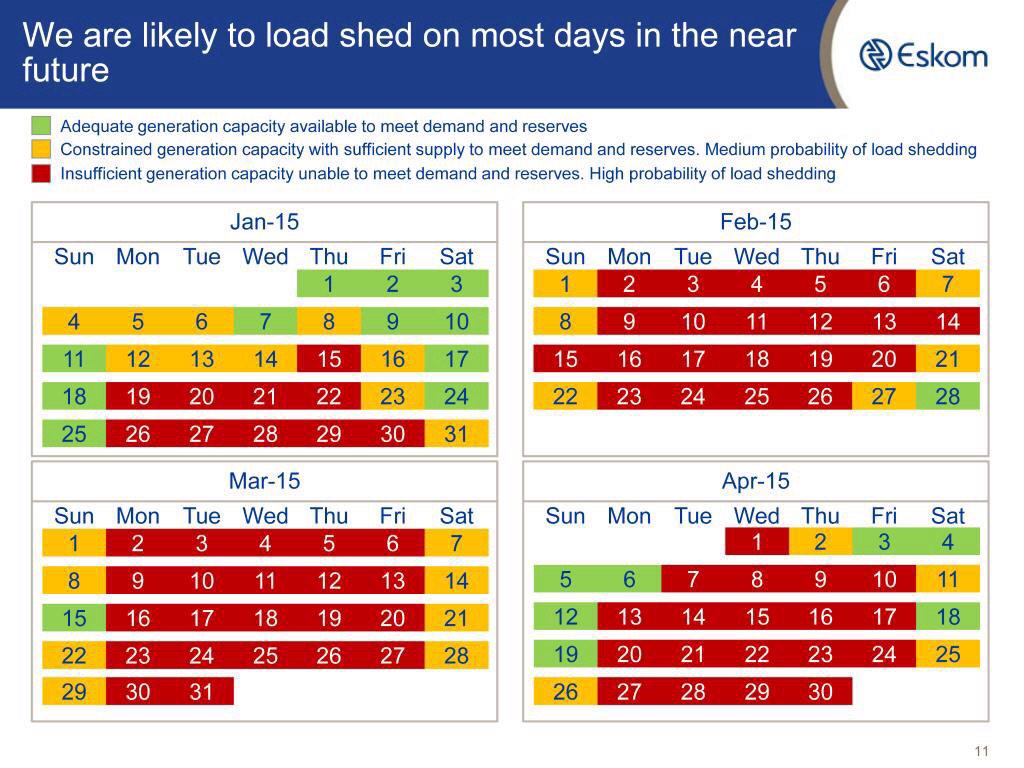
“We are likely to load shed on most days in the near future”

Yep. Here’s a slide from the Eskom briefing this morning. That legend up at the top reads as follows:

Green days: Adequate generation capacity available to meet demands and reserves.
Yellow days: Constrained generation capacity with sufficient supply to meet demands and reserves. Moderate probability of loadshedding.
Red days: Insufficient generation capacity unable to meet demands and reserves. High probability of loadshedding.

eskom

A rudimentary count from next Monday gives us 102 days of which 11 are green, 20 are yellow and 71 are red. That means that until the end of April, SA will have a high probability of loadshedding 70% of the time. Even more worrying for the economy is that there are only three working days which are not red, and none of those three are green.

This is summer, when demand is lower, meaning that in some ways, we’re getting off lightly. But there’s no indication that come May, some magic bullet will have solved everything. No quick fixes here.
So yes, we’re screwed whichever way you look at it. But I think the time for recriminations is done now (I actually think that the time for recriminations was done a long time ago). Spilt milk. This has happened, it’s how it’s dealt with now that matters.
And that doesn’t mean that you shouldn’t try to help out. Switch off what you’re not using, use high-wattage equipment less and try to make some sort of difference.
Do your bit in trying to turn a red into a yellow or a yellow into a green.
It really can’t do any harm.

Just a reminder that you can view the Cape Town schedules here. These are due to change on the 1st February, and we’ll keep you updated when that happens.

It’s the most busiest time… of the year

That’s a direct quote from the lady behind the counter in the bottle store, by the way.

Agulhas is packed. Fuller than I’ve ever seen it.
And while I’m happy that (according to several sources) the area is enjoying a bumper holiday season, I don’t really like all these people being around.

The fact is that the local infrastructure can’t cope with this huge influx of tourists. And I’m not just talking about the shops and restaurants, although they are happily groaning under the collective weight of tens of thousands of Gautengers: the food outlets are struggling to get the dishes to their patrons timously and the local supermarkets are finding it difficult to keep the shelves stocked.
This is fair enough though, becuse you can’t restructure your entire business simply for two weeks of the year. The staff are new and untrained, because there’s no demand for them at any other time, and the kitchen size is more than adequate for more than 96% of the year.

But it’s not just food and drink that’s the issue. There’s simply not enough water to go around and thus, there are some draconian restrictions in force. Not that they are being enforced in any way, of course. And this means that Kobus and his extended family who are down from Pretoria (and there are a whole lot of Kobus’s about, believe me) are out unnecessarily washing their massive double-cabs twice a day, before they begin their Groot Trek back up North on the weekend, leaving Struisbaai some breakfast and taxi fare home. But no drinking water.

It’s not just that though. It’s personal too. I don’t want to have to share my beach. It’s not actually my beach, but it is my beach, if you see what I mean. If I’d wanted company, I’d have gone to Hermanus. But I much prefer wandering along the empty coastline with just the oystercatchers and the waves for company. Now I have Kobus and his fisherman friends filling the rocks every day while they discuss the latest vehicle shampooing techniques and plan where to have tonight’s dubbel brandewyn en Coke.

And yes, I’m “a visitor” too, but I like to think that I’m a bit different. I didn’t bring down any car cleaning products and I refuse to use a hosepipe unless I have express permission to do so. I’m nice like that. So thanks for coming, Kobus, and thanks for supporting the local tourist industry and the local businesses.
But your time is up now, the Jukskei is calling you and I want my beach back.

Better Sheffield

Sheffield looks different today. Better.
I was here on a Monday a couple of months ago and I was distressed by when I saw. It was grey and empty, sad and miserable. Killed by Meadowhall (the local huge shopping mall) and the online revolution.

image

Today though, it’s like I remember it. Mood and numbers artificially swelled by the approaching festivities, I know, but still – it could have been empty and horrible.

As it is, today is bringing back many happy memories for me.