Test cricket is still mainly boring

With dropping attendances, bore draws and the huge push towards shorter versions of the game, it was nice to finally see an exciting finish to a 5-day test match yesterday. The second time in three matches in this series, actually. (In the other game, England obviously wiped the floor with sorry SA).
But while the last over histrionics, South Africa’s constant and often desperate appealing and Graeme “The Cramp Man” Smith’s wonderful innings and penchant for referring everything were all briefly gripping to watch, it was really only the last couple of hours of the game which were actually “exciting”.
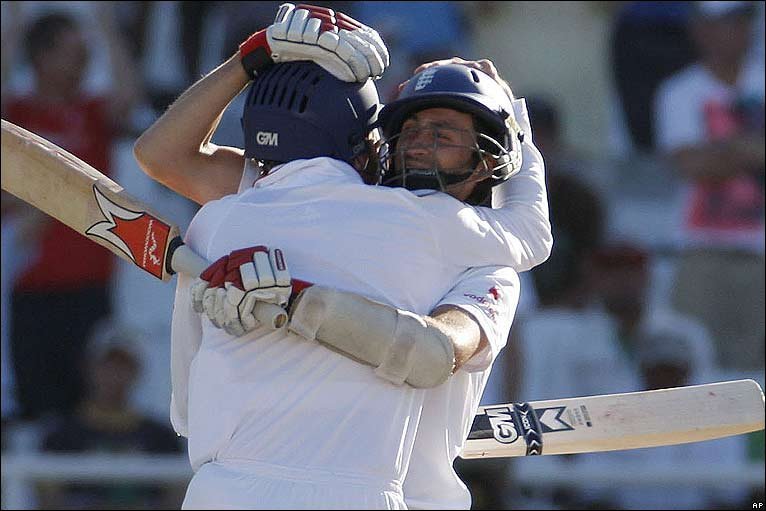
All of which leads me to believe that in actual fact, Test cricket is still mainly boring. And that isn’t really a problem if you’re happy to be bored; if you have days to spare at the ground or on the couch, beer and snacks to hand. But for the majority of us, that’s not the case.

The problem as I see it is that in order to get the exciting finish, you have to sit at least through four days of potential dross. And yes, I know there were “gripping” bits here and there, like the Steyn vs Collingwood thing and Fatty’s lovely innings, but mainly it was quite dull going through to motions stuff. For 4½ days. And that’s why T20 – which condenses the best bits from Test cricket into a couple of hours and is therefore exciting – has become so popular.

So what I propose is this: T6000 cricket. In this new and revolutionary form of the game, one takes scenarios from all the Test matches in history which have ended in an exciting manner. (There must be at least three or four of them.)
These scenarios would then be played out to a finish in front of a capacity crowd. Games would consist of one innings of variable length, as the different scenarios would kick in at different times. For example, I would propose that for yesterday, we start at tea on the final day – after all, it was mostly pretty dull before that.
So England (or South Africa, depending on who wins the toss) would start 5 wickets down, needing to survive 35 overs. 
In this case, the batting side could only ever get a draw, but them’s the breaks. And before you moan that you’ll never see the top batsmen playing, you’re wrong: the warm-up would consist of the top order being put through their paces before going and having a drink in the players lounge as their tail-enders actually play the game.
As an added benefit, since each 15-session match will now be played in one single session (a reduction of 93.33%), there will be less danger of player burn-out – a major cause of the top players not being able to play in the first place.

Sure, the purists will hate this, but they’re the ones with the time, the couch, the beer and the snacks.
For the vast majority, T6000 is the future.

Conflicting reports

While the cricket is on at Newlands, News24 have been trying to keep up with the (apparent) final throes* of South African (previously) fast bowler and all-round sporting ambassador, Makhaya Ntini’s test career. With limited success.

One of the great things about internet news sites is that they are updated with every single new piece of information that comes along. Thus, you get lovely anomalies like this one in the Sports headlines:

As News24 report– it’s all over for Ntini because he’s signed a contract with Middlesex. And then Ntini denies that’s the case. And both are reported.
It used to be the case that the Daily Mail newspapers could hide those embarrassingly incorrect stories by simply just publishing the best information they had to hand at deadline. But in today’s fast-paced world of internet news, it remains there; rudely demonstrating how inaccurate the journalists were.

As for the cricket, it’s been a hugely exciting day at Newlands. But I’m not there – saving leave for real sport in June and that little trip in December.

* No dodgy bowling action pun intended.

A negative end?

The plan was to end off 2009 as this blog has seen 2009: a look forward with typical realistic optimism to what 2010 has to offer for South Africa.
And then the Mail & Guardian reproduced this little gem from The Guardian in the UK.
It’s one of those opinion pieces which is written with a cheeky gleam in the author’s eye, the well-known “this should prompt a reaction” gleam. It’s not a difficult thing to do: pick an emotive subject, cherry-pick facts to suit your agenda, sprinkle with a couple of disingenuous statements and rely on the reading public not having the knowledge to question them, hit PUBLISH, sit back and watch the sparks fly. Jonathan Steele did it in this case for The Guardian and then Nic Dawes et al picked it up and used the same techniques to keep the M&G website ticking over while everyone should actually have been on the beach.
But no one falls for that sort of trap anymore, do they? So, it didn’t work, did it?
Of course it did:

…written by a Brit, I must point out. Typical whingey, onanistic bluster.

(the full irony of which is fully revealed after this comment on this post)
and:

It amazes me that the Brits have so much to say about SA.
It’s not as if we’re still a colony.

and:

A bunch of whingy Brits have a go at South Africa (see the comments).

Honestly, if you’re going to judge an entire country on the work of one journalist on a slow news day, we’re in trouble. And if you’re going to judge an entire country on the comments on a website news article, then we’re really in trouble. Especially South Africa.
No – much better to judge an entire country on their cricket team, I always say. *ahem*

Moving on to the article itself, it’s actually rather cleverly written, reminding me of that Peter Hitchens one from last March, except that it’s rather cleverly written. There’s no one fact in there that is actually incorrect, but there’s a good deal of careful omission and use of “opinion” to put a negative spin on things. And then there’s the fact that while the title “Why 2010 could be an own goal for the Rainbow Nation” hints towards something about the World Cup going awry, the article is primarily about the supposed failings of the ANC  Government over the last 15 years – and nothing to do with next year at all, save for a passing mention in the first paragraph and a vague assertion that next year will bring further scrutiny on the ruling party. Who knew?

The only moment of positivity I could find in this otherwise one-sided effort was that Jacob Zuma is “more accessible to ordinary South Africans than his aloof predecessor, Thabo Mbeki”, which is hardly much of an earth-shattering epiphany either. And then it’s tempered with a nice dig at everyone’s favourite enemy of the world… er… Nelson Mandela, “who, according to former ministers, could be brutal in cabinet, shutting speakers up by saying he had already taken his decision”.

But from then on in, it’s all doom and gloom; flirting with the full truth on occasion:

Instead of scapegoating the innocent, poor people are aiming their criticism at officials of the ruling party, the African National Congress, and demanding delivery of long-promised improvements. The bad news is that the government and the media seem unwilling to engage in serious debate, let alone action, on how to supply people with what they need.

hiding behind the author’s own prejudices opinion:

South Africa’s press and blog sites are dominated by rightwing thinking. They regularly headline claims that the government is “lurching to the left” and that the Communist party and trade union allies are getting the upper hand.

and being downright disingenuous with others:

Zuma was unlucky to come to power just after the onset of the global economic crisis. Growth in 2010 is projected to fall by 2.6% at a time when western economies are already reviving.

I don’t think that Zuma doubts that South Africa has problems. Nor do I think that he is afraid to stand up and face them or those who rightfully demand service delivery. The trouble is that for every township that riots, there are another [large number] that also face exactly the same problems. Apartheid left a huge wound on South Africa which is going to take many decades to heal. To expect everything to be sorted out already is laughable: these people are politicians – they are just human beings.
South Africa is going the right way – but too slowly. Zuma’s task is to speed up that change.
How? I don’t know. I’m a microbiologist. But I will suggest that if anyone had a magic wand, they surely would have waved it by now.

I felt sure that I was going to disagree with Steele about his view of South Africa’s prospects in 2010. But if the only conclusion he comes to is that “The spotlight on the country’s progress since apartheid will be more intense than ever”, well then maybe I agree. But I do think it will stand up to that spotlight.
It’s all very well talking of an (unreferenced) average class size of 50: 15 years ago, there weren’t even any classrooms.
It’s all very well talking of the “brutal” police service: what were they doing pre-1994?
And yes, the people are now turning to the justice system to bring change: how is that not progress?

Next year promises to be huge for this country. With the FIFA World Cup comes a massive opportunity to showcase what South Africa has to offer. I’ve said before that there will be dissent; that there will be articles (like Steele’s) which will seek to derail the occasion and pounce on every little error or problem. But we don’t have to live our lives like that.
It should be a year of progress – not by overlooking the problems, but by tackling them.
It should be a year of celebration – enjoying the successes and learning from the failures.

South Africa isn’t perfect. Nowhere is perfect.
But in 2010, SA is going to shine.

Happy New Year.

The curious case of the ex-South Africans

Here’s an interesting article from Ilham Rawoot in this week’s Mail and Guardian (one of very few that actually made it in – the Christmas issue was rather thin).

Martine Schaffer, managing director of Homecoming Revolution, a non-profit organisation that encourages and aids the return of skilled expatriates estimates that two million South Africans live abroad – mostly in Australia, Canada and the United States. Each month, she says, about 200 of them contact her organisation for advice on how to come home. Emigration is not a uniquely South African phenomenon, she says, but nowhere else is the act of leaving so steeped in guilt.

Schaffer described to the Mail & Guardian the emigration trends that she has seen over the past decade. Although more black people are heading off these days, most emigrants are white, she says. She attributes earlier waves of emigration to hysteria, generated by the political situation: “The people who left in 2000 didn’t want this country to succeed. When the lights went out [in the Eskom crisis] they were celebrating.”

Schaffer says 2008 was the year of “our biggest outflow”. The people who left at that point felt they had “stuck it out and had given the country a chance. Then Polokwane happened, Zuma came into power, there was the Eskom crisis and they felt their fears became rational.”

The article doesn’t make clear whether figures are available for 2009 yet. Probably not, as there may be a huge pre-New Year exodus or something, but I’m interested to see them. Because it seems to me that the “rational” fears of those 2008 emigrants haven’t actually followed through.
While Eskom and Zuma are still a little shaiky (geddit?) around the edges, crime rates have fallen, the country has ridden out the global credit crunch and the weather is superb. There hasn’t been the widespread load-shedding of early 2008, Zuma hasn’t killed all the whities and we have the World Cup coming next year. It’s all good.

For me, the exceptionalism comes not with the guilt of those leaving, but rather with the bad-mouthing of SA once they’ve gone. Now, I know that not all SA ex-pats do this: I can name a couple from the blogroll who definitely don’t. But there’s a huge proportion that do. I’ve not really seen this in ex-pats from anywhere else. Perhaps the odd toot about how Gordon Brown has dragged the UK into Kak Creek without a paddle, but that’s really about it. Nothing so serious, so vehement and so continuous as the stuff you get here. There really is no need to feel guilty for leaving – it’s all about perception and if you really see no future here, then go – but then move on, be positive, celebrate your new home, rather than vilifying your previous one.

Last word to Hilary Alexander, who went to London from 10 years, but is now back home in Cape Town:

Being away from home was like walking for a long time with a stone in your shoe and you can’t shift it. Now it’s as if someone has taken the stone out of my shoe.

And it’s sunny.

New Management Techniques

I learned a lot of new stuff last night on my management course. Last night’s topics were “dealing with conflict” and “establishing a good rapport with your customers”. These are obviously hugely important things to master when you are wanting to run a successful business. The most important thing that I discovered last night was that – contrary to the old adage – the customer is not always right. In fact, even if the customer has a valid complaint and speaks to you about it in a calm and rational manner, then you are quite at liberty to tell the customer that he “has an attitude”.

logo

The management course in question was an impromptu affair, held at the Ocean Basket in Plumstead, Cape Town. I’m a big fan of the Ocean Basket chain of restaurants – it’s good food, it’s well cooked and they have quirky adverts which often spell the word “fish” as “feesh”. And it was for these reasons that we decided to get takeout from their Plumstead branch. Having ordered by phone and been told it would be ready in 15 minutes, we arrived at the restaurant 15 minutes later and were greeted by a very friendly lass called Robyn, who happily took our money and showed us our food, ready to go.

But uh-oh. That’s a Hake and Calamari Combo with rice and we wanted a Kingklip and chips. Just like we ordered and just like it says on the till slip, see? Never mind says Robyn – she’ll sort us a Kingklip post haste. Of course, at this point I should have remembered all the bad things that I have experienced at the hands of the South Africa Post Office. Yes, of course they are known for the speed of their service, but not in a good way.

Time passed by and pretty soon, we had been waiting half an hour, not enjoying the unenjoyable view. And so had the rest of our food, which had been placed in a prime position for looking at the funeral parlour across the road, quite literally chilling by an open window at the front of the restaurant. Which was nice. Unless you like your food warm.
As we (once again) asked Robyn to check on the status of our Kingklip and watched as she went across to talk to the restaurant manager who was barking orders from the kitchen hatch, we were bemused to see an argument begin between the two of them.

I went over to the manager and – noting how firm he was being with Robyn, impressed by his authoritative approach and anxious for my management workshop to begin – asked politely where our Kingklip was.
He grunted, like a manatee. Actually, I have no clue what noise a manatee makes, but think of what a manatee looks like and you’d imagine it grunts in a manner similar to the way in which the manager of the Ocean Basket who I was just talking about, did. Phew.

“It’s in there,” he stated (the bleeding obvious) flapping his right flipper toward the kitchen, “my Kingklip always takes 45 minutes.”
“Oh right,” I countered, mildly confused, “but your staff told us our order would be ready in 15 minutes, so…”
“They lied,” he interrupted.

I was taken a little aback. “Well, perhaps you should sort that issue out,” I suggested.
“What do you think I’m doing?” he asked, incredulous.

At this point, I resisted the huge temptation to suggest that what he was doing was not getting my Kingklip and, eyeing his somewhat portly figure, I began to wonder if he had actually eaten it himself.
Then I reminded myself that manatees are vegetarian.
Then I reminded myself that he wasn’t actually a manatee, he just had some of the physical features and the grunt of a manatee (if, as was queried earlier, manatees do in fact, grunt).

Sadly, this hypothesising took far too long and he dived, sea mammal-like, into the waves of the gap in the conversation.

“You have an attitude,” he stated.

Perhaps it was the manner in which he said it, but I had a feeling that this wasn’t a compliment. But as I was about to respond with a magnificently pertinent and witty comment that I, sir, would still be drunk in the morning (or something of that ilk), which surprisingly appeared on cue from the depths of my brain, a box of Kingklip was thrust under my nose and the moment was lost. 

After a short seethe home and some hot microwave action, we enjoyed the feesh. The Kingklip, ironically, was especially good. The service was bloody awful, but made for a blog post. What you might call a win-win situation.

If it wasn’t for the poor service.