One For Brian

Leafing back through previous blog posts, I suddenly found myself dipping into my Brian Micklethwait archive. It’s been almost two years since Brian died, and even longer than that since our missed connection in London, pre-Covid.

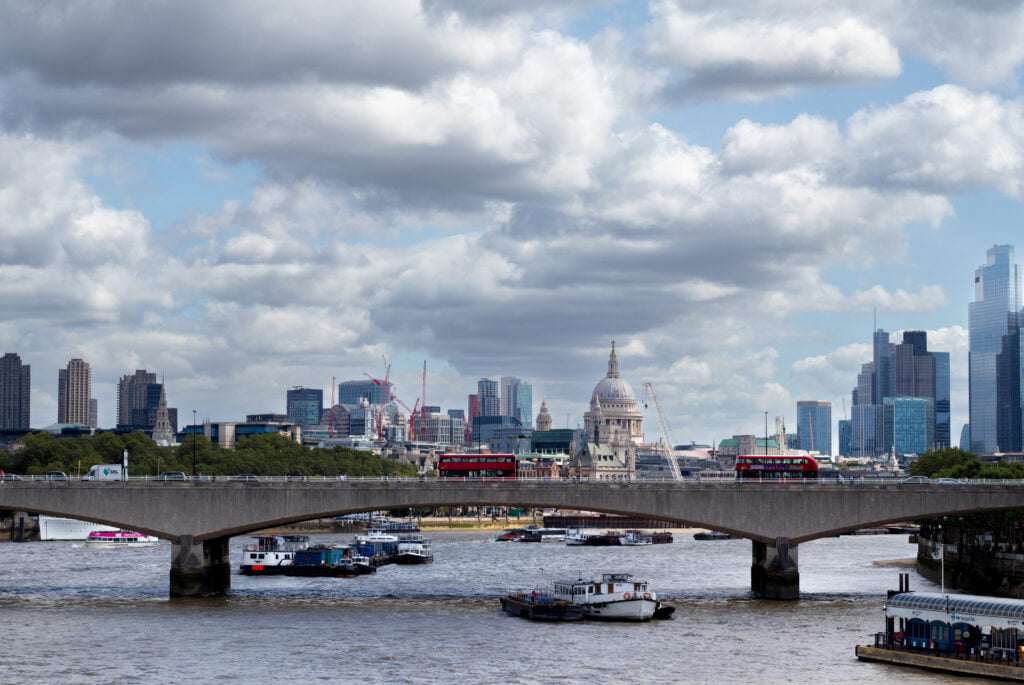
But I did think of him on my recent visit there, and very deliberately took this very Micklethwaitian image as I was crossing the Golden Jubilee Bridge on that Sunday morning.

It has all the elements: iconic London, bridges, several (or more) Big Things and so many cranes.

I think he would have liked it.
And it’s a Quota Photo as well. Perfect.

Not much more to add, really.

An afternoon at the pub

We spent our last Sunday afternoon away in a pub in London and had a drinks and snacks “drop in” session with friends in the London area. The pub – chosen for sentimental reasons and its proximity to Waterloo Station – was Auberge, and we sat outside on the rooftop terrace, amid the delicious noise and clutter of central London.

It was perfect.

The place itself was pretty quiet, although I can imagine it being quite different on a weekday.
On a weekday, for example, I can’t imagine that there would be space for one of the older patrons to finish his lunch and then choose to have a sleep on the couch while his wife patiently read her book.

But as I said, this was a Sunday.

OK. OK. I know what you’re thinking. But it’s just the position of his arms and the flower on the table that make it look like he’s shuffled off this mortal coil. After more than a whole hour later, he woke up, put his sandals back on and went back into real life.

The manager of the place wasn’t entirely happy about the situation when we chatted about it, but truth be told, the sleeping man wasn’t really doing anyone any harm, and reminded ourselves that we have to try to respect older people…

‘Cause one day you’ll be older too
You might need someone who can pull you through

…even when they fall asleep in your bar.

He let it slide when he heard that we weren’t bothered by it.

I’ve seen a lot of people fall asleep in pubs before. I’ve had to wake them up, help them outside and put them in taxis home on several occasions, when I’ve been working in various drinking establishments. But the clear forethought and preparation of this one was certainly different from those.
There’s almost a certain amount of respect due for his chutzpah, even if he himself was being rather less respectful to those around him.

Anyway. It made for a blog post.

And so to London

Probably the best city in the UK beginning with L. OK. Lincoln isn’t bad.

But from there, it’s a disastrous list: Dirty l**ds, Liverpool – “The City of Victims” – and Leicester.
And Luton isn’t a city, but would only drag the letter further down if it were.
L got a raw deal in the UK.

Heading worldwide, there’s a surprise Italian entry.

But I digress (often). We’re London-bound today for the last – and shortest – leg of our brief trip back up North. London City airport is the landing strip of choice – a new one for me – and I’m looking forward to grabbing a window seat and hopefully snapping a couple of pics as we come in over… well.. the city.

At the time of writing, I’m not 100% sure I’m even going to be in London for half the time we planned to be in London. More on that later, if and when plans develop.

For now, it’s goodbye to the Isle of Man. Until next time.

Do Solar Panels work in hot weather?

It pains me to have to post stuff like this.
It’s just simple common sense. Of course they do.

And yet…

This is quite clearly BS, and if you need to be told that it’s BS, you probably also need to seek professional help.

Yes, the UK switched on a coal-fired power station a few weeks ago.
No, it wasn’t because solar panels stopped working.

…liberal-minded news outlets like The Guardian blamed maintenance at nuclear plants in Scotland and inter-tie maintenance on an undersea cable from Norway.

And much as I’m no fan of the Guardian, oddly on this occasion, it turns out that they were far more likely to be correct than those making the assertion that it got too warm for PV panels to work properly.

They’re built to function from -40C to +85C. Performance does fall when temperatures go above 25C, but only by 0.34 per cent for every additional degree. That’s pretty marginal stuff, according to Solar Energy UK. Even at close to boiling point, power output would only be around 20 per cent lower it says, other factors being equal.

“It’s not actually a big deal. High temperatures only marginally affect the overall output of solar power – it’s a secondary effect” says the UK’s leading technical expert on the technology, Alastair Buckley, Professor of Organic Electronics at the University of Sheffield.

Yet another example of someone who read something on Facebook believing that they now hold the same expertise as someone who has been studying the subject for their whole academic career.

It got up to a whole 30C, which is hot for the UK in June, but isn’t really hot when you compare it to the rest of the world. If this temperature had really wiped out the UK’s solar energy production, then basically, no country within a band 50 degrees north to 50 degrees south would be able to utilise solar panels.

Add in the countries north and south of there that can’t use solar because there isn’t enough sun (a genuine concern in placed like Svalbard) and suddenly that’s basically the whole world.

So why would any columnist try to paint this clearly incorrect picture, seemingly in a bid to discredit renewable energy?

Well, I guess it depends on the columnist:

Shaun Polczer is the Business Reporter for the Western Standard, based in Calgary. Formerly, a business reporter for the Calgary Herald, he has also held senior positions at the Daily Oil Bulletin, and the London Petroleum Economist.

Oh.

Sadly, the comments beneath his piece (I’m not giving him any extra traffic by linking to it), tend to suggest that the ability to think rationally and critically might also have been knocked out by the heatwave.

Next week: Why do ice skates not work in the cold?

Long haul

We’re flying today. Total time in the air should be around 18½ hours (Cape Town is long way from anywhere), but then when you add check-ins and door to door stuff, you’re probably looking at nearer a whole day.

We could have gone on a much more direct route (and potentially avoided this), but that wouldn’t actually have saved much more than 3 or 4 hours and would have wasted half a day at the other end. It would have also cost a lot more (like almost double), and to be honest we would rather spend that money on experiences and beer than on a slightly more direct flight.

That slightly more direct flight would also be on a very old plane, instead of the shiny new ones we will be enjoying.

And although BA have now done away with their 747s, they are still running 777-200s mostly built in the last century, on the Cape Town route. Those outdated aircraft don’t offer much comfort for passengers, given that it’s their 5th longest flight at around 11½ hours.

BA’s longer flights are:
4: Gatwick to Mauritius (also on 777-200s and doubly awful because you start at Gatwick)
3: Heathrow to Singapore
2: Heathrow to Buenos Aires
1: Heathrow to Santiago

That discomfort noted, it’s worth remembering that BA have been flying to Cape Town for over 90 years now. The first flight (albeit operating under Imperial Airlines, rather than the BA name at the time) was on January 20th 1932. The distance of er… 6000 Miles… being a bit much for aircraft back in those days, there were numerous stops along the way, and the journey took 11 days rather than 11 hours.

Better book a bit more annual leave.