Caracal Capture

Remember the Caracal (Caracal caracal) that was eating penguins?

Good news from the Urban Caracal Project this morning – they think that they have caught it:


This is Disa – a “healthy adult female” – who will now be radio-collared and relocated some distance away from Boulders Beach.

Yes, it’s a bit dark, but isn’t she beautiful? Look at that shiny coat – that’s the Omega 3 oils from all those penguins she’s been eating. There’s a lesson here for all of us, and it’s only a matter of time until someone (Tim Noakes) launches the LCHP (Low Carbohydrate, High Penguin) Diet cookbook.

After all, extensive studies in caracal populations (n=1) have shown the obvious benefits of this eating plan.

Scientific names

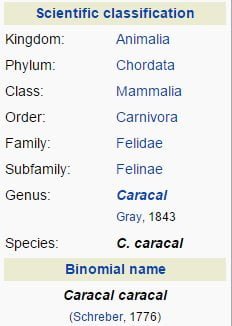
Reading this post, which followed up on this post (which in turn was about this post). I was reminded of the binomial scientific name for the caracal being Caracal caracal.

For those uninitiated types, this scientific name is made up of the Genus name and the Species name. These are (generally) the final two stages of a long process of taxonomic ranking , starting with Domain, Kingdom, Phylum, Class, Order, Family, Genus and Species.
Phew. Thank goodness you don’t to remember all that, unless you’re a biology student.

Damn.

So actually, we just use the last bit of this long list of identifiers:

Fullscreen capture 2016-07-11 103834 AM.bmp

And if you’re a microbiologist, you only ever use the scientific name to refer to your little friends: You’ll likely know about E.coli – that’s just short for Escherichia coli, but they’re all named like that: Staphylococcus aureus, Stenotrophomonas maltophilia, Actinobacillus actinomycetemcomitans, Thermodesulfobacterium hydrogeniphilum being just some examples thereof.

I love my job.

But all that nonsense was merely the preamble. Because now I wanted to know if there were any other binomial scientific names which were just the common name repeated.

Caracal = Caracal caracal, for example.

I actually knew of the lynx (Lynx lynx) as well, which, weirdly, is a pretty close relative of the caracal.

And there are others. Nearly, anyway:

The (American) Bison is Bison bison.
The (Green) Iguana is Iguana iguana.
The (short-tailed) Chinchilla – Chinchilla chinchilla.
The (Western) Gorilla aka Gorilla gorilla.
And who could forget the (Southern) Pudu – Pudu pudu?

LOOK AT IT!!! JUST LOOK AT IT!!!!!!!!!!

And then there are some near misses like:
Rattus rattus, the Black Rat,
The Striped Hyena: Hyaena hyaena and
The Tokay Gecko – Gekko gecko.

But right now, I only have the caracal and the lynx as exact examples of binomial tautonyms being carried across to the common name for an animal.

Incidentally, the caracal also holds the record for being my daughter’s favourite animal, and my favourite wine.

Boxes ticked

Wait – could this be a timelapse [tick] video of an Emirates [tick] A380 [tick] being repainted?

Yep, and obviously, as with every A380-related thing, it comes with some ridiculous stats:

Seven coats of paint weighing 1,100 kilograms were applied on ‘Echo Delta Delta’, covering an area of 3,076 square meters. The entire exterior of the A380 including the fuselage, wings, engines as well as vertical and horizontal stabilizers received a makeover. The paint coats on the fuselage comprised of one layer each of a primer and sealer, followed by three coats of Brilliant White, which is the custom Emirates color, and then two layers of clear coat and decorative paints for the Emirates insignia and logo.

There’s a full description of the process here.

On The Road

Not me. VW. A couple of families travelling right across South Africa (Johannesbeagle to Buffelsbaai to be exact) in Volkswagen vehicles have a fairly implausible number of coincidental encounters whilst ‘On The Road’ before arriving at their respective holiday destinations, only to discover that they will be spending their respective holidays staying just across the road from one another.
What are the chances, hey?

Here’s all 95 seconds of the commercial in question:

Regular readers already know where this is going, and they’re right, because, while the ad is nice and all that, the music is what won it for me.

Thus, step forward Aisha Badru with Waiting Around:

[soundcloud url=”https://api.soundcloud.com/tracks/171788658″ params=”color=ff5500&auto_play=false&hide_related=false&show_comments=true&show_user=true&show_reposts=false” width=”100%” height=”166″ iframe=”true” /]

Limited googlage tells us about this New York singer songwriter with one independently released 4-track EP. Where do Ogilvy SA find these tracks? Amazing.
Apparently, according to her Facebook, she has a new record coming out soon. And, also according to her Facebook, she has a lot of new SA fans.

I’m not surprised.

Weekend photos (sort of)

I found somewhere else with a monitor that actually works, and noted that I need to repair my monitor this evening. Or maybe it’s the video card. I need to repair something, anyway.

The photos are uploaded, but because of the seemingly haphazard and random methods I used to get them onto Flickr, they are in a seemingly haphazard and random order on there. Still, they do represent collections of pixels what I have made, so I guess that they still count.

This one, Saturday’s sunset while we were actually trying to spot the Space Station pass (we did, but it was less impressive than the sunset) is a favourite, but it’s this rather dark one which excites me most.

I wrote here about my desire to improve my photography a bit, and it was through a link to this webpage and a fair bit of tinkering in the icy cold darkness of Suiderstrand over the weekend that I managed to get that shot. It represents a 25 minute exposure, having played around with a million settings to get that far.
Given that it was so very, very cold and I was only bolstered by a sweatshirt and a couple of glasses of brandy, I’d love to have taken things further, but didn’t. With hindsight, I probably should have stuck it out and gone again for something longer. It was an incredibly clear, crisp night, with close of zero light pollution. There will be others though.

But this horribly imperfect image (it’s actually a lot more perfect than the several test shots that went before it) lays down a baseline for future efforts. As that helpful webpage says:

Like anything in photography, but the best way to learn anything is through trial and error and learning through your mistakes… Play around and experiment, it’s the only way to learn, at the end of the day there’s no harm in taking duds, that’s what the delete button is for.

I did this. I followed all the instructions. I tweaked to make the light shots darker, the dark shots lighter, and in the end I got something to build on. Watch this space, but equally, don’t hold your breath.

They’re stars, by the way. Stars.