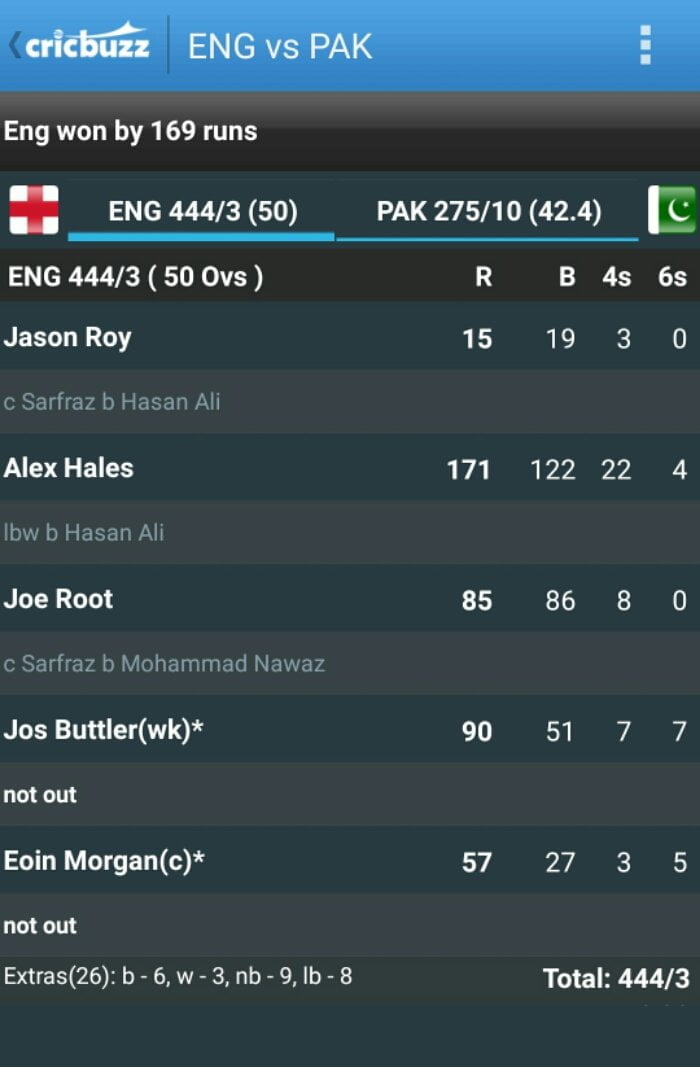
Belated scorecard  

I should have shared this earlier. Or even last night. Still, better late than never.

I remember when SA played the 438 game. Having watched Australia score 434, everyone thought the contest was over. Everyone except one guy in Forries, who I can distinctly recall saying “I dunno, hey? I think we might just do this.” That was during the innings break.

And of course, SA did just do it, scoring 438, and the world is still speaking about it to this day. Yesterday, England blitzed that record, and we should be speaking about that for years to come. Except that the game as a spectacle was ruined by Pakistan not coming close to challenging that monumental total.

Still, it’s recorded for posterity here now. So at least no-one will ever forget.

He’s a keeper

PRAISE your deity of choice. Or, if you’re not that way inclined, just be generally thankful.

Sheffield United have signed a new goalkeeper.

He is fresh in from Cardiff City, where he made 25 appearances after being signed from the Southampton academy.

Look, I’m in no way blaming the current goalkeeper, George Long, for our current woes (but I also kinda am):

wp-1471606555613.jpg

Indeed.
And poor old George Long apparently comes from a whole line of dodgy Blades keepers:

goalie

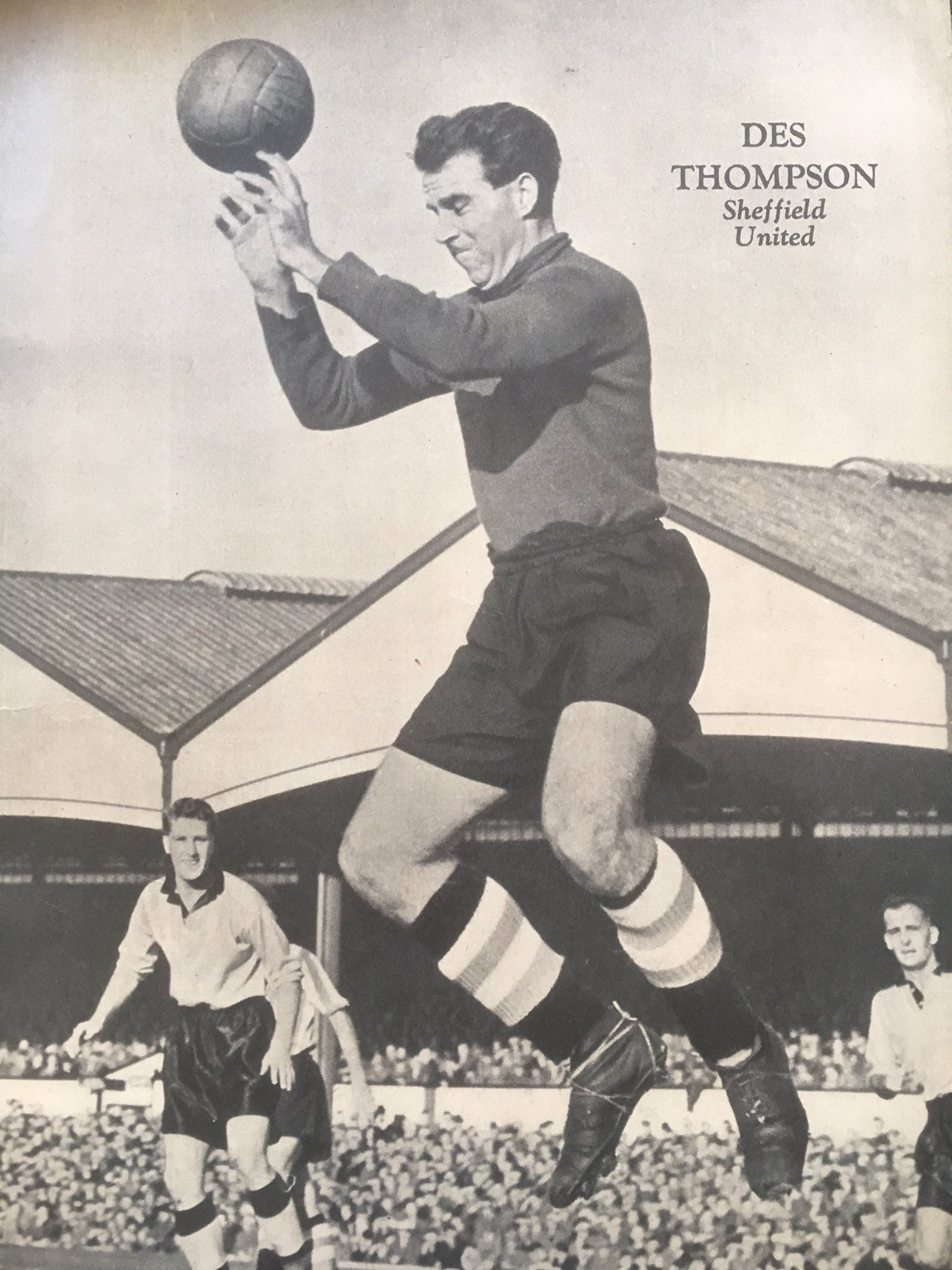
Look at those eyes on the ball. Look at that firm-handed grip.

Des Thompson made 25 appearances for United between 1955 and 1964, before moving to Buxton, which was at that time, not the thriving hotbed of football stardom and celebrity that it still isn’t today.

Des’ brother George was also a goalkeeper, who played for Scunthorpe United, Preston North End, Manchester City and Carlisle United. And, their father (also George) was also a goalkeeper for Southampton.

In the 1929–30 Round 3 match at Bradford City, Thompson allowed a shot to crawl under his body after an awful defensive mix-up for Bradford’s first goal, with Saints going on to lose the match 4–1.

Keeping it in the family.

In form

I did warn people that it was going to be the same old story this season for the MIGHTY Sheffield United. The warning signs were all there: new manager, false hope, a lack of meaningful investment, and the selling off of our top talent.

And, true to form, we lost our first league game, got knocked out of the cup a few days later, and then fumbled and stumbled to scrape a draw at home to… er… Rochdale.

No, I’d never heard of them either.

But tonight is a different story.
Tonight, we play Southend United at Beautiful Downtown Bramall Lane and we are clearly the in form side.

Cp9a6UCWIAAiCaG

Look at those 2 draws. Look at them! 2 draws that Southend clearly don’t have. Lately, at least.

Because the results of football matches can always be decided solely by comparing the recent form of the two teams playing, I am obviously confident in predicting that a victory* is inevitable this evening.


* (or perhaps a draw or a defeat.)

Dead Heat

Filing under Interesting, Really Rather.

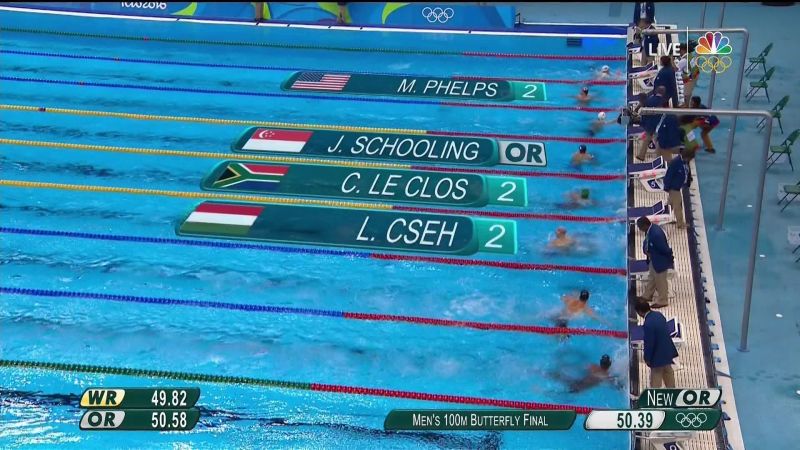
After the three way tie for second between Michael Phelps, Chad Le Clos and László Cseh in the 100m butterfly, you might wonder why the swimming authorities don’t work to thousandths rather than hundredths of a second to separate these athletes.

vhnyosu7cov82wynjmxl

Well, the simple answer is: they can’t.

For the record:

In a 50 meter Olympic pool, at the current men’s world record 50m pace, a thousandth-of-a-second constitutes 2.39 millimeters of travel.

And while that might not seem like a lot (because it isn’t), we are talking about the best swimmers in the world, at the most important swimming event in the world, so these tiny margins count for a lot.

The trouble is, while our swimmers are pushing boundaries all over the place, our pool builders haven’t quite attained the same sort of levels.

FINA pool dimension regulations allow a tolerance of 3 centimeters in each lane, more than ten times that amount. Could you time swimmers to a thousandth-of-a-second? Sure, but you couldn’t guarantee the winning swimmer didn’t have a thousandth-of-a-second-shorter course to swim.

I’ve been doing some rudimentary calculations, and that potential 3cm variation amounts to 12.5523012552 thousandths of a second. That’s 1.25523012552 hundredths of a second. And that explains why timing to thousandths of a second wouldn’t actually be fair. But it’s not like we can do anything about it:

Attempting to construct a concrete pool to any tighter a tolerance is nearly impossible; the effective length of a pool can change depending on the ambient temperature, the water temperature, and even whether or not there are people in the pool itself.

Of course, there are some sports that do time to thousandths of a second – like track cycling and bobsleigh – but the important difference here is that all the athletes compete on the same track. No danger there of Lane 4 being 3cm shorter than Lane 5 (or whatever). If the track isn’t quite the correct length, well, there’s no advantage for any one athlete: it’s the same for everyone.

One anomaly here: speed skating: Yes, they use the same track, but they’re so backward in using a starting pistol to begin races that some competitors definitely start at a disadvantage…