Immortal?

Taking the advice of a colleague, we dined at Panarottis this evening.

Apparently, the chain does great pizza and it is brilliant for kids.

Meh.

The Claremont restaurant that we attended was the dirtiest place I have ever eaten. If I survive this week alive, it probably means that I’m actually immortal. There was dirt. A lot of dirt. And there was a smell too. It wasn’t nice.

The food was cheap and less than average. The service, poor. The kids stuff was frankly rubbish. Mrs 6000’s wine was crap.
The best bits for me were the Black Label and the exit.

We won’t be going there again and neither should you.

Learn a language

As many of you will know, I have family ties to the Isle of Man, that gorgeous little lump of rock ‘twixt England and Ireland. And, on the Isle of Man, they speak Manx Gaelic. Or rather, they did. It’s been dying out now for a long while and the Manx Heritage Foundation have decided to do something about it.

Their latest step in this direction is a free smartphone app to assist people with learning Manx:

The ‘Learn Manx’ app is based on the successful adult language course ran by the Manx Heritage Foundation in the Island and is a fantastic resource for all those who are interested in getting to grips with Manx Gaelic.  ‘Learn Manx’ consists of ten units, each consisting of a variety of activities, whilst two additional revision lessons feature the TT Races as learning tools. The app will eventually cover 30 units in total, providing a fantastic introduction to the language to those unfamiliar with it, as well as a great revision course for those who already know some Manx.

The app development has been supported by a telecommunications company on the island.
Their spokesperson:

It was a pleasure and a privilege to be able to support the Manx Heritage Foundation in a merger between 21st Century technology and our Manx Gaelic language with origins dating back to the 4th Century.
Whether you use the Manx Language App for fun or serious learning it keeps our language very much alive.

And that’s the idea, right?

I’m going to give it a go and see how I get on. There are more gutteral sounds than in Afrikaans, so it might sound like I’m struggling with a nasty cough at first, but pretty soon, I’ll be able to fluently order a pint of Okell’s Ale or fluently find my way to the nearest pub to fluently order a pint of Okell’s Ale.

What could possibly go wrong?

Now all I need is an app to learn isiXhosa as well. Anyone?

Learn Manx (or Ynsee Gaelg) is available FREE from the Google Play store or from iTunes if you’re more Apple than Android.

Android link:


“Almost 100%”

Those of you who regularly read this blog will probably know that I recently switched hosting providers from Site5 “across the pond” to Afrihost, who are much closer to home. People from as far as the UK and the Isle of Man (as well as many in SA) have asked me to let them know how I get on, because they’re looking for good value and good service hosting packages. Well, this post serves as the first report back.

Sadly, since I made the move, I’ve had no end of problems, mainly around the issue of catchy sounding “508 Resource Limit Is Reached” errors. 6000.co.za had 9101 of them yesterday alone.
Even more sadly, Afrihost, a company who I have my home internet and ADSL line, our business internet and ADSL line and a couple of other domains with – based in no small part on their incredible customer service record – have seriously let me down on the customer service front.

Yesterday, I spoke to a guy who told me that he didn’t call me back a couple of weeks ago as he promised because (and I promise you that this is word for word):

The office gets so busy and things get mixed up

Which is hugely reassuring.

But then this morning, an email from their support desk which suddenly cleared everything up:

Hello,

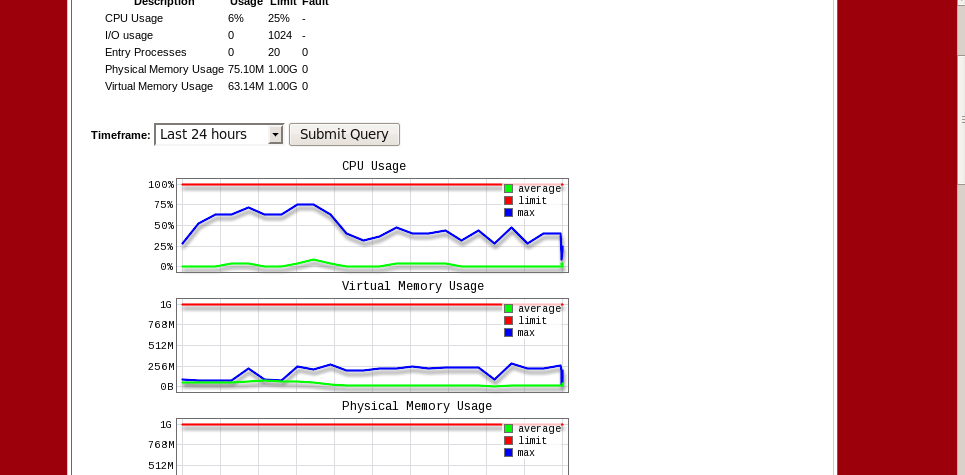
I could see from the cPanel that your CPU usage is almost 100%. Please see the screenshot attached.

Here’s the screenshot in question:

and for CPU Usage, you’ll probably want to look at that top graph titled “CPU Usage”.

Look, maybe I’m missing something HUGE here, but there are three lines on that graph. The red one labelled “limit” runs at 100% and I’m presuming that that’s the limit of the CPU Usage I can do. The blue line (that’s “max”) shows the maximum CPU Usage that I did at any one given time during the 24 hour period. The green line – helpfully labelled “average” – presumably shows the “average” amount of CPU Usage over the given period. In that fourth block, it almost gets up to 15%.

Yikes.

So how does that clear anything up?

Well, what I realised is that Afrihost are obviously very committed to customer care and technical support. They believe that they’re giving it “almost 100%”.
Unfortunately, what constitutes “almost 100%” to them could be viewed very differently by anyone capable of reading a graph.
One could extrapolate and suggest that perhaps the maximum levels they ever reach in any given 24 hour period is 75%, and even then only occasionally. Maybe, on average, their levels are right down on that green line, but remember, they still believe that that represents “almost 100%”.

I have no problem when things go wrong. That’s because things do go wrong. It happens. It’s how you put them right that matters. And not returning calls or emails, overlooking obvious problems and misinterpreting graphs isn’t a good way of putting anything right. It’s now been almost 3 hours since I replied to the email mentioned above – described by Afrihost as “High Priority”. I’ve heard nothing.

Meanwhile, there have been another 6698 “508 Resource Limit Is Reached” errors on 6000 miles… in the last 24 hours.

So would I recommend Afrihost to people as a decent hosting option for their websites or blogs?

What do you think?

La Capra – The Goat Run

My first ever trail run yesterday and it nearly killed me. I felt pretty rough as I crossed the finish line, but it was only this morning when I saw the photo my wife took of me dying recovering in the shade of a handy tree a couple of minutes after that (and no, I’m not sharing it here) that I realised quite how rough I looked as well.

The reason for my unfortunate appearance was twofold: ridiculous heat at 7:30 in the morning in Paarl and ridiculous hills at 7:30 in the morning in Paarl. The two combined to produce a dangerously hot and hellishly steep run up Paarl mountain, which is more mountainous (and hotter) than it looks.

First things first, I didn’t sleep well. I never sleep well when I have an early start the next morning and I never sleep well when my kids wake me up a total of 7 times between midnight and 4am. That said, the last 90 minutes of my night were sheer heaven.

So, up and at ’em with a Red Bull and a Bar One for breakfast and out to Fairview, where the parking was well organised and race registration was a breeze. Goodie bags contained cheese and wine amongst other treats, but I did the sensible thing and left those for later. We stood in the shade of the grape bins and watch the 15km go off just after 7:30, before I lined up for my start at 7:45. And then we were away.

The first km was a dream – records show that I knocked it off in 7’14”; not bad considering the crowds and the terrain – winding through the lower slopes of the vineyards, running literally between the vines, grabbing a grape or two for sustenance on the fly (not really – wrong season) and into the welcome shade of the forest – WHERE THERE WAS A CUNNINGLY HIDDEN HUGE HILL.
To be fair on the organisers, they had said that there were going to be some hills, but to disguise the first one in peaceful, shady woodland was just unfair. Still, I ran up that hill and it was only when I reached the top and emerged into the sunlight that I realised that I wasn’t actually at the the top.

Not anywhere near.

In fact, we climbed and climbed until almost 5km into the “8km” race (more of that later). And after about 3km, I swear that I was more tired than at the end of the Two Oceans Half back in April. Still, onward and (slowly) upward along the well-marked route and I began to realise that trail running probably wasn’t for me. Even trail walking wasn’t feeling particularly attractive. I was getting slower and slower, with a 10’10” for the fourth km and a shocking 11’47” for the fifth. In my defence however, I was overtaking as much as I was being overtaken, so I’m guessing that no-one was finding things particularly easy.
But it was hot and there wasn’t a breath of wind and I was seriously struggling.

At this point, veteran trail runners are probably pointing and laughing.
“Amateur!” they’re saying, and actually they’re absolutely right. Yes I am.

But anyway…
Reaching the summit of Paarl mountain, 4.84km in and 566m up, I chucked down a couple of cups of coke and a couple of cups of water (one in, one on) and started the descent. Even though I’m usually great at going downhill, for the first 500m my legs were still in shock and it took a great deal of persuasion to convince them that we were now heading back down towards the place with wine and an air-conditioned car ride home. But I have to say that once they realised that we were heading in the right direction (downwards), they came along and joined the party. I banged out a 6’22”, a 5’59” and a 5’37” and all was finally going well.
Eagle-eyed readers however, will be wondering how I hadn’t actually managed to finish the 8km race, despite having run 8km. Well, this was because the 8km that I had run had actually left me some way short of the finish line (and with it, the wine and the air-conditioned car ride home).

Truth be told, this didn’t seem to put my legs off and I actually slipped in a fairly magnificent (given the situation) 5’30” for the ninth km. Even then though, Endomondo tells me that I had another 650m of hard graft to do to get myself over the finish line.
It was the longest 8km I’ve ever run. By exactly 1650 metres.

And the time? 1:12’41” for an average of 7’31” per km which I was hugely happy with. “Yay me.”

Yes, there are aches and pains today, quads and calves being the main areas of concern, obviously. But nothing that won’t be sorted by Tuesday, I don’t think. (I’m not saying which Tuesday though.)
So will I try it again next year? Yes – and it should be easier now I know what to expect, although how one can train for those hills and that heat, I actually have no idea. Run up hills like those in that kind of heat, I guess?

All in all, a really testing, but eventually enjoyable run. Things at Fairview were really well organised and the route was really clearly marked all the way round. If I was pressed, I’d vote for an earlier start time (it was already foolishly hot at 7:45) and a more accurately measured distance. Also, if they could maybe take a couple of hundred metres off the top of that mountain, it would probably make things much easier for all concerned.

Incidentally, the winner of the 15km race clocked an average of 4’20” per km for his run.
But I bet he missed the awesome views from the top.

Knot good

It’s one of those pet hates; when you pop you headphones in your pocket and the tangle elves get to work tying all sorts of knots in them, meaning that listening to music the following day takes 10 minutes longer than you had planned.

Well, it’s not your fault. I’ve recently learned that you can blame PHYSICS!

A duo at the University of California found no elves (durr – they’re invisible!) but they did find some PHYSICS!

It is well known that a jostled string tends to become knotted; yet the factors governing the “spontaneous” formation of various knots are unclear. We performed experiments in which a string was tumbled inside a box and found that complex knots often form within seconds.

From that initial line, maybe the best way to avoid this difficulty is not to jostle your pockets. Some men may find this rather taxing.

We used mathematical knot theory to analyse the knots. Above a critical string length, the probability P of knotting at first increased sharply with length but then saturated below 100%. This behaviour differs from that of mathematical self-avoiding random walks, where P has been proven to approach 100%. Finite agitation time and jamming of the string due to its stiffness result in lower probability, but P approaches 100% with long, flexible strings.

Basically, all other factors (and basically, this means trouser jostling) being equal, the longer your cable, the more likely it is to knot.

There are graphs, photos and a whole raft of other formulae and statistical explanation in the paper. I did my best to work my way through it and, despite falling asleep twice, managed to get to the end.

Imagine my disappointment when I found that they had not even bothered to provide a solution for this horrible phenomenon.

Science is amazing and science can be used to demonstrate amazing things. You only have to look at some Austrian bloke jumping from what appeared to be a large, old-fashioned kettle on the edge of space to see this. But all those amazing things are no use if they can’t be put to practical use. Lest we forget, Felix’s freefall allegedly taught us that we could safely eject from spaceplanes of the future (ok, bit of a stretch there in attempting to justify their expense sheet by the guys at Red Bull perhaps, but still).

But this, for all their efforts:

The experiment was repeated hundreds of times with each string length to collect statistics.

gives us just that. Statistics. And they are statistics that say that if you put your headphones in your pocket and you jostle (or even if you don’t), you are going to end up with knotted cable.

This is no help whatsoever and I feel that I must apologise on behalf of science. In my humble opinion, experiments with no practical application should be banned. Physics should be banned. Raymer and Smith have dragged its name through the mud.

And if those bans leave us with no more skydives from space, well so be it. The likelihood of me ever having to evacuate a spaceplane seems rather small when compared with the likelihood of me having to untie another sodding knot in my Sennheiser CX300II’s every time I take them out of my pocket. And no, I am not a serial jostler.

Science must provide answers and solutions. Otherwise we might as well just all study the arts.