Axonometric station maps

You what what?

Axonometric projection is a type of parallel projection used for creating a pictorial drawing of an object, where the object is rotated along one or more of its axes relative to the plane of projection.

Got it now? No. No, you haven’t.
And so, because a picture is worth a thousand words, here’s a picture.

wood-green

[click it for bigness]
It’s an axonometric representation of Wood Green Underground Station. So now you can see what I mean.
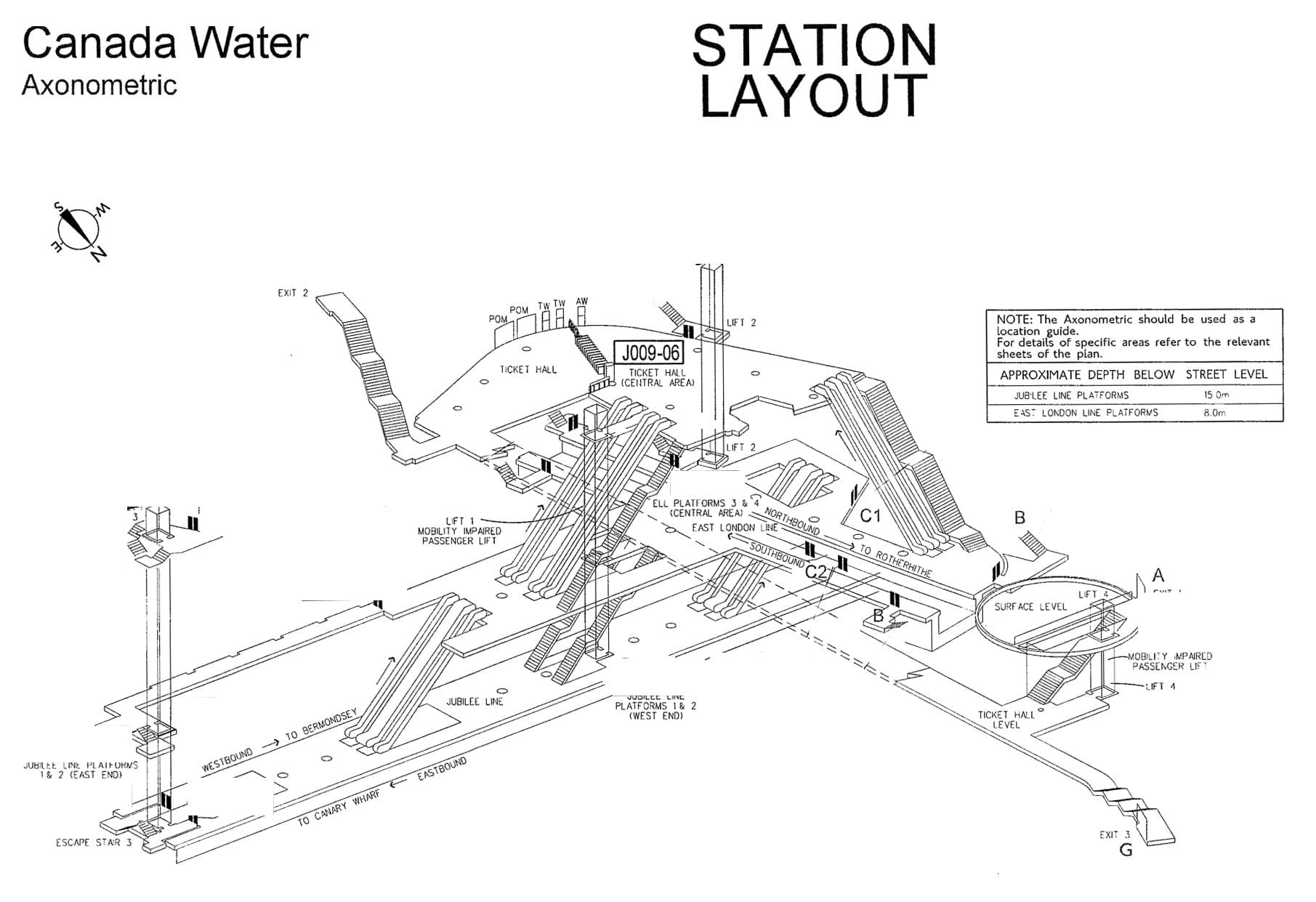
Ian Mansfield of ianvisits.co.uk documents the results of a Freedom of Information request to TfL. They were obliged to hand over axonometric representations of all the stations on the London Underground, which he shares on the link above.

Look, Wood Green is a simple station, out of town (so not too deep) (12.8m) and on a single line, perfect for illustrating what an axonometric map is. Get into some of the bigger stations though and things get complicated:

Westminster:

westminster

or Canada Water:

canada-water

I suppose that these will mean more to you if you’re a Londoner, or if you used to live there. And not all the stations are shown (indeed, there are actually only 120 out of the 270 on the system), but it’s still quite fun to look at.

No?

Just me then.

Travel time

Commitments in places that aren’t Cape Town mean that I’m not around to blog today. But never fear: I saw this situation arising some time ago and I have pre-prepared a pre-prepared post for you.

(Before you get too excited and thankful, it’s not very good)

Since I’m travelling today, I thought we might do something geographical, so herewith the wikipedia page of the Extreme Points of Earth.

It tells you interesting things like where Point Nemo (so called because people are always trying to find it) (possibly, anyway):

The Pacific pole of inaccessibility (also called Point Nemo), the point in the ocean farthest from any land, lies in the South Pacific Ocean at 48°52.6?S 123°23.6?W, which is approximately 2,688 km (1,670 mi) from the nearest land (equidistant from Ducie Island in the Pitcairn Islands to the north, Maher Island off Siple Island near Marie Byrd Land, Antarctica, to the south and Motu Nui off Rapa Nui in the north east).

I’m not going anywhere near Point Nemo. Unless things all go a bit MH370.

And:

The most remote airport in the world from another airport is Mataveri International Airport (IPC) on Easter Island, which has a single runway for military and public use. It is located 2,603 km (1,617 mi) from Totegegie Airport (GMR; very few flights) in the Gambier Islands, French Polynesia and 3,759 km (2,336 mi) from Santiago, Chile (SCL; a fairly large airport).

I’m not going anywhere near there either.

All in all, it’s pubquiztastic stuff though. So get learning, because I’ll be organising a test just as soon as I am back.

Trance Monkey Update!

The monkeys are safe! Remember when we told you that the monkeys were going to go crazy by the doof-doof sounds of the Astral Circus party at Monkey Town in Somerset West this weekend (he said without taking a breath)?

Regular reader and (now) part time, informal trance party correspondent for 6000 miles…, AniB, got in touch this morning with great news:

That link takes you through to Astral Circus’ Facebook page, where they state:

I’m sure most of you have read the article about Astral Circus regarding how the sound is going to affect the monkeys and animals surrounding the venue.

I’m pretty sure they meant Monday’s post on here.

A sound test was done today and we’re happy to announce the sound doesn’t reach the monkeys therefore it will cause no harm to any of them.

THE PARTY WILL GO ON!
-SAME VENUE
-SAME TIME

See you on the dance floor.

Well, look. I’m glad they’ve done the responsible thing and tested the sound levels. And I hope that the SPCA are ok with the party going ahead now, but you can’t help but feel a little sorry for the monkeys. One can only imagine that they had been looking forward to several (or more) hours of chilled vibes kicking off with local bad boy (I actually have no idea if he is local, bad, or indeed a boy) Hoax and moving on to the likes of DJ D-rANg3D, Phixius, Satori, the hugely anticipated trance-off twixt Psyden and Erreur (“They teach you there’s a boundary line to music. But, man, there’s no boundary line to art”), before culminating with the magic musical dreamweaver that is Psyfunk.

Instead, all that they’re able to look forward to is some peanuts and (possibly) an extra banana on Sunday morning.

Unless, of course, we can crowdfund a few tickets for them…

Industry Experts say…

I was just wandering around Bloomberg.com articles from 8½ years ago, when I came across this one by Matthew Lynn – a Bloomberg News columnist.

“The opinions expressed are his own.”

says the disclaimer at the bottom. Looking back now, I bet Matthew wishes that the opinions expressed had absolutely nothing to do with him, given that the headline is this:

Apple iPhone Will Fail in a Late, Defensive Move

Ugly.

In other Apple related foolishness, there’s that famous thing that golfer Rory McIlroy shared in 2012:

If anyone is having a bad day, remember that today in 1976 Ronald Wayne sold his 10% stake in Apple for $800. Now it’s worth $58,065,210,000

Because yes, if you are having a bad day, it’s somehow comforting to know that someone has had a worse day than you. Thus, in the same way, if you’ve ever thought that you might have been massively wrong on something, take a look at the link above, because you won’t have been more wrong than Matthew.
Matthew has taken the proverbial biscuit when it comes to being wrong. Publicly wrong. Wrong on the internet, where no-one ever forgets and stuff like this gets brought up on top class South African blogs on Monday mornings 8½ years later. That wrong.

There’s some deep insight from the industry expert, as he states with the sort of confidence that only an indusrty expert can state:

The iPhone is nothing more than a luxury bauble that will appeal to a few gadget freaks. In terms of its impact on the industry, the iPhone is less relevant.

Well, yeah. But no.

Matthew wades through plenty of incorrect assumptions and erroneous assertions before coming out with this blisteringly mistaken final paragraph:

The mobile-phone industry is becoming a cozy cartel between the network operators and a limited range of manufacturers. It could certainly use a fresh blast of competition from an industry outsider.
It may come – but probably from an entrepreneurial start-up somewhere. How about phones with fewer gadgets but better at making calls? Or with never-ending batteries? Or chargers that don’t weigh three times as much as the phone?

It won’t come from the iPhone. Apple will sell a few to its fans, but the iPhone won’t make a long-term mark on the industry.

Look, credit where it’s due – we’re still waiting on the never-ending battery (wo-o-oh, wo-o-oh, wo-o-oh) (sorry), but “phones with fewer gadgets but better at making calls”? Hahahahaha, because this is 2015 and we don’t talk any more.

Thankfully, as far as I am aware, Matthew Lynn is still around and the continual resharing of his 2007 column hasn’t yet driven him to suicide. That’s good, because if we weren’t reading his opinion pieces, how else would we know that the Pope is going to renounce his Catholicism in 2016?

Infinite Bridge

Here’s one for the bridge fans among you. It’s Gjøde & Povlsgaard Arkitekter’s Infinite Bridge in Aarhus (in the middle of Aarstreet), Denmark.
From above, it’s rather London Eye, isn’t it?

…but flat.

Say archdaily.com:

The Infinite Bridge has a diameter of 60 meters and is positioned half on the beach and half in the sea. It consists of 60 identical wooden elements placed on steel pillars housed about two meters into the sea floor. The deck of the bridge rises between one and two meters above the water surface depending on the tide. The curvature of the bridge follows the contours of the landscape as it sits at the mouth of a small river valley extending into the forest from the beach.

No fence. But Danish people are known for their sense of balance and are generally great swimmers, so it’s all ok.

Described by its designers as an opportunity to “experience the changing landscape as an endless panoramic composition and at the same time enter a space of social interaction with other people experiencing the same panorama” (i.e. there are views and crowds) (c.f. iterum London Eye).

It’s a very pretty thing, as you can see on the gallery at the link above, but while it is a bridge in that is is:

a structure carrying a road, path, railway, etc. across a river, road, or other obstacle.

it’s not exactly very functional, is it? And yes, I know it’s not meant to be functional – I do recognise that it’s sculpture, it’s “a true art piece”, but while you’re admiring the images of it – check out its little companion at the bottom of that pic above.

(c)_-_DANISH_TMIt’s basically a plank over a stream – an ugly, disappointing, almost pitiful effort against that sweeping, circular path of beauty next door. But look at how good it is at effectively carrying people from one side of the stream to the other. See how they can continue their onward journey. Note how they are physically able to access another place by using it.

So sure, the infinite bridge is the big, headline-grabbing principal player in this story and I’m sure it’s a wonderful addition to Aarhus’ landscape, but maybe there’s a lesson here to never forget the ordinary, hard-working backroom team that allow the star to shine.