Here’s what we found on the beach today:
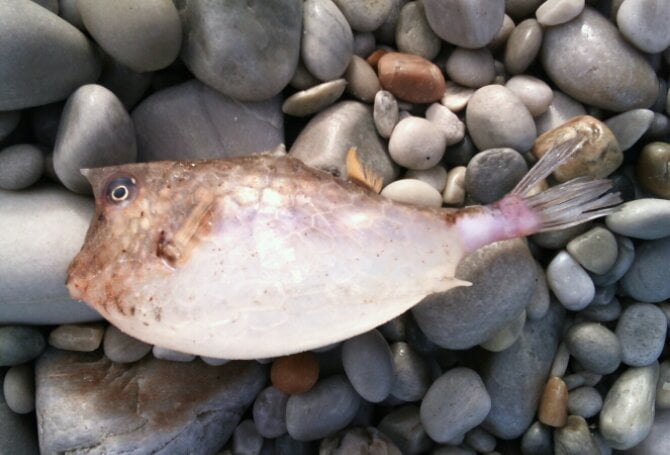
My readers will recognise this as a Spiny Cowfish (Lactoria diaphana).
I didn’t recognise it until I checked my reference books. Now, I’m the local expert on Spiny Cowfish.

Here’s what we found on the beach today:
My readers will recognise this as a Spiny Cowfish (Lactoria diaphana).
I didn’t recognise it until I checked my reference books. Now, I’m the local expert on Spiny Cowfish.
Cooking blogs are all the rage and who am I not to jump on the bandwagon?
Having decided to “invite” Mrs 6k and her mother around for Mother’s Day lunch, I asked what I should cook for them. My wife thought for a moment and then said that she would prefer something “not too fancy” and suggested something using just one pot “like a paella”. I’ve been married to Mrs 6k for over 7 years now and I am well versed in picking out her subtle hints. Still, it’s important to realise that I’m still my own man. So, taking everything into account, I decided to make a paella.
Never having made a paella before, I quickly taught myself Spanish before heading to the internet and asking that trusted source of pukka recipe goodness, Mr James Oliver. His straightforward, step-by-step instructions took me though the previously unknown vagaries of cocina española, thus.

I don’t have a paella pan, so I made do with a wok, doing my bit and cementing sino-Spanish relations. And it went quite well, if I say so myself. The best bit is that we have about half of it left (simply because of the volume, not because anyone turned their nose up in disgust), so that’s lunch sorted for a few days ahead.
So, my advice to you. If you want to make a paella and you have a wok: do it.
Much rejoicing Chez 6000 as it appears that after my only partially successful repair of iTunes last week, I have managed to find another 1788 tracks that were “missing”. I’m still not 100% sure that I will be able to get them onto iTunes, but at least they’re safely somewhere on a hard drive. The next step might be a little messy, but it should be pretty straightforward.
The tracks disappeared when I plugged in my daughter’s prize from Kfm (not that I’m blaming her or them) – a shiny little iPod shuffle she got for dancing in the rain while watching the Two Oceans Marathon last month.
It brought up a beautifully clean iTunes window, to which I added some songs she liked (Coldplay, Freshlyground, Slipknot etc) and all seemed well. However, when I later plugged my Big Daddy iPod in, iTunes comprehensively failed to revert to my previous library, leaving me with about 30 tracks, some of which were by Shakira.
Issues.
I have since pieced together a rudimentary replacement library, but there were gaps. Massive gaps of several thousand tracks.
I had to root around on external hard drives and the like, but with today’s discovery, there’s “only” a discrepancy of about 900 items. I have yet to check whether they are important items, replaceable items or stuff I can (or will have to) manage without. This may be a difficult task, since sometimes, I’m just heading to the lab when I have a “must listen to” moment. It will be then that these discrepancies will become immediately obvious. Rage will surely ensue.
My advice to you if your 3 year old wins an iPod is not to plug it into your computer. At all. The best way is to find another computer and use iTunes on there. Or sell it on gumtree. It will save you sleepless nights, much wailing and gnashing of teeth.
I’m sure that there is a safe and surefire way of running two (or more) iPods from the same computer. More fool me for ever imagining that Apple would have made it as simple as just plugging the new device into the USB port.
By all means, let me know the best way of doing it in the comments section below, but don’t expect me to let that little silver square anywhere near my desktop ever again.
Capisce?
They say that a picture is worth a thousand words, but this… umm… “interesting” Descriptive Camera suggests that it’s probably nearer twenty.
The Descriptive Camera works a lot like a regular camera—point it at subject and press the shutter button to capture the scene. However, instead of producing an image, this prototype outputs a text description of the scene.
Wait. What?

Yes. There’s no picture here, just a brief description of what the picture would look like. So how does it work?
The technology at the core of the Descriptive Camera is Amazon’s Mechanical Turk API. It allows a developer to submit Human Intelligence Tasks (HITs) for workers on the internet to complete. The developer sets the guidelines for each task and designs the interface for the worker to submit their results. The developer also sets the price they’re willing to pay for the successful completion of each task. An approval and reputation system ensures that workers are incented to deliver acceptable results.
Each “picture” costs $1.25 to “develop” and the process typically takes around 6 minutes.
The inventor, Matt Richardson, suggests that being able to file data about the contents of a photograph would be useful in searching, filtering and cross-referencing our photo collections. This rather clumsy (but still clever and innovative) system explores the possibilities of what being able to capture this data in this in the future might mean.
No-one can deny that the latest fatal shark attack in False Bay was a tragic event. David Lilienveld, a 20 year old body-boarder from Camps Bay who had represented South Africa in the sport, died after he was attacked at “Caves”, a popular surfing spot at Kogel Bay between Gordon’s Bay and Rooiels.
What’s also tragic is the sudden outpouring of pseudo-expert opinions, many blaming the Ocearch shark project which was taking place in False Bay at the time, for the attack. Of course, understandably, emotions were running high due to the incident yesterday and the controversial, if often over-exaggerated, reports of Ocearch “chumming” the water to attract sharks to tag offered a convenient scapegoat. These accusations were further supported by the director of Biodiversity and Coastal Research, Alan Boyd immediately cancelling Ocearch’s research permit when he heard about the attack.
Now, 24 hours on from the attack, the City of Cape Town has released a report and review of the events yesterday. It’s calm, detailed, factual and rational. Everyone should read it. Especially this bit:
The following critical point needs to be stated. During the attack the sharks dorsal fin broke the surface (as reported by the eye witness Mr Marais). If this shark had been one of the tagged sharks, the satellite transmitter would have given off a signal that would have been recorded on the system and located the shark at Kogel Bay. On assessing the data, no satellite records exist for that area. Two of the sharks tagged in False Bay have given off signals and were located in the Macassar/Strandfontein area shortly before the attack. The lack of satellite signal is clear information that the shark involved in the attack is not one of the sharks tagged by the Ocearch Research Programme.
Further, with regard to public speculation of the role of chum, the following should be noted. White sharks occur in False Bay in healthy numbers throughout the year. The small and limited chumming by Ocearch would not have attracted additional sharks to False Bay as the amount of chum used is insignificant in comparison to natural chum sources in the bay including the natural chum slick emanating from Seal Island, fishing activities in False Bay, by-products from Kalk Bay harbour as well as the small and immaterial chumming by permitted cage divers. Furthermore, the Ocearch Programme operated in False Bay at Seal Island on Sunday and Monday. The wind direction has been strong south east throughout the week. Any residual chum from their activities would have dissipated within hours and, due to the wind direction, moved from the island in an opposite direction to that of Kogel Bay.
As a result, there is no evidence or reason to suggest that the tagging of four White Sharks over a period of 24 hours from Sunday 15 April to Monday 16 April, in False Bay, by the Ocearch Programme had any role to play in the tragic events that occurred at Caves.
Although the City has, and continues to have, no role in the Ocearch Programme, as well as not feeling that it is appropriate, or required, to defend or support the programme, it holds the view that it is essential that the correct and factual information be provided to the public. Public and media speculation linking the two unrelated activities is uninformed and misleading.
Highlighting is mine.
There’s more detail in the report as to why the City has (independently) reached this conclusion, but I applaud them for actually taking the time and effort to put that last paragraph in.
The report also answers several of the questions asked by ZigZag’s Anton Louw in an obviously personal column “Ocearch and the Kogel Baai attack – Searching for answers, finding few” published overnight. There are a few questions still outstanding though, including this one (on the practice of chumming):
Why are almost all the scientists and researchers lined up on the one side of the fence, and the laymen on the other?
When tragic events like this occur, people look for any reason that can explain things. In this case, Chris Fischer’s methods and Alan Boyd’s go-ahead had already raised the ire of the layperson community well before yesterday’s incident. But that ire was based upon misinformation and exaggerated facts (see also: fracking). Do these people really think that the director of Biodiversity and Coastal Research just signed off that research request without some degree of forethought?
Sadly, his kneejerk reaction yesterday in cancelling, instead of simply postponing, Fischer’s permit will lead many to think he did.
And ironically, because of his actions, we will now know less about the behaviour of great white sharks in False Bay; information that could potentially assist in preventing further attacks of this nature.
All in all, it’s another lesson that sometimes bad things happen for no reason. And also that looking at factual information – especially independently reviewed factual information – is infinitely more sensible that leaping to emotional and incorrect conclusions.