More on celebrity death

OK, first off, before we begin, I didn’t write this.
Well, I mean, I wrote this, but I didn’t write the thing that I’m sharing.
So don’t shoot the messenger.

Also, just because I’m sharing this, it doesn’t necessarily follow that I’m talking about you. There are plenty of thoughtful pieces out there (you know who you are) which perfectly describe the writer’s feelings about <celebrity> dying without resorting to hyperbole and the exhibition of apparent Munchausen syndrome.
So don’t shoot the messenger.

Those disclaimers aside though, I did enjoy this piece by Alex Proud in the Telegraph.
Oh, I enjoyed it so much.

On Thursday, Twitter, Facebook and various other social networks echoed with the wails of Prince fans who had come together to publicly grieve the Purple One.

In much the same fashion as the reaction to the death of Victoria Wood barely 24 hours earlier, the sites were soon overrun with comments such as “Can’t stop crying, feel so empty. RIP.”

Inevitably, we then had the immediate backlash, where people pointed out that if you are, say, a 45-year-old Surrey-based facilities manager with two children, who had never actually met Prince, mild sadness might be a more appropriate response than utter devastation.

Then we had the backlash to the backlash, where the mourners attacked those who questioned their heartfelt grief. And so on, like ever-decreasing ripples bouncing off the sides of a pool into which a dead celebrity has been dropped.

But ok. I’d argue that it’s not for me (or Alex, or anyone else) to tell people how they must react to the death of these public figures. Perhaps it’s the instant nature social media, and its enforced brevity that concentrates emotions and the perception of emotions. Add to that the narcissism and the egocentric nature of the platforms, throw in the faux-bravado of the anonymous commenter and the general lack of respect that individuals display for one another these days and you’ve got a recipe for the perfect storm, precipitated by the latest celebrity death.

People are over-emoting everywhere.

So you’ve got those “over-reacting” to the news, and you’ve got those “over-reacting” to those who were “over-reacting”. Because:

If your opinion (and the opinions of those like you) have come to dominate the media and the public discourse, then, surely, others are allowed to find this overwrought and tiresome.

Were these people always around? Was it just that we never saw or heard them?
Or is an entirely new phenomenon that has been spawned by social media?

Either way, we’re going to be seeing more of it, and that’s not good news:

Now, God only knows where it’s going to end. We’ve got an awful lot of pensionable celebrities these days and they’re all going to die at some point. Also, how far down the food chain we can take this? If I’m devastated when Kinga from Big Brother shuffles off this mortal coil, is my social grief any more or less valid than the utter emptiness you felt when Bowie died?

Alex Proud takes few prisoners and that column is worth a read.

UPDATE: As is this wonderful Michael Legge post, via Jacques. Thank you.

Snakes

Not too much time to do anything other than repair last night’s damage, so here’s something I spotted on the Snakes of South Africa FB page earlier.

Yes, obviously it’s about snakes. If you’re frightened of snakes, maybe look away now or something, although, given the title of this post, what were you thinking clicking through anyway?

It concerns the photography of a python. Because pythons are apparently misunderstood:

There is a great deal of myth about pythons, especially with regards to attacks on people. Pythons in Africa do kill people, but rarely so. There are as few as 3 proven cases where people were killed by pythons in Africa in the past 100 years+.

Well, ok, fair enough.

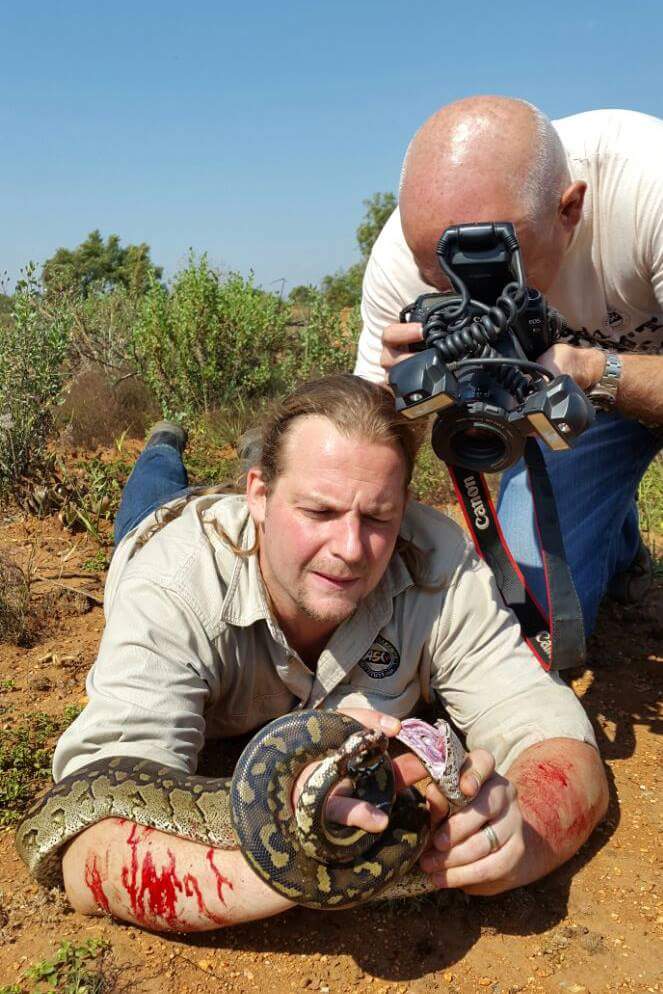
FB_IMG_1461514677140But they can still give you a nibble right? Uh-huh.
Look:

FB_IMG_1461514685272

Apparently, this is “a willing volunteer”. His name is Shawn. Right. I was once a willing volunteer for something far more dangerous than this, but it didn’t involve being bitten by a snake. That’s just silly. Haven’t you heard that they have a mouth full of razor-sharp teeth and the ability to inflict very nasty bites, often resulting in stitches?
You hadn’t?

Pythons do have a mouth full of razor-sharp teeth and have the ability to inflict very nasty bites, often resulting in stitches. The reason is that people pull the pythons off and the sharp teeth rip through skin.

Well, there you go.
But yes, folks. It’s the pulling off of the python which causes the injuries, rather than the actual bite. So next time you’re bitten by a python, just leave it hanging on whatever bit of your body it’s hanging on and wait for the feeding response to subside and it’s grip to subside. I don’t know how long this takes, but if it’s not hours, then it must at least feel like hours. If it is hours then it probably feels like more hours than it actually is.

To finish the set on the FB page, there was an image of Shawn holding the snake’s mouth open for one last snap of those lovely teeth.

LOOK AT HIS ARMS! LOOK AT THEM! THERE ARE BLOODS!

FB_IMG_1461514689655

And (at the time of blogging this), the only comments on that picture?

What flash are you using there?

and the reply:

That’s a Canon MT24EX. Best macro flash there is.

Yeah – because the Canon MT24EX is the most striking thing about that photograph (I’m being sarcastic, but actually it does have some fantastic reviews). What are these people thinking? Why no mention of the copious amounts of claret cascading down Shawn’s manly forearms? And what of Shawn? Is that a look of scientific curiosity on his face there or is he grimacing, wondering why the actual funk he is spending his Sunday morning flat out on the African dirt bleeding from wrist to elbow?

If I were him, I’d be thinking three things:

1. What braai’ed python tastes like.
2. How deep I would be burying the photographer’s body. and…
3. How much I should put the Canon MT24EX on Gumtree for.

I hope Shawn has learned a valuable lesson about volunteering. And some stuff about pythons.

UPDATE: Please see Shawn’s comments in the appropriately-named “Comments” section below.

On celebrity death rates

I posed the question last night on twitter:

Have more celebrities died in 2016 than in other years or are we just more aware because of a couple of deaths early in the year?

David Bowie and Alan Rickman being those two early ones I was thinking of.
No-one answered. Perhaps that was because no-one was sure of the answer. It’s a very difficult thing to measure. The term “celebrity” is hard enough to define, before you even start to look at clog-poppage rates.

But I wasn’t alone in asking. The BBC website featured the same question this morning. And they have come up with an answer of sorts.

Fullscreen capture 2016-04-22 021617 PM.bmp

And that doesn’t take into account Victoria Wood or Prince who were April deaths. So yes, it would appear that so far, 2016 has been a bad year for celebrity deaths. Which bring us to the obvious next question: why?

The BBC’s obituary editor Nick Serpell has got that covered too:

One factor that may play into the impression that more celebrities are dying is that we have heard of more celebrities than before.

and:

People who started becoming famous in the 1960s are now entering their 70s and are starting to die. There are also more famous people than there used to be.
In my father or grandfather’s generation, the only famous people really were from cinema – there was no television. Then, if anybody wasn’t on TV, they weren’t famous.

So, more celebrities, and more older celebrities. Add to that the social media phenomenon, meaning that no celebrities death has a chance of passing unnoticed, and you have the perfect recipe for huge awareness of vast numbers of celebrity deaths. Thus, there have been more celebrity deaths, but arguably, not a disproportionate number of celebrities dying, given that there are just so many more of them around to die.
And, if the BBC guys are right (and I have to say that their logic seems sound) then this trend of increasing celebrity death will continue.

So yes, 2016 has been an utter bastard thus far, possibly taking several (or more) of our favourite actors, singers, comedians and personalities, but sadly, it seems that it’s something we’re just going to have to get used to.

Gripen video

Wow. Just… wow.

You’ll need HD and full screen – the bigger the better – for this.
It’s going on my large Smart TV as soon as I get home this evening.

This comes from SAAB, the Swedish Air Force and production company Blue Sky, and apparently, it’s a big step forward in aeronautical video.

If you want to make a video like this, you’ll need a custom-designed gyro-stabilisation system, a 6k (nice number) Red Dragon digital cinema camera and a $40,000 Canon camera lens.
Oh, and a Saab JAS 39 Gripen multirole fighter at $60,000,000.

But that’s pocket change to make something this spectacular.

Germs, Disease, Infection!

Three health related things for you to know about:

Firstly: Dead reindeer!
You know that awkward feeling when you thought that chronic wasting disease (CWD) was restricted to deer, elk (Cervus canadensis) and moose (Alces alces) in North America and South Korea, but then researchers announce that the disease has been discovered in a free-ranging reindeer (Rangifer tarandus tarandus) in Norway.
Yeah. Exactly. Bad news for free-ranging reindeer in Norway. Glad I’m not going there any time soon.

It is a mystery how this disease arrived on a mountaintop in Norway. Researchers think it unlikely that it was it imported. They suspect that it might have arisen spontaneously, or jumped the species barrier from a prion disease in sheep called scrapie, although such a jump has never been seen before.

Now that it’s there though, history has shown us that it will be hugely difficult to eradicate.
Not great.

Secondly: A comeback!
Scarlet fever struck fear in the hearts of Victorian-era Americans and Europeans. In the late 19th century, it was a leading cause of death in children—killing as many as a third of those who caught the infection.
Not great.
Then suddenly, <sparkly lights>antibiotics!</sparkly lights> and we humans were saved as the Streptococcus spp. succumbed to Alexander Fleming’s penicillin. But now…

…the disease is making a comeback. In 2011, Hong Kong experienced an outbreak that quadrupled in the number of scarlet-fever cases. And, since 2014, England and Wales has been hit by a big outbreak, too. This season, the number of scarlet-fever cases reached a 50-year high.

And no-one knows why. There is no vaccine for Scarlet Fever, so it’s not foolishly impressionable parents making poor decisions based on dodgy “science”. It’s as much a conundrum as CWD in free-ranging reindeer in Norway.
(That’s my new goto metaphor for mysteries now.)

Thirdly: Talking of crimson!
Science, as an entity, was 0-2 down in this post so far, but there’s hope of a late comeback as we snatch a point against the run of play in the treatment of red scrotum syndrome. I’m no expert on this particular condition, but – if pushed – I think I could come up with a guess at both the area affected and the signs and symptoms on said area.
Not great.

We report two cases of red scrotum syndrome responding to oral pregabalin, an anticonvulsant medication commonly used for neuropathic pain. These two cases suggest pregabalin as an effective means for treating red scrotum syndrome and endorse a neuropathic etiology.

Serendipity with the assist on that one, it seems. But either way, I’m sure that anyone suffering with red scrotum syndrome will be relieved to learn that a potential cure has been discovered – by whatever means.