Save Water – Times Live

Here’s local rag The Times reporting on the City of Cape Town’s new water usage calculator website:

If you think it starts with some bad advice (and it does – why immediately double the length of your shower “just because you can”?), then you need to read through again and see how it ends:

Jesus. No. Simply not happening.

Doomed Cape Town

With all the global talk being of the upcoming nuclear war between the USA (+UK, EU, South Korea) and North Korea (+China), I wondered if that was also the biggest worry on the minds of the folk all the way down here in the bottom left corner of Africa.

I chose four things which myself and my Cape Town dwelling colleagues considered particularly worrying right now and employed the most scientific method of measuring local fear that there is: a Twitter poll.

Obviously, we had to start with the whole World War Three thing. Because that’s why we got to wondering about this question in the first place.
Perhaps equally obviously, the drought is in there. Particularly as it’s a ROASTING hot day in the Mother City today and it’s basically never going to rain ever again (tomorrow’s drizzle doesn’t count).
And then, after I stumbled across this Facebook group on the weekend, the Cape Town Tsunami had to get a mention.

Just for the record, the “warnings from multiple sources” which they cite are basically a handful of people who have dreamed about a tsunami hitting Cape Town, like Debbie for example:

A truly mericaluous escape. (What happened to your son, by the way?)

…and the word of a local charlatan Pastor who wants your money “had a vision”. If you want to read more (and you do, because it’s a deep, deep rabbit hole, go and have a look at their 73 (seventy-three) page dossier, full of reasons why the tsunami will take place (not enough people being Christians, shockingly), many details of how it will occur (big wave, mostly), and what exactly will happen:

Every time I stand in Town , Milnerton God tells me and reminds me see this tall buildings they will be completely covered with water
When I stand on Sir Lowreys pass God reminds me only those who come over this pass at that given time will be safe
Snakes will be in the water and bite the people and they will die
It’s almost like those who survive water will die by shark attack or snake bites

Hectic. Milnerton God doesn’t mess around, hey?

But I digress. Often.

The fourth option was one that has plagued the province for time immemorial: the Twitter account of Lord High Empress of the Western Cape. Like here. And here. And… er… here.

Certain individuals have long believed that one of Helen Zille’s tweets would spell the end of the Western Cape… somehow. But is that something that the general public also buy into? Our poll will tell us.

The results are in:

As we can see, the religious nutcases predicting their god-driven tsunami are the least of Cape Town’s worries. Quite rightly, too. They’re not called religious nutcases for nothing.
And nuclear war – an altogether much more likely doomsday scenario – is of limited concern to Capetonians too. Could this be a geographical thing, or is it because they are actually much more panicky about one (or both, but twitter polls don’t allow for multiple voting) of the other potential apocalyptic situations?

And it’s Helen, who takes it by a head, although if I were the drought, I’d be eyeing up a coalition with that impending nuclear war to sneak top spot.

Clearly though, the two options are troubling the majority of Cape Town citizens, and I don’t really think it’s a matter of one winning through over the other. These are obviously both issues that are of huge concern to people here.

Sadly, it seems like the only thing we can do to prevent either disaster actually happening is to cut down on the amount of water we use, and cut down the amount of Twitter that Helen Zille uses. Given the numerous failed attempts by the City Council and Mmusi Maimane respectively to achieve these goals, neither seems very likely to happen any time soon.

We’re doomed, Cape Town. Doomed.

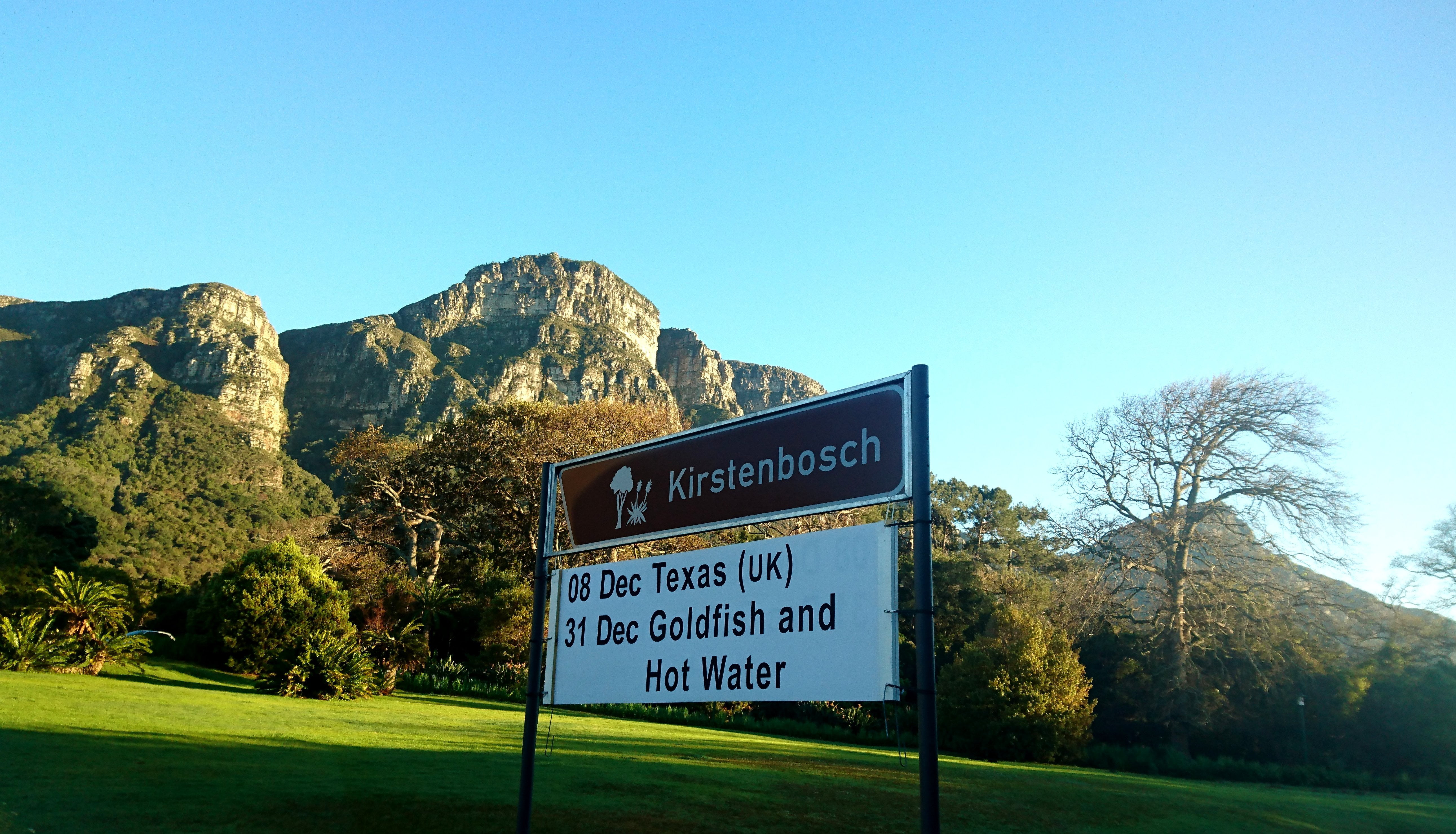
I have questions, Kirstenbosch

Another day, another local sign.

This one is outside Kirstenbosch Botanical Gardens, a place very close to my heart – I actually got married to the long-suffering Mrs 6000 there. So I’m not writing this lightly.

Texas (UK)?

Let’s not beat about the bush here: Texas is not in the UK.

Texas is nearly three times the size of the UK.
Texas would swamp the UK.
Texas is not in the UK.

I asked 100 individuals which country Texas was in* and 99 of them knew that it was in the USA. The other one was a beagle, and you can’t really expect a beagle to know that sort of thing. But then, who knows: maybe the sign was done by a beagle? What they lack in geographical nous, they surely make up for with their sign-writing abilities.

I do understand that as a National Botanical Garden, Kirstenbosch is obviously more about horticulture than geography. But still, publicly displaying this sort of inaccuracy is – at best – embarrassing.

And at worst…? Well, it’s not even the worst bit of the sign.

What sort of repugnant nonsense are you planning on serving in your restaurant on New Year’s Eve?
Literally no-one wants to bring in the New Year with cool fish soup. We’re all well aware of the results of boiling a fish anyway: it’s mingy. It’s absolutely the worst way of cooking fish that exists. That’s why normal people advocate frying or grilling fish, with a touch of lemon or garlic butter, (add seasoning to taste).

Also, why goldfish? How bizarre. Is this the latest hipster fad or something? I also felt that it might be ecologically unsound, so I checked the SASSI lists, but goldfish isn’t even mentioned. That’s because you don’t eat goldfish, you look at them. Serving goldfish soup is the start of a slippery slope. What next? Sautéed hagfish? Parrotfish bisque? Ugh.

You simply don’t need to do this. Play to your strengths. Just do plants.
That’s what you’re good at. Plants. Do that.

But maybe I’ve got this all wrong. Again.
Maybe this isn’t a meal at all, but rather just a spectacle. How very cruel.

We’re all well aware that the average goldfish is able to survive in a range of temperatures, from near freezing right up to 30ºC. But 30ºC is merely warm. However, ‘Hot Water” would suggest something well in excess of that. And while the goldfish may be able to briefly tolerate this higher temperature environment, the amount of oxygen dissolved in the water will decline as the temperature increases, meaning that the goldfish will struggle to breathe and eventually die or be cooked. Or both.

It’ll probably make a horrible whining noise as it expires. Goldfish usually do in my experience (Rocking The Daisies, 2013).

For your information, I will be reporting this sign to the SPCA and the Two Oceans Aquarium. I would also have reported it to some local geographical society or other, but I literally couldn’t find one that still existed. Maybe that’s what’s behind the Texas (UK) debacle.

Please, Kirstenbosch. Don’t put the anyone through such unnecessary cruelty. Let’s go into 2018 on a high note (and I don’t mean the last squeals of an expiring Goldfish). There’s enough to see and do in Kirstenbosch. You don’t need gimmicks like this.

Please reconsider.


* obviously, I didn’t really do this. I have a full-time job. 

Poor Chalkboard

Here’s an image of the A-frame chalkboard outside a popular ice cream parlour in Claremont, Cape Town.

Ja. As you may have guessed, I have a few issues with it.

Let’s break it down into two handy statements, shall we?

Coffee as warm as a firefly’s nose.

Firefly is the common name for the Lampyridae family of insects in the beetle order Coleoptera. They’re called fireflies (or lightning bugs) because they use bioluminescence to attract mates at twilight:

The enzyme luciferase acts on the luciferin, in the presence of magnesium ions, ATP and oxygen to produce light.

All of which is biologically amazing, visually incredible and weirdly somehow rather romantic. But the reaction doesn’t yield any significant heat, and it certainly doesn’t happen in their noses (they don’t even have noses).

Fireflies produce a “cold light”, with no infrared or ultraviolet frequencies. This chemically produced light from the lower abdomen may be yellow, green, or pale red.

Not “warm” then. And certainly not hot (71ºC – 85ºC), which is the temperature I generally like my coffee to be.

Mmmm.

And then that second statement:

Ice cream as cold as a polar bear’s toes.

I have some bad news for patrons of this particular ice cream parlour. Ice cream is best served at around -12ºC, while polar bears’ toes (such as they even exist) are maintained at a decent 37ºC, just like the rest of their body.

Polar bears are mammals, brilliantly adapted to their habitat in the Arctic. They have blubber and thick, air-filled fur, which allows them to survive in the sub-zero temperatures in the polar region. Their paws are no exception to this. If they were not kept at 37ºC, the polar bear would get frostbite, which without prompt surgical and antibiotic treatment, would likely develop into gangrene and septicaemia, and inevitable death.

There’s also an additional problem. Polar bears’ toes are smelly. They stink. This is due to prominent sweat glands on their paws, and the fact that that the bears use their feet to tread urine into the ground and ice. It’s simple scent communication, but it’s really not something that I want my ice cream to be associated with.

So. Nice rhyme, but wholly inaccurate. Very poor.
Let’s sort that it for them:

Coffee as warm as the current ambient conditions at The Creamery.
Ice cream served at body temperature, with a slight smell of sweat and wee.

That kinda works, and I bet that brings the customers flocking in.

Thank me later.

Pairs of animals

This is a post about pairs of animals. Not since the mythical days of Noah and his big wooden boat have so many animals been paired up – and he didn’t even do it in a blog post.

It’s two, by the way. Two pairs of animals.

The first pair is a hawk and a snake. Sadly, neither of them is with us anymore, after a disastrous electrocution incident in northern Montana, USA. It’s believed that the hawk, fancying a sssssnack, swooped down and picked up the snake in its talons, before retreating to a convenient local power line in order to eat its prey.
Ssssssadly, the snake must have been dangling beneath the hawk and touched one of the other power lines as the bird came in to land. If any hawks are reading this (and they might be, because they have eyes like a… like a haw… well look, they just have really good eyes, ok?), let it be a lesson to you to always hold your lengthy prey somewhere in the middle, to prevent excess danglage.

Both the snake (already in a great deal of peril) and the hawk (peckish (no pun intended), but otherwise largely doing fine), were electrocuted and died.

Hawkward:

Their still smouldering carcasses then fell to the vegetation below and started a fire which consumed 40 acres of Montana.
Look, if you’re going to go, go bigly.

The hawk and the snake aren’t the only ones to have started fires. There’s a whole list of animal arsonists on that site: squirrels, dogs, pigeons, kites. They’re all at it.

Our other animal pairing is elephants and bees. They haven’t (to the best of my knowledge), been arsoning together. In fact, elephants aren’t huge fans of bees at all, and would much rather stay well away from them, like some pachyderm/apian apartheid situation.

“So what?” I hear you ask. “At least they aren’t starting fires.”
And yes, that’s great news for African farmers, but what’s even better news for African farmers is that they can use bees as a natural deterrent to keep elephants off their crops:

In more than a dozen studies, Dr. King and her colleagues have experimented with beehive fences on East African farms, finding that the region’s indigenous bee, Apis mellifera scutellata, can turn elephants away. A notable long-term trial on farms outside of the Tsavo East National Park found that hive fences deterred 80 percent of elephant raiders compared to unfenced plots used as a control group.

And then, because the farmers need to keep the bees happy to keep the bee numbers up to make the fences effective, they can tap off the honey – which is made by the happy bees – for a second income stream, while reaping more from their original, more traditional crops. Everyone’s a winner.
Apart from the elephants, obviously.

If you have any more interesting (or not) stories about pairs of animals and how they can affect our daily lives (if we’re in Montana or Chad), then don’t hesitate to get in touch and we might even share your tale on 6000 miles…