…comes this absolute bombshell suggestion from the UK:
You know me: I like to see some scientific evidence for these sort of wild claims, but I might just give this one a go for the rest of the day, and see if there are any positive results.
Love him or hate him (or just see him as yet another ANC cadre deployment that will increase the ministerial wage bill while providing absolutely no tangible difference to the issues he is supposed to be fixing), the new Minister of Electricity, Kgosientsho Ramokgopa is certainly making waves.
Yesterday came reports that he had allegedly suggested that the problems at Kusile Power Station were “nothing to do with so-called corruption”, which is ridiculous, but might also be a bit of a misquote. Because he might just have been referring to the issues with the chimneys rather than all the problems with Kusile (Supposed to cost R81bn, now at least R161.4bn; started in 2009, supposed to be fully operational in 6 years, now hopefully ready by 2026).
And then the chimneys broke.
“But, with the issues on the units that have gone out as a result of the structural integrity and design components, they have nothing to do with corruption. This is everything to do with technical designs. There are significant modifications that they are making and I am happy with what they are proposing.”
Yeah, the chimneys fell down because they were made of cardboard and the got wet and soggy. (This is a bit of a joke, but it’s scarily close to the actual truth.)
I say it “might be a bit of a misquote”, because any other reason for this statement would be completely laughable:
The latest quote by the minister shows that he’s right back on track though:
It’s actually amazing that no-one came up with this idea before. Stop loadshedding by having power all the time. This idea was so mind-blowing to me, that I actually tried to apply it elsewhere in my life:
Consistently having lots of money will stop you being poor.
And if you’re more into health than cash:
Consistently being healthy will stop you being ill.
Where has this man been all our lives?
And why can’t he just go back there?
Yes, yes. I know that this is bound to be another misquote, but can’t we enjoy just a bit of fun occasionally?
It was all a bit weird from the start. Populist, vocal, flipflopping political party, known for its publicity stunts and – let’s be honest here – “occasional” forays into violent protest, calls for a day of National Shutdown to end loadshedding and oust the President. But given that their grievances are an ongoing thing, it was odd that they gave us all six or seven weeks notice.
Until you realise that they had chosen the Monday 20th March because it falls in between a weekend and Tuesday 21st March – a public holiday. Schools were closed, many people would have taken one day of leave from work to get an extra long weekend: it would likely be quiet anyway. This did not go unnoticed by some people:
But it did meant that the organisers could easily claim that images of quiet cities and empty streets were down to support for their cause, when actually, a control for their experiment would have yielded much the same result.
Hint: Don’t mess with a national keypoint, guys. Silly move.
And many of those businesses (not the airport) won’t be open today Not because they are supporting the protest, but more that that they are terrified of the potential violence that might befall them, should they open. And while the leaders of the party are publicly calling for peaceful protest, the EFF dosen’t have a great record at doing that:
I’m not saying that today’s EFF protests will be/would have been violent. I’m just saying that their history is enough to assume that there’s a fair chance that it won’t all be peaceful. And in the lead up to the protest, over 24,000 tyres (the SA protestors weapon of choice):
were found – many of them sequestered at strategically important localities like major intersections – and removed.
So when journalists report that “street vendors stayed away”, and the EFF supporters claim that shows endorsement for the protest, I’m more willing to believe that it’s just for the vendors’ safety and that of their businesses.
And then there’s the misinformation, because there always is misinformation. Old videos, old pictures, entirely normal traffic jams: the works. Thankfully, all debunked here. But not before they have had millions of impressions on social media.
Also, it rained in Cape Town this morning. It rained a lot. Now I’ve never been a fan of sports which are stopped by a bit of rain (tennis, padel, cricket etc…). And the rain certainly kept the protest numbers down around here. Much to the amusement of the mayor:
Cheap shot, agreed, but I reckon that he’ll be extremely glad that the weather helped his city out today. And after all the sabre-rattling, intimidation, threats and bravado from the other side, why not push back a little?
It’s 4:30pm now, and there have only been sporadic or unverified (at the time of writing) incidents across the country, thus far. It seemed like a lot of people stayed away from the protests instead of work – there have been a lot of images of tiny groups of red-shirted individuals from various places around the country.
A couple of valid(?) points have been raised though. The sudden availability of police officers to combat any trouble that may arise, when they’re usually nowhere to be found when actual crime happens to actual individuals. That said, I do know that they are working unsustainable shift patterns in many places to have extra numbers on the ground today. Even Struisbaai SAPS has 12 hour shifts going on this weekend, and the EFF only managed 20 votes there in the recent by-election. And the sudden availability of electricity, as well. Is it really down to hard work and good luck, or can the powers that be actually positively affect loadshedding? And if so, how? Because if so, that’s quite sinister. Why aren’t they doing it all the time? The proof of the pudding here will be what happens tomorrow and the rest of the week. And finally – why the panic by the government? Lots of police, lots of talk, lots of unnecessary drama:
“Regime change”? “Unconstitutional means”? (Let’s talk about constitutional means after the elections next year.) And the military on standby. Overkill. Sorry – poor choice of words.
All in all, an awful lot of “all mouth, no trousers” again, as it usually is in SA politics. OK, in worldwide politics, but especially in SA politics. Still a few hours of the day to go, though. And then the rest of the year.
Anything could happen.
And what’s happening here? Well, I’m going to have a beer, because my fridge hasn’t been shut down.
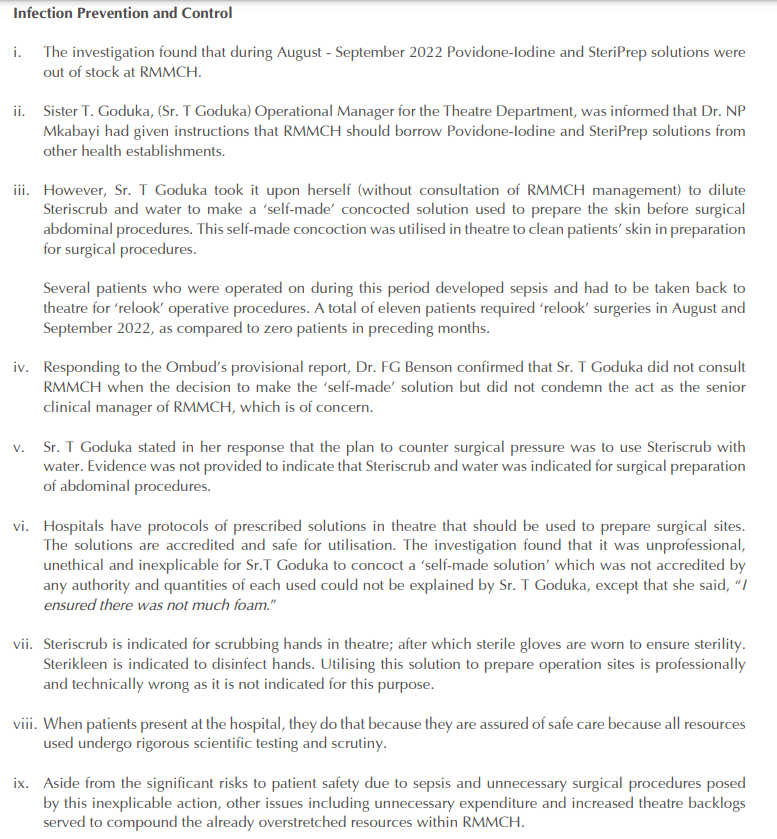
The Health Ombudsman today released his report into complaints about the Rahima Moosa Mother and Child Hospital (RMMCH). It doesn’t make for pretty reading. There are many, many problems highlighted, and I’m only really looking at one here, but if you want to read the whole damn(ing) thing, here’s the PDF.
It’s Page 14 that made me weep though.
tl:dr?
They ran out of the antiseptic disinfectant solution that was used to treat the skin pre-operatively on abdominal surgery sites, so instead of sourcing some from any nearby healthcare facilities, the sister in charge made up her own concoction of diluted handwash to use instead.
Not that this is any way safe, effective, legitimate, ethical, acceptable or sensible, but – just out of interest – what sort of amounts of handwash and water did she use?
The quantities of each used could not be explained by Sr. T Goduka, except that she said, “I ensured there was not much foam.” [sic]
Ah yes, “not much foam”. That’s the generally accepted formula for illegitimate, homebrewed pre-op solutions. Too much foam gets in the way and can be quite distracting for the surgeon. That’s why they don’t use Sunlight washing up liquid for these sort of things.
Or diluted handwash.
Anyway, the upshot of Sister Goduka’s efforts was that eleven patients ended up back in surgery because they developed infections.
I am shocked like Cyril.
The report goes on to say:
When patients present at the hospital, they do that because they are assured of safe care because all resources used undergo rigorous scientific testing and scrutiny.
Oh, so not because they want to be guinea pigs for Sr Goduka’s latest potion? Honestly, there would probably have been a better clinical outcome if they’d let Willy Wonka have a pop at it.
Incredibly – and shamefully – this is far from the worst thing that patients had to face at the hospital, but hopefully, some lessons can be – and have been – learned.
Well, it’s phosphorus. So well done if you had that on your bingo card this morning.
Too much phosphorus is going to kill us, and too little phosphorus… er… that’s also going to kill us. It does seem like phosphorus is one of those things that you have to get just right. And also that we’re doing really badly at that.
Too much phosphorus is being used in fertilisers, which are then running off into waterways and creating massive blooms of algae. When that algae dies off, it releases a lot of methane, which is a major contributor to climate change. And brilliantly, because of that climate change, more algal blooms will form in the future, which will result in more methane being release.
It’s a good example of a viscous circle (because the algae makes the water a bit thicker).
And because we’re using too much phosphorus in fertilisers, it’s likely that in a few years time, there won’t be enough phosphorus to go around, so we won’t be able to make fertilisers, and so we won’t be able to grow crops as efficiently, meaning food shortages and famine for millions – if not billions – around the world.
Happy days.
Aside from the direct issues caused by too much or too little phosphorus, there are spin-off problems as well. Like the researchers into those phosphorus problems coming up with this sort of thing:
“We have reached a critical turning point,” said Prof Phil Haygarth of Lancaster University. “We might be able to turn back but we have really got to pull ourselves together and be an awful lot smarter in the way we use phosphorus. If we don’t, we face a calamity that we have termed ‘phosphogeddon’.”
No, Phil. No. I value your work, and I am genuinely concerned about the warnings you are giving us. It’s clearly important that mankind changes the way that we are using phosphorus. But what’s also clear is that you should stick to the science, and let the English language experts come up with any new terminology to describe your results. Because ‘phosphogeddon’ is an absolute car crash of a word, and detracts from your important research.
Adding a scary suffix to just any word might be linguistically correct, but it doesn’t necessarily make for catchy terminology that’s going to be memorable and therefore influence public behaviour. And I feel that I need to take a stand on this, because otherwise, we’re surely headed for a portmanteaupocalypse.
That would mean fewer deaths because of erratic weather and worsening food security, but many, many more facepalms at terrible attempts to make words to describe concerning over- and underuse of chemical elements and the like.
We can still change this now and make a difference.