You Will See Me

The new album Repent. Replenish. Repeat. from Dan Le Sac and Scroobius Pip is good, but the last track You Will See Me is outstanding. Now they’re releasing it and thankfully there’s an outstanding video to go with it:

Warning! Contains some naughty language!

It’s dark, angry, passionate, mocking, inspired and inspiring – but by all the wrong emotions – it’s gritty and it’s thought-provoking. It’s also been playing on repeat on my iPod for the last month. This is really good stuff, with more to hear and understand each time you listen to it, and it also demonstrates amazing Pip’s lyrical fluency. While the likes of Tinie Tempah are reliably informing us that:

I got so many clothes, I keeps some in my aunt’s house.

Pip is sharing lines like:

I will use you to cruise through any writer’s block,
Any lazy days when a glazed gaze invades my mind’s cave of creativity.

and warning us:

I will wipe out entire races,
I will erase faces and displace with great haste and no graces.

All in all, it’s a spectacular work of art and passion. Although you may note that it does lack the festive feel of certain other Christmas singles.

Incoming: Black South Easter

Much talk around about the ‘Black South Easter’ that is expected to hit Cape Town over the next 36 hours or so, bringing with it high winds, dark clouds and much rain. And right from the outset, it should be pointed out that this nomenclature isn’t a racist thing. We don’t have an alternative ‘White South Easter’ which lives very comfortably in Constantia, happily subsisting off its ill-gotten, pre-94 gains and complaining about the ANC. No, this is so named because of the threatening colour of the clouds – a kind of meteorological Swart Gevaar, if you wish to continue the rather tenuous analogy.

The braai-ruining South Easter or ‘Cape Doctor’ which is usually prevalent in Cape Town from October through to (at least) December is due to a pressure area called the South Atlantic High (SAH) which sits just off the Cape coast and fairly regularly joins up with its equally high friend in Durban. These guys hang around together, being high, giggling at nothing in particular, eating Pringles and forming a ridge of high pressure below South Africa, bringing with them the warm Cape Doctor, which, despite its reputation for blowing patio chairs over in Vredehoek, is actually a fair weather wind.

All good so far? Fantastic.
So what goes wrong in this Black South Easter scenario, which is responsible for such nastiness as the great Laingsburg Flood?

At first the rain was gentle as a result of a low pressure system.  But from Saturday afternoon to Sunday a high pressure system brought heavy thunder showers to the catchment area.  Up to 425 mm rainfall was recorded that week-end, whereas the normal rainfall per annum is only 175 mm.

Well, despite their insistence that a high pressure system was solely to blame, it was actually the interaction between that high pressure system and what’s called a Cut-Off Low pressure area. Please don’t think for a moment that we’re talking about the usual mild-mannered inland low pressure trough that sits over the Karoo in summer here. No, this puppy is a deep low pressure area and it would much rather be with its mates down towards Antarctica at this time of year. Sadly, our South Atlantic High is so out of it that he’s joined up with his Bru from Durbs and unwittingly separated the low from his friends. Awkward.

Let’s explain what’s going on by transposing this situation into a bar room scenario. It would be a bit touch and go.
Ideally, the low pressure area would note the obviously wasted state of the South Atlantic High, politely point out the awkward social situation that had occurred – “Sorry dude, I just need to slip past, please” – and things would be quickly resolved.

Sadly though, meteorological pressure areas are unable to communicate with one another – or anyone else for that matter – and the angry young low has been doing Jägerbombs since lunchtime. He lets fly with everything he’s got, dragging the warm air from our high friends, chucking in some filthy black clouds and several inches of precipitation in his annoyance at not being allowed to sit with his mates over at the other side of the pub.

Fortunately, all this bluster doesn’t last for very long. Whereas a normal winter low pressure area would go on for a few days, the cut off low soon runs out of energy and falls down drunk at the bar. The ridge of high pressure looks on, grinning: “Dude, he totally fell over,” and gets on with clearing the dark clouds over the Mother City. That’s why Sunday actually looks quite nice and summer returns on Monday, when we’re all back at work.

If the forecast is to be believed, we’re in for a lot of rain from Friday evening through into Saturday. So do stay safe and remember these numbers in case of emergency.

Thinking Things Through

Thinking Things Through is always a good idea. Without sound research, consideration and analysis, we’d forever be making poor decisions, and it’s rare that any good comes of having made a poor decision.

We waste time, money, energy and attention by not Thinking Things Through… Our beliefs inform our actions – and if beliefs are used to support irrational choices, then our society is likely to be less free as a result.

To that end, the Free Society Institute (FSI) is holding a conference on 1st December 2013 called Thinking Things Through with an excellent line-up of speakers, addressing many of the obstacles to a free society, such as “oppressive or irrational legislation, moral confusions, bigotry and prejudice, and misconceptions about science and secularism”.

This is a great opportunity for (at least) two reasons: Firstly, that it’s a chance to hear and engage with some of the country’s great minds and social commentators in fields such as science, journalism and philosophy and secondly, to enlighten yourself as to how these issues and obstacles could affect (and are affecting) our society.

The line-up includes MC Chester Missing (what could possibly go wrong?), Eusebius McKaiser, Gareth Cliff (think beyond the Breakfast Show, really) and The Guru, Jacques Rousseau. It looks like it will be a really fascinating day and I would be there in the manner of an ursine if circumstances allowed. But just because I’m missing out doesn’t mean that you should. Tickets are R200 for students, R400 for the rest of us and there’s also an option to tag a half price annual membership of the FSI on to your ticket, should you so desire.

Click here for direct link to ticketing

Thinking Things Through, hosted by the Free Society Institute.
10:00am, Sunday 1st December 2013.
SciBono Discovery Centre, Johannesburg.

Plans for weekend – avoid falling satellite

Yes. Really. Because the European Space Agency’s GOCE satellite, launched in 2009 to measure the Earth’s magnetic field, is falling back to Earth. This is because it has run out of fuel, which was the only thing keeping it up in a rather tenuous 280km orbit. Now, already having fallen to about 190km above us by yesterday, it’s expected to fall out of the sky completely by Sunday or Monday.

Should you be worried? Well, no.
Not according to Dr Stuart Clark anyway. He says it’s likely that the one tonne unit is “likely to fragment into 25-45 pieces en route”. And although “No one knows exactly when or where it will smash down”, we’ll probably be ok. That’s because those pieces (each weighing an absolute minimum of 22.22kg if his assumptions are correct) will likely burn up before they touch down.
Much like most other meteorites:

According to Cornell University’s Ask and Astronomer webpage, between 18,000 and 84,000 meteorites bigger than 10 grams hit the Earth every year. Not all of these survive to strike the ground.

The total amount of mass contained in a year’s worth of meteorites is about 37,000-78,000 tonnes, or 101–214 tonnes per day. So, another tonne from GOCE represents an increase of just 0.5-1% on the day.

To put the numbers into clear context, the Chelyabinsk meteor that struck Russia on 15 February 2013, injuring people and causing wide-spread damage, is estimated to have been 12,000–13,000 times more massive than GOCE.

All of which is very reassuring, until 20 kilos of hot metal ruins your Sunday evening braai.

Chiton

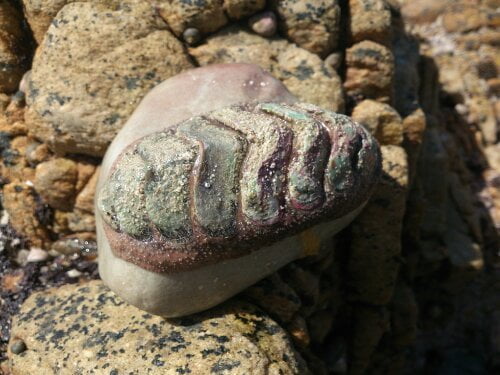
I found some of these molluscs on the beach in Agulhas today. They’re called Chitons and they’re rather cool:

image

And why are they so cool? Well, because they have metal teeth. And they don’t just use them for eating with:

Chitons have radular teeth made of magnetite (an iron compound) making them unique among animals. This means they have an exceptionally abrasive tongue with which to scrape algae from rocks. The iron crystals may also be involved in magnetoception, the ability to sense the polarity or the inclination of the Earth’s magnetic field, and thus may be used in navigation.

Pretty cool, hey?
Told you so.