Trying Serial

Despite my veritable smörgåsbord of podcasts, I’ve found myself a little short of listening material of late. I’m not sure if I’m spending more time listening or more time in the car or even if the podcasts in question are getting shorter.
Maybe it’s a combination of these things, maybe it’s none of them. Like I said, I’m not sure.

Either way, it seems that I am short of podcasts. And that’s something that needs remedying.

Step forward, then, Serial – the podcast that everyone is currently talking about. As far as I can work out, Serial is popular because it’s popular, rather than any other reason right now. It’s very not me, but I’m going to give it a go with an open mind because I’m fed up of downloading crap and then having the choice of either sitting through the crap or not having a podcast on. And I’ve been very careful to not read about what Serial is about, because then I won’t be swayed. There are now eight episodes downloaded onto my phone and there’s a weekend of Cape Agulhas to play them at.

I’ll let you know.

Data Maps of London

Really interesting, this one. And nice to blog on a busy day because the explanatory work and analysis is all done for me on this BBC Magazine webpage. There are some fascinating insights into London life in the twelve separate infographics, maps and graphs, but there were two that stood out for me.

Firstly, this one, depicting the average monthly rents along the Central Line:

_78781053_976generationrente

Not just because of the obvious trend of increasing rents as one heads towards the centre of the city, but also because of the clever way it has been expressed. And Bond Street, fully 30% ahead of its nearest rivals along Oxford Street, despite only being about a kilometre from each.
Right now, £4,200 is R74,251.04, by the way. For a two-bedroom flat. Per month.

Wibble.

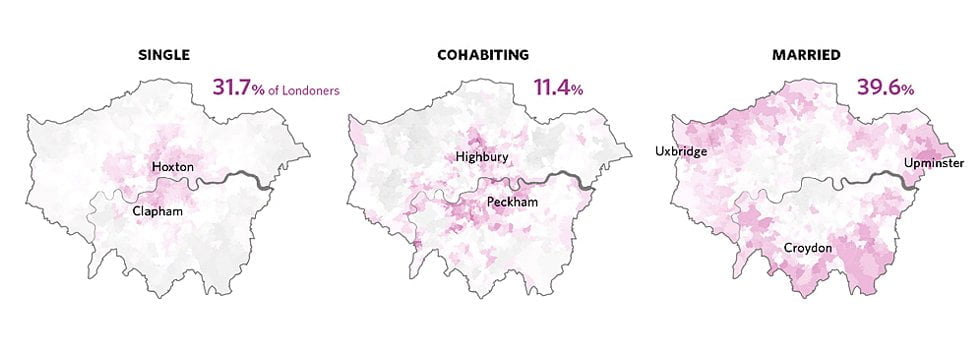
So how come so many young, single people can afford to live in the centre of London? Because that’s what they do:

_78784823_976newrelationshipstatusb

And then as their lives become bogged down, sensible and boring complete and filled with the love of another, and kids and beagles come along, they move further out so that they can maybe afford a small garden for their beagle to dig up and destroy.

As an indication of how we conform to the way our Western lives are supposed to work, it’s almost too perfect, isn’t it?

There’s more to see on that link: shipping, flickr, lost property, football clubs – it’s just really interesting if you like data and numbers. And especially so if you have a London connection, I suppose.

Is Hout Bay the world’s most dangerous beach?

And lo, it came to pass that a comment was left uponeth my Facebook by Jonny “Harvard” Faull, regarding the Snakes On A Beach thing in Hout Bay on Monday. Here’s that comment:

At least nobody’s overreacting
http://www.mirror.co.uk/news/world-news/worlds-most-dangerous-beach-huge-4606856

And yes, the headline is:

Is this the world’s most dangerous beach?

The ever reliable Daily Mirror [see 6000 miles… passim] cites the “huge Cape Cobra beside the shark-infested sea”. And that’s lovely, but yes, it is an overreaction if you’re just going to base it on those two things. You need to be a whole lot more hazardous than just “huge Cape Cobra beside the shark-infested sea” if you’re going to challenge for this title.
Fortunately for the Daily Mirror headline-writing monkeys, I believe that they were inadvertently correct in their query regarding Hout Bay beach, because it has so much more danger to offer than just a big snake and sharky water.

Let me take you through some of the things that make Hout Bay beach potentially worthy of being the world’s most dangerous beach.

1. The snake and sharks.
As mentioned by the Daily Mirror (and who are we to doubt them?), these are really dangerous if you get near them. So don’t get near them. But assuming that you did get near them, really dangerous.
Danger levels: 9/10

2. The contaminated water.
To be fair, no self-respecting person is going to get eaten by a shark in the shark-infested sea because no self-respecting person would step into the water anyway. I actually was surprised that the snake gave it a go.  That’s because the E.coli levels in the Hout Bay water are through the roof. And there isn’t even a roof (we’ll discuss that later). While many of the Western Cape beaches are clean and shiny (27 of them have Blue Flag status), Hout Bay is not one of them.
Hout Bay is full of poo bugs. Eww.
Danger rating: 7/10

3. The crime.
Sadly, yes, there was a mugging on Hout Bay beach fairly recently. This doesn’t quite compare with the astronomical levels of crime on Rio’s Copacabana beach, but we’re not talking about Rio’s Copacabana beach here, we’re talking about Hout Bay beach. The best way to avoid being mugged on Hout Bay beach is not to go to Hout Bay beach. This is also a good idea because of all the other dangerous things on Hout Bay beach.
Danger rating: 6/10

4. The seismological activity.
I’ve been doing some historical research on volcanoes and earthquakes around Hout Bay beach. There are actually no documented records of either of these thing having ever happened on Hout Bay beach, but that doesn’t mean that it couldn’t happen on Hout Bay beach. After all, it happens all over Hawaii and Iceland’s beaches with alarming regularity. And it might happen while you were on Hout Bay beach, if you were foolish enough to go to Hout Bay beach. That’s why if you do go to Hout Bay beach, you should always have a well-rehearsed evacuation plan to hand in case there’s a volcano.
Danger rating: 5/10

5. The UV levels.
OMG! There isn’t even a roof on Hout Bay beach. That means no protection whatsoever from the sun. And we all know what damage the sun can do to our skin: sunburn, premature aging, melanoma, vitamin D overdose. This is a huge omission by the Hout Bay beach management people and – with summer coming – is yet another reason that Hout Bay beach is right up there with the other most dangerous beaches in the world.
Danger rating: 6/10

6. The Radioactivity.
Can you imagine how ridiculously radioactive Hout Bay beach would be if there was loads of naturally-occurring Uranium just below the sandy surface? Has anyone done any research into whether or not this is the case? Thought not.
So, in the meantime, let’s play it safe by assuming that Hout Bay beach is a seething bed of alpha particles. Lethal (ish).
Danger rating: 8/10

7. The smell of fish.
The local fish processing plant in Hout Bay harbour is wonderfully fragrant, especially on hot, still days.
Technically not dangerous in itself, but wholly unpleasant.
Danger rating: 4/10 (odour may attract bears)

8. The risk of alien abduction.
In the USA, the majority of UFO sightings and alleged alien abductions seem to be in rural areas and states with a higher than average rate of inbreeding. Look, I’m really not casting aspersions here, but I’m just saying that Hout Bay beach might be a bit of a hotspot. *high sixes the local residents*
Danger rating: 2/10

In conclusion, there are many beaches in the world that are really dangerous for any of the reasons given above, but it’s rather the combination of factors that makes Hout Bay beach well worthy of the title “Most Dangerous Beach In The World”.

The Daily Mirror weren’t overreacting: Hout Bay beach really is horrifyingly risky.

Physics Demo

The best branch of science is microbiology. I can say this for certain because I’m a microbiologist, so I should know. There are other sciences that are quite good as well, and then there are some that are OK, and then somewhere deep into the lower half of the list of good sciences is physics. Physicists would probably argue with this, saying that “without physics, there would be no gravity”, but this is plainly untrue. Without microbiology, there would still be bacteria, and it’s not like we’d all go floating off the surface of the planet if physics was suddenly abolished as a science.

Anyway, this isn’t their list.

I did see some physics demonstrated the other day though, and I was impressed. Not impressed enough to move it above anthropology, but impressed nevertheless. And so, I’m going to share the video with you, right here, right now.

What happens in the video isn’t unexpected – physics tells us what to expect and what physics tells us to expect, occurs – but it is still a bit weird and tough to get your head around. Allow me to demonstrate – bring forth The Coxmatron!

The lead in is actually really interesting too, but if you just want to skip to the mentally confusing bit, jump to 2:30.

Galileo hypothesised that falling objects would fall at the same rate regardless of their masses, and so yes, the only reason that a bowling bowl falls more quickly than a bunch of feathers is because of the added air resistance on the latter. And yes, you know that, but because you have never seen a bowling ball and some feathers dropped in the absence of air (until now), it’s properly weird to actually see happening, isn’t it?

PHYSICS!!*

* It’s nowhere near as good as microbiology, but still much better than biochemistry.

John Snow for the Ebola era

Here’s a very important point:

It’s impossible to treat an epidemic when you know next to nothing about the population it’s ravaging.

Just thought I’d plonk this here for your reading delectation. It’s a good starting point as to how the principles of John Snow and the Broad Street pump are still relevant and how they can be applied to the Ebola outbreak in West Africa, and also how and why that’s not happening.
The piece itself is unremarkable, but the sum of its parts and all that…

It’s an instance where the gloss of digital ubiquity hides our lack of real understanding. Where technological solutionism masks the fact that nothing has been solved.

A lesson for us all in how technological Utopianism isn’t always quite the flawless answer to everything. There’s a lesson for SA’s TB diagnostic progamme in there too, but I’m wholly unwilling to elaborate on that bit.