Foolish Fortnight

Yeah. Ke Dezemba in ZA and we all know what that means. But the revelry it brings isn’t new and it certainly isn’t exclusive to South Africa.

Kegeesh Ommidjagh – the foolish fortnight – begins (began?) on Oie’l Thomase Doo (Black Thomas’ Eve) (that was 21st December) on the Isle of Man, and well… they got up to some naughtiness, back in the day:

Rampant fun & the relaxing of moral codes(!) were the norm across the Isle of Man throughout Christmas in the past. Barns were claimed for dancing across the Kegeesh Ommidjagh, with fiddlers hired by public money, where parties apparently got so wild that youths sometimes felt compelled to go outside to continue their ‘close celebrations of the festival’ in the hedgerows…

There’s even a passage from George Waldron’s ‘A Description of the Isle of Man’ , written in 1731 that recounts the scenes – surprisingly candidly for those days:

“There is not a barn unoccupied the whole twelve days, every parish hiring fiddlers at the public charge; and all the youth, nay, sometimes people well advanced in years making no scruple to be among these nocturnal dancers.
At this time there never fails of some work being made for Kirk Jarmyns; so many young fellows and girls meeting in these diversions, nature too often prompts them to more close celebrations of the festival, than those the barn allows; and many a hedge has been witness of endearments, which fear of punishment has afterwards made both forswear at the holy altar in purgation.”

The whole thing is quite a read.

But if nocturnal copulation in the local farmers’ fields in the middle of winter wasn’t foolish enough, then you really need to click here and read some of the astonishingly bizarre traditions of the Kegeesh Ommidjagh.

Groups of young lads roamed the towns making ‘a rare din’ singing, dancing and playing homemade instruments, carrying mollags – inflated sheep’s bladders – with which they hit anyone who got too close. The aim was to make money, but they were perhaps hounding it out of people more than receiving willing donations!

Ah yes – the old sheep’s bladder boinkers. Always a giggle.

In church was the Oie’ll Verree service which took place on Christmas Eve. Here the singing of carols was accompanied by young women throwing peas at young men.

Standard religious nonsense.

Amidst the final drinking and dancing there was the Cutting off the Fiddler’s Head, where the fiddler lay his head on a woman’s lap and made prophesies of who would pair with whom over the coming year.
But these festivities were interrupted by the Laair Vane – a person hidden under a sheet controlling a horse’s head. This ‘White Mare’ would go around attacking people snapping its jaws until it was chased from the room.

Ah. Simpler times.

Look. There was no Netflix, no internet, no football around back then. I guess that you just had to make your own entertainment, and it does appear that the Manx people, having saved up all their joviality (and all their sheep’s bladders and their peas) for 50 weeks, really went to town on making their own stuff up for the Christmas period.

But honestly, who was the first to come up with any of this stuff, and why wasn’t he or she immediately stopped at the first mention of decapitation of musicians or people hiding under bedsheets pretending to be bits of an equine?

They were clearly all rather mad over there.

Not much has changed.
Olive

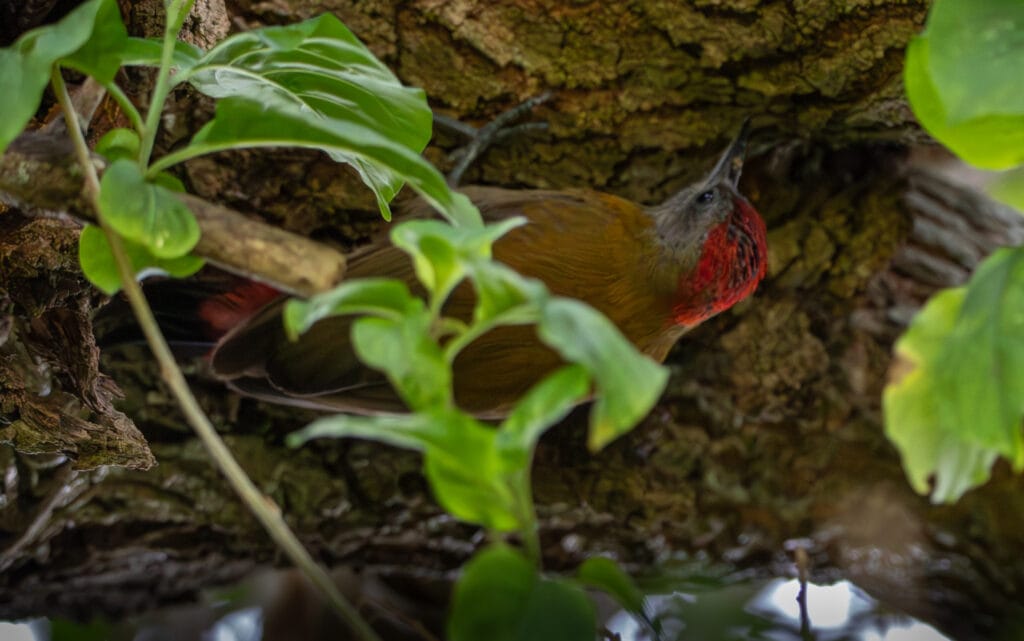
Seen once before here but still a pretty elusive visitor to the back garden: an Olive Woodpecker (Dendropicos griseocephalus).

Never easy to shoot (just look at that post I linked to above), because they are so agile and so ready to slip around a tree trunk or branch just as you are getting them into focus.
Not to mention the leafy suburban garden getting between the lens and it.

But he soon got into the mood and even gave me a very brief smile before we headed our separate ways.

One of my jobs for this holiday is to compile a list of birds I have seen in – and birds I have seen from – our garden. There will be a couple of surprising* entries in the latter (African Fish Eagle, Great White Pelican) as well as the usual Cape Town run-of-the-mill feathery stuff.

* OK, less surprising now, I guess.

Fake courtesy

No-one ever reads the bits at the beginning and end of your emails. And yet, if you don’t include them, suddenly the whole thing suddenly sounds a bit rude and impersonal. That’s because email conventions have led to us expecting to see alleged “courtesy”, even when we don’t acknowledge it because everyone is absolutely aware that it’s only ever included for etiquette purposes.

If only there were a way of saving valuable time on the completely unnecessary – and yet also absolutely necessary – fake courtesy.

Hang on a second!

Brilliant. And I really love the fact that it occasionally makes a typo as well. It makes it seem all the more human, when it patently – isn’t.

An excellent analogue for the actual line which it is typing.

And there are many more excellent things to be seen on Amadeo Capelli’s Instagram account and Youtube channel.

Human to Human Rabies Transmission

Come for the unusual medical case study, stay for the line about the skunk.

Yeah – this is a very unfortunate case of human to human transmission of rabies via a kidney transplant, resulting in the death of the recipient. (The donor was obviously already dead, but more on that later…)

When I used to work in a lab that tested donor specimens for transplants, we never tested for rabies virus. But that’s because there isn’t any rabies virus in the UK, where we were doing the testing. So it would have all been negative anyway.

In the US, there are around 5000 rabies cases in animals each year, but fewer than 3 in humans. Quite literally a one in a million thing. So you might excuse them for not testing for it either. But this does seem to be a bit of an unusual case in a few ways.

Firstly, that the donor died in unusual circumstances. Cause of death at the time was listed as cardiac arrest. But that came after some interesting symptoms:

In early December, the donor was confused, had difficulty swallowing and walking, experienced hallucinations, and had a stiff neck. Two days after symptom onset, he was found unresponsive at home after presumed cardiac arrest.

And there was mention of a scratch from a skunk in the Donor Risk Assessment Interview:

The DRAI is a tool to document a potential donor’s health history, given to their next-of-kin, and is a series of questions.

But it seems that it was overlooked. At this point, given that history (and the power of hindsight), I’m already wondering why they thought that he was a suitable candidate for organ donation. But hey, I’m not a doctor and I’m not in America. Who knows what rules apply there?

Only after the death of the recipient were the family of the donor interviewed again, where the skunk line came out:

Interviews with the family added details not included in the DRAI questionnaire. In late October 2024, a skunk approached the donor as he held a kitten in an outbuilding on his rural property. During an encounter that rendered the skunk unconscious, the donor sustained a shin scratch that bled, but he did not think he had been bitten. According to the family, the donor attributed the skunk’s behaviour to predatory aggression toward the kitten.

Emphasis by me. Skunk battery by the guy in Idaho.
The battle was clearly won that day, but as we now know, the war was lost.

But, skunk scratch or not, unusual symptoms prior to alleged cardiac arrest or not, the organ donation went ahead. (And to be fair, post-incident testing on other specimens taken at the time of the operation didn’t yield any positive results for rabies.)

Sadly for the recipient, 5 weeks after the transplant, things went downhill very rapidly. Within two weeks of his first symptoms and just 5 days after rabies became suspected, he died.

But the kidney was not the only organ that was donated:

The heart and lungs went to a medical training facility in Maryland. Concerningly:

By the time of the public health investigation, no specimens were available for testing.

And four ocular grafts were prepared from recovered corneas:

Three patients, one each from California, Idaho, and New Mexico, received grafts in December 2024 and January 2025. While investigation of the donor’s rabies status was ongoing, the cornea recipients underwent precautionary graft removal and received PEP. They remained asymptomatic. A planned transplantation of the fourth corneal graft to a Missouri patient was cancelled. 

And ominously:

CDC detected rabies virus RNA consistent with a silver-haired bat rabies virus variant in one previously implanted corneal graft.

We are not told which one. I wonder if the recipients were? They were all treated.

So now, everyone who had been in contact with donor, recipient or organs had to be identified, counselled and potentially tested and/or treated. That was 380 individuals.
I know that all that boring paperwork is tedious and irritating, but these sort of situations are exactly why we do it.

No other persons or animals were exposed to the presumed rabid skunk.

And there probably wasn’t any documentation if there was any exposure anyway. Skunks are notoriously poor at following even the most basic recordkeeping SOPs.

Finally, what will be done to stop this from happening again?

CDC, the Health Resources and Services Administration, and partners are reviewing the occurrence of reported exposures to animals among donors to identify interventions to further reduce transplant-associated rabies risk.

No standard guidance currently exists for addressing reported donor animal exposures by transplant teams.

If a potential donor, particularly one with acute encephalopathy, had a bite or scratch from a rabies-susceptible animal during the preceding year, transplant teams should consider consulting public health officials to determine rabies risk.

Much like the rest of the world, there is a real shortage of transplant organs in the USA. But that doesn’t mean that seemingly simple red flags should be overlooked. It won’t knock many potential transplants out given the rarity of rabies cases over there, but it will prevent any further scenarios like this.

Hot stuff – an early report

I’m not sponsored by this guy. Hey, I’m not sponsored by anyone, but if you want to give me some money, please just let me know.

But…

I did get this advent calendar, and I have now opened 4 (four) boxes.

So how’s it gone so far?

Pretty well.

Day 1: Chimichurri – I’m new to the smokiness of these products, but this was exactly what it said on the tin: a smoky Argentinian-style chimichurri. Strong flavours. Lovely. But not as good as it would have been after 6:45am. I chose to open the boxes in the evenings from now on.
7/10 before breakfast. 9/10 in the evening.

Day 2: “Brinjal” – brinjal = aubergine = egg-plant, depending on where you are in the world. This was a mild relish, which allowed for a lot of smoke without too much chili. Very flavoursome, and impressive to make brinjal taste of… well, anything really.
7/10.

Day 3: “Hot Sauce” – described on their website as “Medium/Hot”, but…

And yes, that is actual footage. Eina fok! This was a warm one. I’ve learned in my time on this earth to take it easy with things of unknown spiciness, but even with a tiny amount (neat, to be fair) this was right up there for HEAT! I think it may well have been the acidity of the lime that added to the effect, but either way, treat this one with caution.
Still absolutely amazing on a cheese sandwich this lunchtime though.
8/10.

Day 4: Smoky Barbeque Sauce – oh wow! A flavour explosion. All the smoke, all the herbs and spices, and a real tomato/onion kick. Also not hugely hot, but just a hint of kick. It’s got everything.
Definitely my favourite so far. And it’s going to be hard to beat.
10/10.

I’m not promising to review ALL 25 of the products, but I’ll try to keep you up to date with at least the best ones.