That’s it.

That’s it. After that result at Wembley, obviously, I’m giving up on football.

Aside from the La Liga stuff I watched yesterday after the playoff game.
And the DfB Pokal final last night.

But that really is it.

Well, I did just watch the Girona v Atletico Madrid game.
And I will be watching several (or more) Premier League games this evening after some Villareal v Sevilla.

And then maybe the Bilbao game at 9 tonight.

And that will be that.

OK, maybe the UEFA finals on Wednesday and Saturday.
That’s just dotting the i’s and crossing the t’s.

And then perhaps the FIFA Club World Cup, just because you can’t go full cold turkey. That’s dangerous.

And maybe some more English football after that, because there will be a new season to watch.

But then that’s it. I’ve learned my lesson.

Possibly.

How good is this?

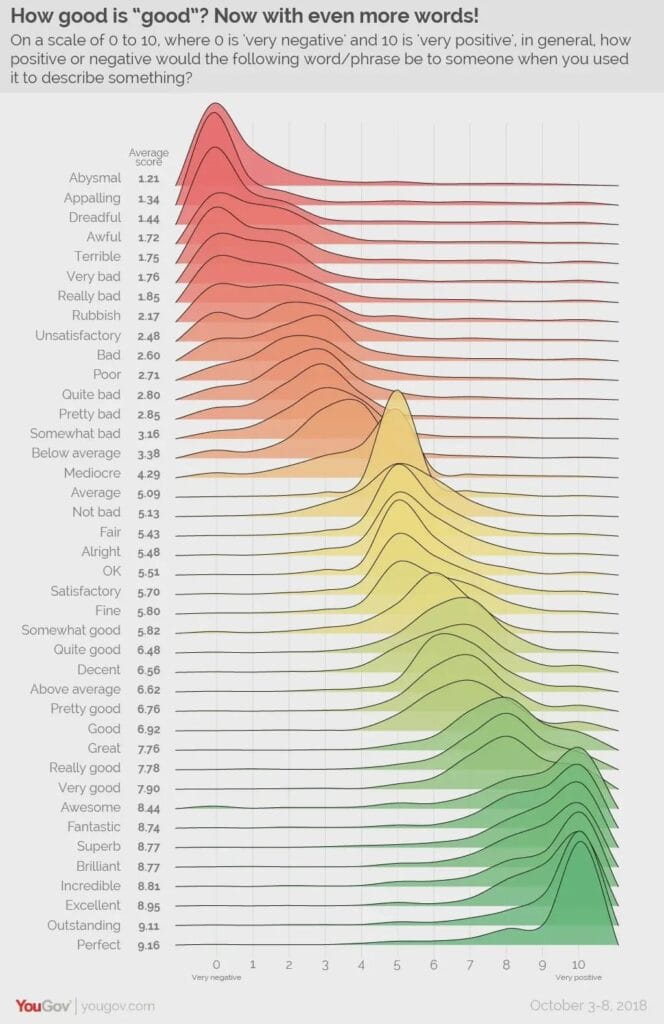
And by “good”, I obviously mean [checks notes] 6.92 out of 10.

Words are subjective, and that’s why scientists like objective things like numbers and data. Those make for a great (7.76/10) way of describing things in a way that everyone can understand and relate to.

But there is definitely some agreement when it comes to adjectives describing the goodity or the baditude of things. Look at this:

Here’s a list of adjectives which people have scored indicating just how “good” they feel the word is. And there are some lovely bell curves there: the best one being “average”, which at 5.09/10 is pretty much spot on for what you might think, but then the good stuff outweighs the bad ones on here, so it doesn’t quite work.

“Perfect” clearly isn’t perfect at all. As an absolute, we really should be seeing 10s across the board like Com?neci in Montreal, but some weirdo seems to have said that it’s only 4/10 and that goes to show just how unreliable words – and people – can be. So next time someone tells you that you are perfect, just remember that they could mean somewhere between “mediocre” and “below average”.

Ouch.

All in all though, there’s not a lot to argue with here. Generally, I’d say it’s OK (which I was happy to see was above “average”), and I can go on using my adjectives and superlatives safe in the knowledge that most people will just about understand exactly what I mean.

Amber Arrows

Incredible levels of dullness in this video, all about Amber Arrows – the less good aerobatic display team – in Blackburn, Lancashire.

It might be the dullest video I’ve ever put on here. And there have been some great contenders.

Where else would you get to hear such gems as:

We were still using 300 mil arrow aspects instead of the now standard 200 mil. Therefore, if you wanted to retrofit such an aspect, you had to replace the whole signalhead. Now you don’t need to do that.

It’s also amazingly niche Geoguessr meta, which I will almost certainly never use.

Do we have Amber Arrows in South Africa? Amazingly, I have never noticed.
Is that a bit worrying?

EDIT: Yes, we do.

We don’t have an amber between red and green, I do know that. Oh, and no-one obeys any amber light (or any other “aspect”) anyway, so maybe it’s not really important.

Little country

We’ve all seen those maps in which various large countries are projected onto Africa to make us understand just how huge Africa is and how dirty it’s been done by the Mercator projection.
Ones like this:

Thank heavens that Cape Town avoids being dragged into China. I don’t speak a word of Chinese. Although, they did bring us some key ingredients in this delicious offering.

Anyway, this is a really good way of illustrating the actual size of something, relative to other things. Some people might find that map of Africa rather surprising. Having sat on planes going up and down the length of it for many, many hours, I was less surprised.

But Luxembourg? Tiny, little Luxembourg? It’s not actually that small:

Or is it? Because the Africa map has been filled in with numerous VERY BIG countries. And I couldn’t help but notice that the numerous countries filling in the Luxembourg map, are actually very small. Quite literally the smallest countries on the whole planet.

The map is meant to show us that Luxembourg isn’t a microstate, and it does that very well by showing us just how easily seven (don’t miss the Vatican between Malta and Gozo!) actual microstates fit into its borders.

Luxembourg is 2,586.4 km2 (998.6 sq mi) with a population of 576,249, making it one of the world’s smallest states; 168th by size or 164th by population.
However, the combined populations of these 7 microstates is 6,248,221: nearly 11 times more people than Luxembourg. So Luxembourg is not only not a microstate, but it’s practically empty!

“Empty” compared to some of the most densely populated countries on earth, perhaps. The 7 microstates above come in at 2, 3, 7, 9, 24, 60 and 75 out of the 242 territories on this list. But Luxembourg actually comes in at 55/242 – less “empty” than Andorra or Liechtenstein, and less “empty” than 77% of the other places on the planet.

But it’s not a microstate.

And Africa is very big.

Die Mimik der Tethys

[OK. Some few internet problems here in the bottom corner of Africa, so I’m getting this out now in case everything falls apart later.]

In Greek mythology, Tethys is a Titaness, the wife of Oceanus and mother of the river gods and Oceanids.

Die Mimik von Tethys is piece of artwork in which a suspended buoy in Turin – at least several miles from the Bay of Biscay – mimics the movement of an real, identical buoy in the Bay of Biscay:

Continuously transmitting motion data via satellite to its relocated double, the information guides eight electric motors and cable winches, which precisely reproduce the buoy’s movement in the ocean. 

And it is quite interesting, thought-provoking and maybe a little disconcerting to watch a buoy suspended in an old car factory (because we’ve all watched this video, right?) moving up and down as invisible, distant waves drag it around.

Aside from the technology involved, and the idea of the art…

You inevitably understand the ocean as a character—you feel the whim of the wild water that can potentially hold your life in your hands. Most people lack such existential experiences with the sea. Buoys function as outposts in the sea. They are like space probes—external ambassadors that represent our human existence without our actual presence.

Yes. Space probes and external ambassadors. Just what I was thinking.

…it’s also quite interesting to see just how big some of the waves are. Waves of 6m high are a regular occurrence in the notorious Bay of Biscay, and visualising that as a couple of storeys in the art gallery is quite sobering and unsettling.

Some of JvB’s other projects are also rather interesting. he really doesn’t hold back…
Have a look here and here for examples.