Completely untrue and wholly without foundation

Not much good news in the cricket for England this morning, but I note that The Times is up to its usual tricks again:

Apology to Kevin Pietersen

THE Times would like to make a full apology to Kevin Pietersen for printing an article headlined “KP’s beer-flinging fury” on 6 January 2010. Following representations on My Pietersen’s behalf made by the England team management and the ECB (Eng-land [sic] and Wales Cricket Board), The Times now accepts that the article was completely untrue and wholly without foundation.

KP was out again cheaply at the Wanderers this morning.
Let’s hope he doesn’t throw any beer over the crowd again like he didn’t do last time.

Duncan White gets it right

I don’t often reproduce other people’s work in full on here, but after I wrote this, it was nice to see that I’m not the only person feeling that way. Here’s Duncan White in the UK’s Sunday Telegraph

It is wrong to equate Angola with South Africa after Togo attack

It was grimly predictable. No sooner had the first reports of the shooting in Cabinda begun to filter through than South Africa’s ability to host a safe World Cup was called into question

What a laughable leap of logic, what reactionary racist rubbish.

It seems almost insulting to have to make the distinction between what happened in Angola and the security situation in South Africa but with banal parallels being so blithely drawn, the organisers of the World Cup have had to defend themselves. This is ludicrous.

It seems there was a lack of communication between Caf, African football’s governing body, and the Togolese federation about the team’s movement. At least, that’s what the political buck-passing indicates. The terrorists did not have any problems locating the Togolese convoy. Caf needs to prove they did not underestimate the dangers Cabinda presented when scheduling games there and that they had appropriate security measures in place. But, ultimately, it is impossible to prevent acts of terrorism taking place.

Since Munich in 1972, sport has been the target of terrorist attacks. After the Sri Lanka cricket team were fired on in Lahore last year, Arsène Wenger predicted that international sports events would increasingly become the target of terrorists. He has been proved right.

The infuriating flaw is when people equate an act of terrorism with a wider sense of African danger. There it is, the creeping stereotype about the “dark continent” and its propensity for violence. Shouldn’t we take the World Cup back to safe old Europe?

Terrorist attacks occur everywhere. We had one in the United Kingdom on Friday when a bomb went off under the car of a police officer in Northern Ireland. Yet because this attack happened in Africa, it gets translated into a general continental problem, rather than one relating to a specific exclave of a specific country.

Angola and South Africa are miles apart. Quite literally: the capital Luanda is 1,500 miles from Johannesburg, the distance between London and Moscow. Angola only emerged from a brutal 27-year civil war in 2002 and while it has enjoyed huge economic growth in the last eight years, it still bears the scars. It has the highest infant mortality rate in the world and the second-highest death rate in the world. The median age is 18.

South Africa is vastly more developed and has a track record of hosting major international events, especially sporting events. As Danny Jordaan, the chief executive of the 2010 World Cup, has pointed out, a war in Kosovo did not mean the German World Cup was called into jeopardy.

South Africa has its problems, especially the rate of violent crime. During the Confederations Cup last summer, you felt many people waiting for something serious to go wrong. Nothing did. The job of ensuring the World Cup passes with as few incidents as possible is a big one. Let’s not burden South Africa with the responsibility for Cabindan terrorism too.

Brilliantly put. One has to wonder why the local news fails to notice this sort of article in the international press, but readily and happily reproduce bigoted, negative rubbish.

Thanks to my Dad for the heads up.

Some perspective, please

After the dreadful attack on the Togolese national football team, questions have been raised about the World Cup tournament in South Africa later this year. But why?

 After all, France 1998 went ahead despite the Kosovo conflict, which was occuring on the same continent.

As Danny Jordaan has pointed out, South Africa 2010 has nothing to do with the African Cup of Nations save for being held in the same year.  What happened on Friday, 3,000 kilometres away from SAFA headquarters is tragic, but it has no bearing on the World Cup.

This situation has merely highlighted the West’s blinkered view of Africa as a single troubled entity. But Angola is just one of fifty-two countries here and is as different from South Africa as Hungary is from the UK and Honduras is from the US.

So can we drop the hysteria and get a little perspective, please?

EDIT: See also here.

Test cricket is still mainly boring

With dropping attendances, bore draws and the huge push towards shorter versions of the game, it was nice to finally see an exciting finish to a 5-day test match yesterday. The second time in three matches in this series, actually. (In the other game, England obviously wiped the floor with sorry SA).
But while the last over histrionics, South Africa’s constant and often desperate appealing and Graeme “The Cramp Man” Smith’s wonderful innings and penchant for referring everything were all briefly gripping to watch, it was really only the last couple of hours of the game which were actually “exciting”.

All of which leads me to believe that in actual fact, Test cricket is still mainly boring. And that isn’t really a problem if you’re happy to be bored; if you have days to spare at the ground or on the couch, beer and snacks to hand. But for the majority of us, that’s not the case.

The problem as I see it is that in order to get the exciting finish, you have to sit at least through four days of potential dross. And yes, I know there were “gripping” bits here and there, like the Steyn vs Collingwood thing and Fatty’s lovely innings, but mainly it was quite dull going through to motions stuff. For 4½ days. And that’s why T20 – which condenses the best bits from Test cricket into a couple of hours and is therefore exciting – has become so popular.

So what I propose is this: T6000 cricket. In this new and revolutionary form of the game, one takes scenarios from all the Test matches in history which have ended in an exciting manner. (There must be at least three or four of them.)
These scenarios would then be played out to a finish in front of a capacity crowd. Games would consist of one innings of variable length, as the different scenarios would kick in at different times. For example, I would propose that for yesterday, we start at tea on the final day – after all, it was mostly pretty dull before that.
So England (or South Africa, depending on who wins the toss) would start 5 wickets down, needing to survive 35 overs. 
In this case, the batting side could only ever get a draw, but them’s the breaks. And before you moan that you’ll never see the top batsmen playing, you’re wrong: the warm-up would consist of the top order being put through their paces before going and having a drink in the players lounge as their tail-enders actually play the game.
As an added benefit, since each 15-session match will now be played in one single session (a reduction of 93.33%), there will be less danger of player burn-out – a major cause of the top players not being able to play in the first place.

Sure, the purists will hate this, but they’re the ones with the time, the couch, the beer and the snacks.
For the vast majority, T6000 is the future.

Boring heroism

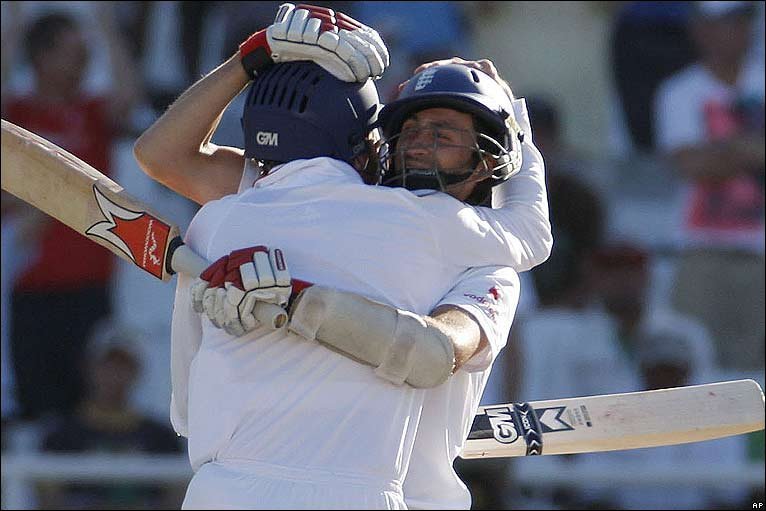
As Paul Collingwood and Ian Bell display boring heroism and continue to frustrate the South Africans just down the road at Newlands, I have better things to be doing than blogging. And not that I want SA to succeed in winning this game, but maybe they’d do better if they had a little help.

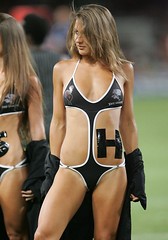
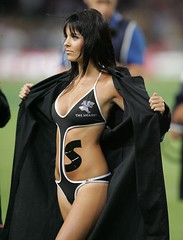
You know, like the help that the Sharks use – the cheerleading help:

Give me an H!   Ohhhh K!   Give me an S!

Might be a bit warm at Newlands for those trenchcoats, though.