(almost) A microbiologist’s dream

And I am being quite serious about this.

There are a few things that bugs and diseases are named after. The boring ones are the medical ones – just basically what the disease does to you or how it works. Tuberculosis gets its name from the bacterium that causes it, which in turn gets its name from the tubercules that it produces. Dull.

Then there are the ones named after places or events. I quite like the idea of those. Lyme disease is named after the town in Connecticut where it was first identified. Legionella – the causal agent of Legionnaire’s Disease – was named because it caused an outbreak at an American Legion conference in Philadelphia (incidentally in 1976 – just a year after Lyme Disease was named – woohoo mid-70s North East USA).

But if you want longevity in the microbiological world, you need a bug or disease named after you. There are loads of bugs that are named after people – the people are usually being the ones that discovered the bug. I used to work in an office next to Professor Sir Anthony Epstein, of Epstein-Barr virus fame. I guess that the name Epstein will live on in another context now (sadly still involving kissing teenagers), but that’s not the virologist’s fault.

Everyone who ever works with that bug will know that it is named after you: always. So it is a bit of a dream to have a microbe named after you in that way. If you’re a microbiologist.

But then there are the eponymous diseases. And while you might also gain fame and longevity from having one of those named after you, it’s generally not a good thing, no matter how you try to spin it.

Yeah. There’s not much good that can come out of that sort of diagnosis.

So, no thanks. I’ll happily settle for the “he discovered it” route, rather than the “we’ve never seen this set of symptoms in a human before” one.
It’s probably ok

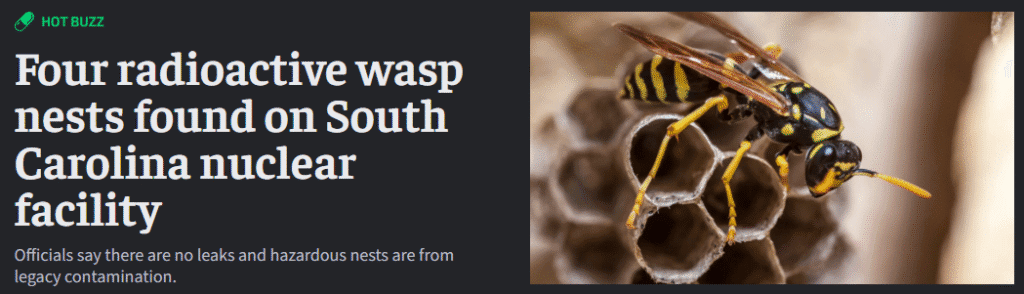
You can’t judge a book by it’s cover (you can’t judge Lethal Weapon by Danny Glover), but you can look at a headline and think… hang on a second…

Hang on a second…

Nuclear Wasps were so far down my “Things We Need To Be Worried About” List for 2025 that they didn’t even make Page 3. And I think that’s a clear sign of just how horrific a state the planet is in, given that they’d definitely be in the Top 20 in most other years.

Apparently – “apparently” – it’s nothing to worry about:

The report said that the nest was on a post near a tank used to store nuclear waste and that it “was probing 100,000 dpm/100 cm2 beta/gamma.” This contamination level “is greater than 10 times the total contamination values” listed in federal regulations for areas that require contamination posting and monitoring, the report said. Still, it concluded that the radioactivity of the nest was considered to be from “onsite legacy radioactive contamination not related to a loss of contamination control.”

But you can’t help but think that no contaminated wasp nests would surely be a better situation for us to be in.

I mean, whatever next? Radioactive Shrimps?

Oh. Oh dear.

Keeping A Lighthouse

You know me. I like lighthouses.
There are many (or more) posts on the blog which refer to lighthouses.
Ones in the UK, the IOM, in SA, in France, even one in Germany.

And so I was delighted to stumble across a new Youtube Channel by a lighthouse maintenance engineer, called Keeping A Lighthouse. All the information that you could ever want about his job… er… keeping a lighthouse running, and a chance to see the inside working bits that you never usually get to see.

Described as:

A personal view of looking after lighthouses around the UK and the Channel Islands. My main aim is to give people an insight into the work that we carry out in order to keep the Aids to Navigation working but also to hopefully inspire others to get into a similar line of work.

it does get a bit technical and nerdy, but that’s really no big deal, because again, no matter the subject, to find someone that is passionate about their job and who wants to share that passion is always a real bonus, and Scott is certainly that sort of person.

Uploads are a bit sporadic, but they do happen and they’re really interesting when they do.

To accompany the channel, there’s an Instagram account as well with loads of good stuff.

Go and give it a watch and a follow.

Bonjourr 21: the background update

I’ve been using Bonjourr for almost a year and a half now, and it’s just lovely. I’d only been using it for a few weeks when I wrote a post about it and said this:

Sometime we can have nice things. And this is one of them.

And I was absolutely right. Well done, me.

Bonjourr is a really simple way to decorate your browser background – although the customisation options mean that it can be far more powerful if you want it to be – and while it might not seem like a very big thing, it’s just really cool to have images there instead of the same old block of colour. With the latest update – Bonjourr 21: the background update – they’ve added several new features, including the choice of using local files as your background, the option of having a video background to your new browser windows, and new texture overlays to make your screen look even cooler.

Let’s get this straight: this isn’t a massively important or necessary app but it’s free, it’s fun and it just makes things look nicer. And who doesn’t want something nicer on the screen in front of them?

I still haven’t really kicked off anything on Unsplash, as I had planned to do, but there’s some work that I am doing at the moment that might tie in nicely with that, so maybe you will be able to have a raft of my images decorating your desktop in the very near future. In the meantime, there’s plenty of other stuff on there for you to choose.

As browser add-ons go, this has to be right up there as one of the best. Again, not because it enhances the functionality of your software, but just because it’s so customisable and it looks so good.

It’s available for all major browsers – and some others, too.

New York City’s Disappearing Horse Elevators

Plenty of news here Chez 6000, but maybe more on the way, so let’s leave that for another post and another time, and head to New York and this lovely little documentary about the last Horse Elevators in that city.

These aging behemoths were used to transport – wait for it – horses! to their second floor stabling facilities from the 1860s until the turn of the 20th Century. Because everyone who way anyone had a horse and carriage. The carriages lived downstairs and the horses lived upstairs, but because they are notoriously bad a doing stairs, they were lifted – elevated – in a horse elevator.

But the horse elevators don’t meet building safety codes anymore, and so they are being removed and replaced. And this is the story of one particular horse elevator and its final journey.

It’s an interesting, engaging 12 minute watch.