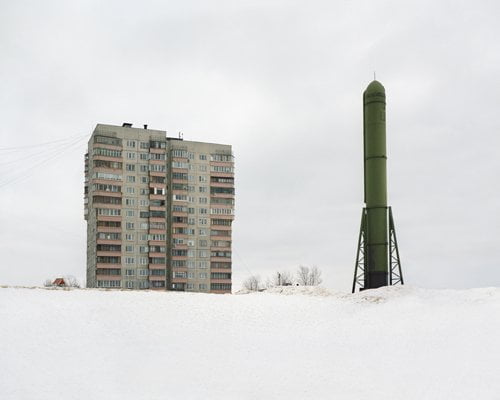
Snowy Russian Graveyard

But not for people; for old Soviet stuff.
6

Herewith the photography of Danila Tkachenko, which is engaging firstly because of its subject matter and the context thereof:

Tkachenko sees the Soviet Union’s aspirations and failures, and a rejection of the pursuit of political and technological utopias. “My project is a metaphor for post-technology apocalypse,” he says.

I would say that a lot of my photography is simply a reaction to pseudo-Marxist predispositions noting the currency of revolutionary recognition, together with the symbiotic link between national liberation and social emancipation. Or, at other times, because I think a flower looks pretty.

19

Secondly, I found this line interesting:

After identifying a location, Tkachenko would wait for fog or snow before shooting with a Mamiya 7. He favoured a small aperture and long exposure to create a dreamy, otherworldly feel.

You can do lots of things with exposure time and aperture size if you’re a good enough photographer (no, not me). But even that skill wouldn’t work were it not for the prevailing weather conditions. The combined results are stunning – depicting an monochromatic oxymoron of futuristic relics, lost somewhere in the clouds.

You can see the other 31 photos in the project here.

Iron Maidgone

They came, they saw, they went all around Table Bay and Robben Island.

im1

And then they left, on flight 666 once again.

Observant people will have noted that it was basically 54 minutes before they actually went anywhere. The cost of flying a Boeing 747-400 for that long? Somewhere around $25,000, or just under R400,000.
Just to play in the sky over Table Bay.

But then, if you had that money, a 747 and a day like today – why on earth wouldn’t you?

Antibiotic resistance apocalypse predicted

Yes, according to the front page of today’s (poorly-named) Independent:

Fullscreen capture 2016-05-19 083721 AM.bmp

“OMG!” I hear you saying. “You’re a microbiologist, 6000. Why didn’t you warn us about this?”

Yeah, you’re absolutely right.

I
Should
Have
Said
Something

Sorry.


(please enjoy the full 84 page report here)

Salt

When it snows (in the other world, not in this South African one), the authorities put salt on the roads. This lowers the melting point of the ice and snow, meaning that it melts even if the temperature drops below zero. Thus, it has to be colder for there to be ice and snow on the roads, meaning that generally, there will be less ice and snow on the roads throughout the winter. Thus, fewer accidents. Or so the logic goes, anyway.

In the cities of the USA, about 19.5 million tonnes of salt is spread across roads in this way each year, and a lot of it comes from a dried-up 400 million year old sea about 2000ft below Ohio. There are some photos and some stories of the mining process on Wired and they’re rather interesting:

A front end loader used to haul raw salt around the mine at Morton Salt Mine in Fairport, OH on March 23, 2015. Photo: Ricky Rhodes

Apparently, when anything breaks down, deep underground, it’s simply discarded there. Why waste time, energy and money in getting it back up to the surface just to throw it away anyway?

I foresee some extremely confused archaeologists somewhere way down the line.

Tenuous a-ha link: Name of salt mine in question is Morton. Oh, and effect of the salt is surely to Stay On These Roads, ne?