China Power Pics

Not a pro-China post. But also, yeah, a bit of a pro-China post.

China might be one of the world’s most polluting countries, but it’s also investing really heavily in wind and solar power, and the stats are nuts:

  • Last year China installed more than half of all wind and solar added globally. In May alone, it added enough renewable energy to power Poland, installing solar panels at a rate of roughly 100 every second.
  • As of late 2025, China leads the world in renewable energy, with total installed capacity exceeding 2,200 GW, making up 59.1% of its total power generation capacity.

2,200GW of renewables is huge. In comparison, South Africa has a TOTAL theoretical power output of 48.5GW. And that’s when it’s all working, which it never is, so we have an actual total power output of about 32GW.

Drop in the ocean stuff. But then – because this is the reason for this post – just look at the infrastructure that’s going into China’s renewable energy drive.
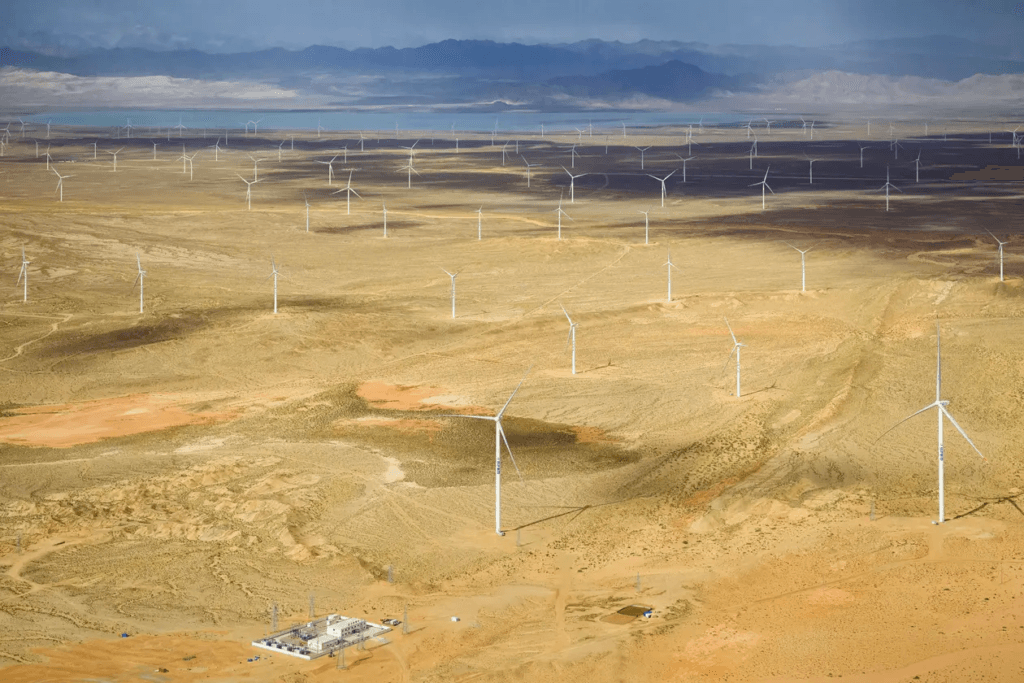
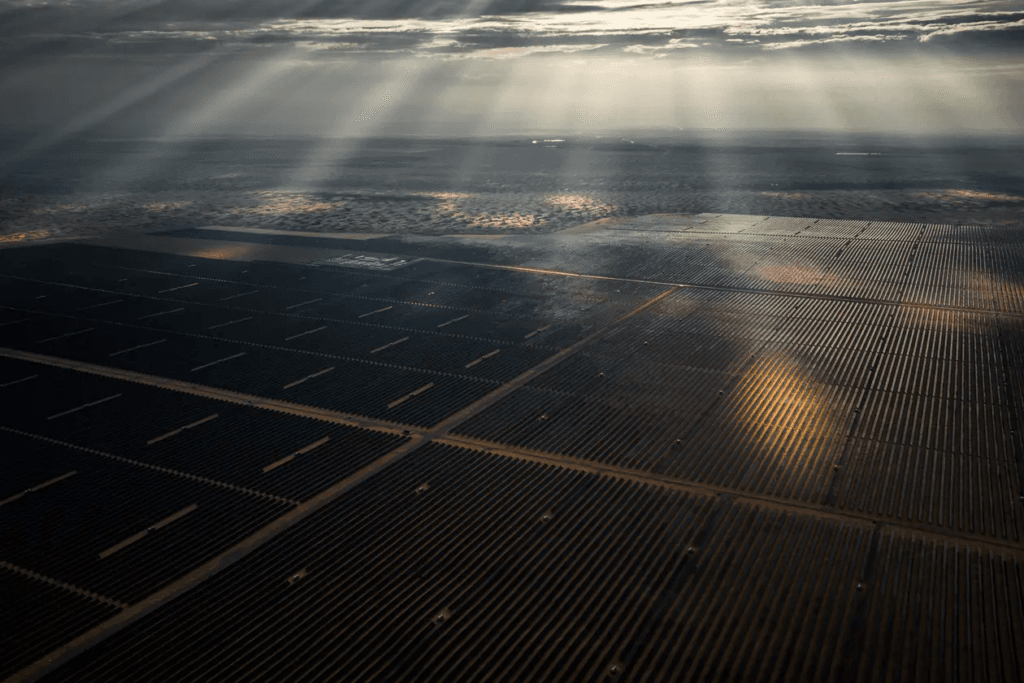
“From the ground, it’s hard to grasp the scale of these power plants,” said Chinese photographer Weimin Chu. “But when you rise into the air, you can see the geometry, the rhythm — and their relationship with the mountains, the desert, the sea.”

Chu has spent three years capturing the shift underway using drones to photograph power plants from overhead. His work, which draws from the visual language of traditional Chinese ink paintings, was featured last year in an award-winning exhibition, presented by Greenpeace.
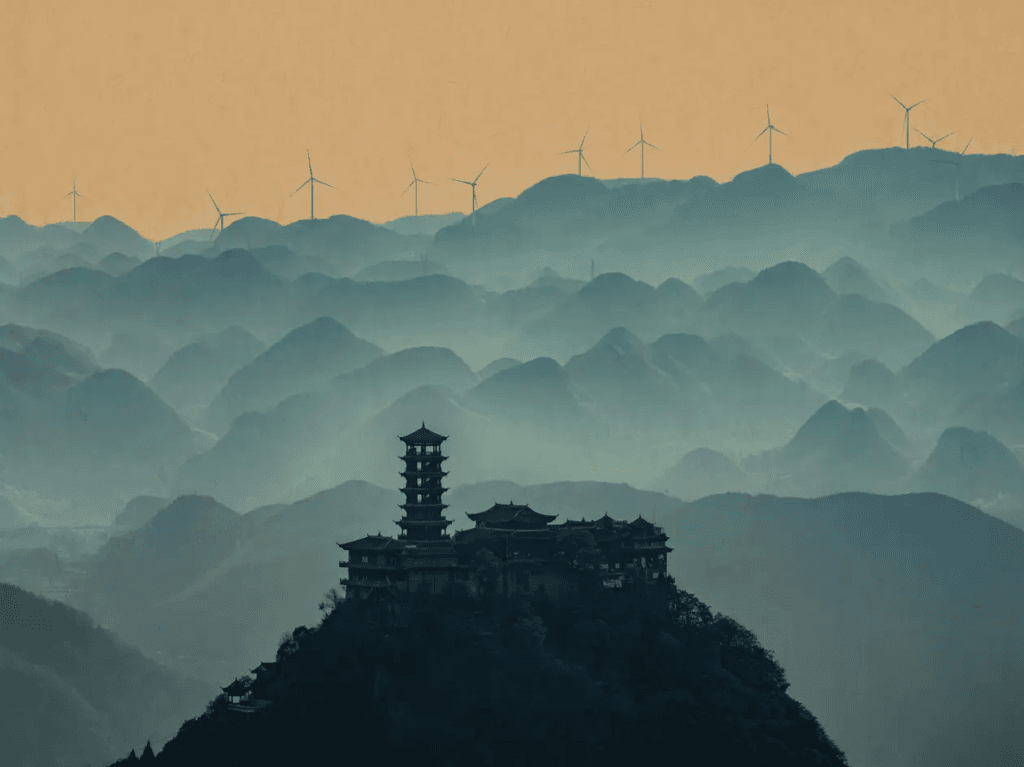
Look, this can only be a good thing for the rest of the world’s air quality and attempts to slow down climate change. It might be less good for the global geopolitical situation in the future, but then things are looking pretty ropey on that front right now anyway.

More photos on that link above, and more information about China’s journey into the renewable energy space, here.

Not now, mystery outbreak of respiratory illness in China

Lol. It only seems like 4 years ago, we were talking about a mystery outbreak of respiratory illness in China that was alarming the World Health Organisation. And now look at this:

Yep. And if you look back at November 2019, we all thought that we were living in a pretty hectic, messed up world. And we were right.

But wow. Little did we know about what was to come. Suddenly, November 2019 looks a very attractive option destination for my time machine settings. Well, at least compared with November 2023.

But now is not the time to be adding issues to our already overworked, overstressed and overtired lives. So please, China: take your mystery outbreak of respiratory illness and sort it out quickly and efficiently (no! god no! not like that!) so that we can get on with prepping for economic disaster, pre-election violence and the seemingly inevitable outbreak of World War 3.

Happy days!

El Niño Is Coming – and the World Isn’t Prepared

That’s the title of this Wired article, and it makes scary reading.

I have no doubt that climate change is a very real thing, but I have often commented that I am regularly unimpressed by the hyperbole and drama with which the news stories around it are presented.

This one seems a little different.

Current forecasts suggest that La Niña will continue into early 2023, making it – fortuitously for us – one of the longest on record (it began in Spring 2020). Then, the equatorial Pacific will begin to warm again. Whether or not it becomes hot enough for a fully fledged El Niño to develop, 2023 has a very good chance – without the cooling influence of La Niña – of being the hottest year on record.

Sure, there are predictions of hurricanes and crop failure, of food shortages and economic impacts, of power outages and ever increasing temperatures, but there’s no embellishment: just facts and indications of what we might expect.

It still doesn’t sound good.

I was less sure about climate change 15 years ago. I was put off by the constantly incorrect predictions and yes, probably swayed by peer pressure when it came to believing (or not believing) what was going on. But if I hadn’t changed my mind about climate change before 2020 (I had, but…) then Covid sealed the deal for me. Not because I believe that the latter was due to the former, but because I watched experts being experts and sharing their expert knowledge, and it being shot down because of poor reporting or just sheer bloody ignorance.

Now I know how those climatologists felt.

The worst bit about knowing that this is happening is not being able to do anything about it. Because it really doesn’t matter how much good stuff like recycling and switching off our geysers that you or I do, when (e.g.) China is building another 15GW-worth of coal-fired power stations in the first six months of 2023 and (e.g.) India is reopening more than 100 coal mines to make more electricity. While collective effort at a local level probably assisted with some degree of relief during our awful drought in Cape Town, it’s absolutely laughable to try to get consumers to behave more responsibly when it comes to climate change when Jinping and Modi are chucking out more CO2 than ever before.

We don’t even have enough electricity to go around, but we’re being told (and paid) by Europe to shut down our 18 coal-fired plants, which at full capacity (ha!) amount to about 45GW of generation capacity. Meanwhile, China is operating over 1,100 coal-fired stations for 1,110GW. And all the emissions that come with them.

Until that sort of dichotomy is rectified, (and I understand how depressing and pessimistic this sounds) it feels utterly pointless to try and “do our bit” on a personal level.

A nasty wallop

Ah, remember back in 2011 when the Chinese Tiangong-1 space station was launched from the Gobi Desert, setting off on its five-year mission to explore strange new worlds, to seek out new life and new civilisations, to boldly go where no man has gone bef… Look, they launched a big space station.

Why is this relevant to you or I? Well, now it seems that they have lost control of said space station and it’s going to plunge back to earth “sometime in 2017”. And if that seems vague, then understand this:

Not knowing when it’s going to come down translates as not knowing where it’s going to come down.

Those would be the words of Jonathan McDowell, renowned Harvard astrophysicist and space industry enthusiast. He continues:

You really can’t steer these things. Even a couple of days before it re-enters we probably won’t know better than six or seven hours, plus or minus, when it’s going to come down. A slight change in atmospheric conditions could nudge the landing site from one continent to the next.

But thankfully, between us and the stricken satellite is the atmosphere: all round lekker ding and protective blanket around our flimsy planet with its fragile residents. And we all know that things entering or re-entering the earth’s atmosphere generally burn up harmlessly.

Generally. Some bits might get through though.

Little bits. Like the super dense rocket motors:

There will be lumps of about 100kg or so, still enough to give you a nasty wallop if it hit you.

What?

Yes there’s a chance it will do damage, it might take out someone’s car, there will be a rain of a few pieces of metal, it might go through someone’s roof…

A 100kg chunk of super dense metal, falling from 450km up “might go through someone’s roof”? I’d suggest that Jonathan McDowell has been astrophysicating so long that he’s forgotten about the 9.81 m/s² force of gravity pulling things (like 100kg chunks of super dense metal) mainly downwards towards us.

Of course, you’d have to be pretty unlucky to be hit by any of this debris, but – without wanting to cause any sort of panic – I’d think that “a nasty wallop” might be a slight understatement as to the effect it might have if it was to land on you.

Hang on. What’s that strange noise? Part shriek, part holler…

Oh – it’s Wu Ping – Chinese space official, who tells us:

Tiangong-1 is currently intact and  authorities will continue to monitor it and strengthen early warning for possible collision with objects.
If necessary, China will release a forecast of its falling and report it internationally.

How very generous of them.

We’ll be keeping an eye on this story over the next 3 to 15 months (seriously – no-one has a single clue when this thing is going to crash), and keep you informed of what we learn and the location of the best caves in the expected landing area.

Splash

Thought I’d share this photo:

world-in-pic-5

Which is apparently a photo of

a wave caused by a tidal bore surging past a barrier on the banks of Qiantang River, in Hangzhou, Zhejiang province, China.

Obviously, time is frozen in every photo, but it seems even more so in this one. The absolute relaxed obliviousness of the man on the motorcycle, accentuated by the chaos in the scene behind him, is wonderful.
And don’t miss the umbrella on the woman’s arm on the back of the bike either. Instantly functionless and overwhelmed by muddy water, like any regional government during a bad flood.
And the juxtaposition of the anchor – traditionally a symbol of stability against the power of water – on the shirt of the girl fleeing from the moist onslaught.
And the expression on the face of the guy nearest the camera, demonstrating that the term “Oooh, shit!” easily transcends any artificial construct of language.

Or it could just be some people about to get wet.

Your call.