I told you they were good

I was listening to 6Music yesterday, and they had an interview with Alex Moore from The Lathums. Nice guy. Very down to earth. Very honest. Very humble. Lovely.

And then the presenter just casually dropped into the conversation that their album From Nothing To A Little Bit More was sitting pretty at No.1 in the album charts.

The only way that this news could be any better is if it was 20 years ago and anyone cared.

But seriously, if you are in the business to make music and sell records, then this is clearly a huge vote of confidence in your ability, and I’m here for it.

Go listen.

Thank you, Frankie

How many lives do cats have?

I mean, it’s 1. We all know that. Hit a cat with your car and it’s game over. No second (or third, fourth, fifth etc etc) chances. That’s it: kicked the bucket, shuffled off this mortal coil, run down the curtain and joined the bleedin’ choir invisible.

But there’s the old saying that “cats have nine lives” because they like to live dangerously and take risks and not all of those risks involve intercepting a 2 ton motor vehicle.

Except, in some places, cats only have seven lives:

And in some places, it’s even as low(?) as six:

Interestingly, the myth that cats have multiple lives exists around the world. However, it’s not always nine lives – the number varies from culture to culture. In certain regions of Spain it is believed that cats have seven lives, for example. Meanwhile, some Turkish and Arabic legends say cats have six lives.

Although Turkey is very clearly in the 9 camp above.

I’m not sure if these differences are down to the countries in question actually being more dangerous for a cat to live, because who is keeping count anyway? And why would some of Switzerland be more risky for felines than, the rest of it? Avalanches? How is Corsica 28.6% safer than Sardinia? And what about trans-border cats? Do they average out at 8?

Nope, wherever you are in Europe – in the world, in fact – stick a cat in front of an SUV and you’ll note that the average number of lives it has is one.

Microbiological facepalm

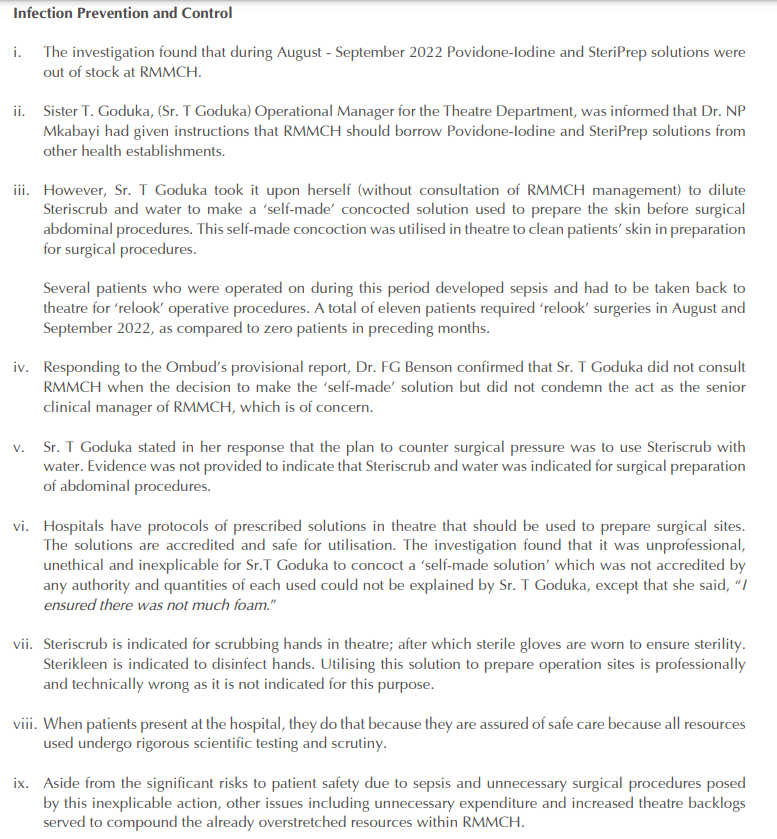
The Health Ombudsman today released his report into complaints about the Rahima Moosa Mother and Child Hospital (RMMCH). It doesn’t make for pretty reading. There are many, many problems highlighted, and I’m only really looking at one here, but if you want to read the whole damn(ing) thing, here’s the PDF.

It’s Page 14 that made me weep though.

tl:dr?

They ran out of the antiseptic disinfectant solution that was used to treat the skin pre-operatively on abdominal surgery sites, so instead of sourcing some from any nearby healthcare facilities, the sister in charge made up her own concoction of diluted handwash to use instead.

Not that this is any way safe, effective, legitimate, ethical, acceptable or sensible, but – just out of interest – what sort of amounts of handwash and water did she use?

The quantities of each used could not be explained by Sr. T Goduka, except that she said, “I ensured there was not much foam.” [sic]

Ah yes, “not much foam”. That’s the generally accepted formula for illegitimate, homebrewed pre-op solutions. Too much foam gets in the way and can be quite distracting for the surgeon. That’s why they don’t use Sunlight washing up liquid for these sort of things.

Or diluted handwash.

Anyway, the upshot of Sister Goduka’s efforts was that eleven patients ended up back in surgery because they developed infections.

I am shocked like Cyril.

The report goes on to say:

When patients present at the hospital, they do that because they are assured of safe care because all resources used undergo rigorous scientific testing and scrutiny.

Oh, so not because they want to be guinea pigs for Sr Goduka’s latest potion? Honestly, there would probably have been a better clinical outcome if they’d let Willy Wonka have a pop at it.

Incredibly – and shamefully – this is far from the worst thing that patients had to face at the hospital, but hopefully, some lessons can be – and have been – learned.

So… until next time (which won’t be long)…

Back to the Rock volume… 4?

It’s a long way off, but it looks like I’ve cracked the nod again to be one of the parent leaders for this year’s school trip to Robben Island.

This will be my fourth tour, and regular readers will know that it is always such a privilege to be able to go over there and help out.

It is an amazing place.

Last time around, I was drafted onto the team with less than 2 weeks before we were due to set off. This time, we have seven months to plan (and therefore no excuses).

I’m already excited.

This has been a good day.

What’s going to kill us this week?

Well, it’s phosphorus. So well done if you had that on your bingo card this morning.

Too much phosphorus is going to kill us, and too little phosphorus… er… that’s also going to kill us.
It does seem like phosphorus is one of those things that you have to get just right. And also that we’re doing really badly at that.

Too much phosphorus is being used in fertilisers, which are then running off into waterways and creating massive blooms of algae. When that algae dies off, it releases a lot of methane, which is a major contributor to climate change. And brilliantly, because of that climate change, more algal blooms will form in the future, which will result in more methane being release.

It’s a good example of a viscous circle (because the algae makes the water a bit thicker).

And because we’re using too much phosphorus in fertilisers, it’s likely that in a few years time, there won’t be enough phosphorus to go around, so we won’t be able to make fertilisers, and so we won’t be able to grow crops as efficiently, meaning food shortages and famine for millions – if not billions – around the world.

Happy days.

Aside from the direct issues caused by too much or too little phosphorus, there are spin-off problems as well. Like the researchers into those phosphorus problems coming up with this sort of thing:

“We have reached a critical turning point,” said Prof Phil Haygarth of Lancaster University. “We might be able to turn back but we have really got to pull ourselves together and be an awful lot smarter in the way we use phosphorus. If we don’t, we face a calamity that we have termed ‘phosphogeddon’.”

No, Phil. No. I value your work, and I am genuinely concerned about the warnings you are giving us. It’s clearly important that mankind changes the way that we are using phosphorus. But what’s also clear is that you should stick to the science, and let the English language experts come up with any new terminology to describe your results. Because ‘phosphogeddon’ is an absolute car crash of a word, and detracts from your important research.

Adding a scary suffix to just any word might be linguistically correct, but it doesn’t necessarily make for catchy terminology that’s going to be memorable and therefore influence public behaviour. And I feel that I need to take a stand on this, because otherwise, we’re surely headed for a portmanteaupocalypse.

That would mean fewer deaths because of erratic weather and worsening food security, but many, many more facepalms at terrible attempts to make words to describe concerning over- and underuse of chemical elements and the like.

We can still change this now and make a difference.